Are Cleaning Tablets Worth It? A Practical Buyer’s Guide
You’ve learned what cleaning tablets are.
You’ve seen how they work.
You’ve learned how to prepare and use them.
You’ve compared them with traditional liquid cleaners.
And you’ve asked the most important performance question:
Are cleaning tablets effective?
Now comes the question that usually decides whether someone actually makes the switch:
Are cleaning tablets worth it?
It’s a slightly different question.
A cleaning product can work perfectly well and still not be worth buying for you.
Why?
Because value isn’t only about cleaning performance.
It also depends on:
- How much you pay
- How often you clean
- How much storage space you have
- How much you value convenience
- Whether you like reusable bottles
- How easy the product is to prepare
- How much packaging comes with each purchase
- Whether the format fits your routine
That’s why there isn’t a universal yes-or-no answer.
For some households, cleaning tablets may make a lot of sense.
For others, a ready-to-use liquid cleaner may remain the more convenient choice.
The sensible approach is to understand the trade-offs before buying.
What Are You Actually Paying For?
When you buy a conventional ready-to-use cleaner, you’re purchasing a finished product.
The bottle is filled.
The formulation has already been prepared.
You take it home and use it.
With cleaning tablets, the model is different.
You’re buying a concentrated cleaning formulation that you prepare with water when you’re ready to use it.
As we explained in What Are Cleaning Tablets? A Beginner’s Guide, the basic idea is:
Cleaning tablet + water = cleaning solution
That means comparing the price of a box of tablets with the price of one bottle of liquid cleaner isn’t always useful.
Instead, ask:
How much finished cleaning solution do I get from each purchase?
And then:
How much does each usable bottle or cleaning session cost?
That’s the more meaningful comparison.
Cost Per Use Matters More Than Sticker Price
Imagine two products.
One costs less when you buy it.
The other costs slightly more.
That doesn’t automatically mean the first product is cheaper.
What matters is how much cleaning you get from each purchase.
For cleaning tablets, consider:
Price of tablets ÷ number of prepared bottles
You can take the comparison further:
Price of tablets ÷ approximate number of cleaning sessions
You don’t need complicated mathematics.
You simply need to compare like with like.
For example, if a tablet pack produces multiple bottles of cleaning solution, compare its cost with the number of equivalent ready-to-use bottles you would normally buy.
This is especially important because cleaning frequency varies dramatically between households.
Someone who cleans every day will use products differently from someone who does a major cleaning session once a week.
The Bottle Is Part of the Equation
There is another factor people sometimes overlook:
the bottle itself.
A tablet-based system may involve purchasing a reusable bottle initially and then buying tablet refills.
A conventional cleaner typically comes as a complete bottle of finished product.
That means your first purchase and your repeat purchases can look very different.
With a reusable system, the model may look like:
Buy bottle → Use → Refill → Refill → Refill
With a traditional ready-to-use cleaner:
Buy bottle → Use → Finish → Buy another bottle
The exact economics depend on the products you’re comparing.
But when deciding whether cleaning tablets are worth it, don’t look only at the refill price.
Consider the complete system over time.
Are Cleaning Tablets Cheaper?
Sometimes they can be.
Sometimes they aren’t.
There isn’t a universal answer.
The cost depends on:
- Tablet price
- Number of tablets per pack
- Recommended dilution
- Bottle volume
- Frequency of use
- Bottle cost
- Packaging
- Shipping or delivery
- How much product you actually use
That’s why we don’t recommend saying:
“Cleaning tablets are always cheaper than liquid cleaners.”
That is too broad.
A better question is:
“What is my cost per prepared bottle or cleaning use?”
That gives you a number you can actually compare.
Convenience Has a Price Too
Price isn’t the only thing you’re buying.
You’re also buying convenience.
And convenience means different things to different people.
For a ready-to-use cleaner, convenience usually means:
Pick up → Spray → Clean
There’s almost no preparation.
For a cleaning tablet system:
Fill → Add tablet → Dissolve → Clean
There’s an additional step.
So if you value immediate use above everything else, that preparation step may feel like unnecessary effort.
But convenience can also mean:
- Not storing large bottles
- Having refills ready when needed
- Keeping the same bottle
- Carrying compact tablets
- Not running out of bulky liquid products
- Having a consistent cleaning system
This is why convenience should not be reduced to “how many seconds does it take to start cleaning?”
How Often Do You Clean?
Your cleaning frequency can make a big difference to whether cleaning tablets are worth it.
If You Clean Frequently
Suppose you’re regularly cleaning:
- Kitchen counters
- Bathroom surfaces
- Glass
- Floors
- Tables
- Appliances
- Other everyday surfaces
You’re going through cleaning products regularly.
In that situation, a refill-oriented system may become more interesting.
Instead of repeatedly buying complete bottles, you can keep compatible bottles and prepare another batch when required.
The more frequently you use a product, the more important the repeat purchase experience becomes.
If You Clean Occasionally
If you only use a particular cleaner occasionally, the calculation may be different.
You may value immediate convenience more than a refill system.
You might not mind purchasing a ready-to-use bottle because it lasts a long time.
So ask yourself:
How often will I realistically use this product?
Not:
How often do I think I should use it?
Your real routine is what matters.
Storage Space Is Part of Value
This is one of the areas where cleaning tablets can be genuinely attractive.
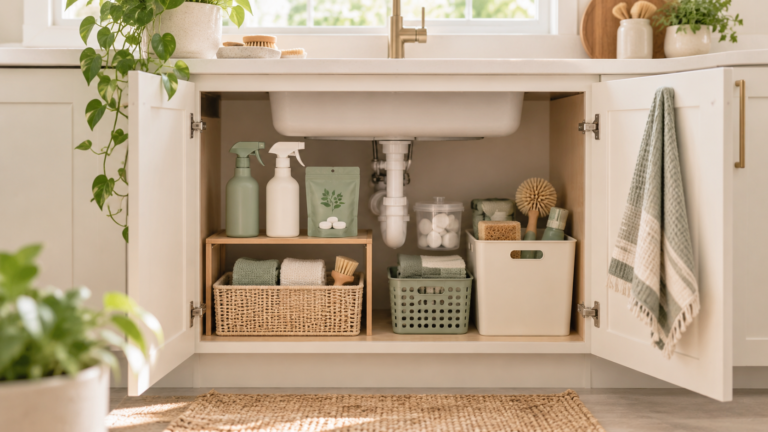
Look under a typical kitchen sink.
You may find several bottles competing for space.
Glass cleaner.
Bathroom cleaner.
Kitchen cleaner.
Multi-surface cleaner.
Floor cleaner.
And perhaps several products that you barely use.
Cleaning tablets take a different approach.
Instead of storing the finished liquid, you store the concentrated product and add water when you’re ready to prepare the solution.
As we discussed in [Cleaning Tablets vs Liquid Cleaners: What’s the Difference?], this can make the format more compact and can work particularly well with reusable bottle systems.
So if storage space is limited, the value isn’t necessarily about saving money.
It may simply be:
Less space occupied by cleaning products.
For a small apartment, that can be meaningful.
What About People With Larger Homes?
The same principle can apply in a larger home.
In fact, having multiple cleaning products can make storage even more noticeable.
You might have several bottles on different floors or in different rooms.
A compact supply of tablet refills can potentially simplify the backup stock you keep at home.
However, there is an important caveat:
Don’t buy a large supply simply because tablets are compact.
Storage efficiency only creates value if you actually use the products.
A drawer full of unused tablets isn’t a saving.
It’s just another form of clutter.
Is the Preparation Step Worth It?
This is perhaps the most personal question in the entire decision.
Some people will think:
“Why would I bother adding water? I can just buy the cleaner already made.”
Fair enough.
Other people will think:
“I’m already filling a reusable bottle. Adding a tablet takes hardly any effort.”
Also fair.
There isn’t a right answer.
The key is whether the preparation step becomes friction in your routine.
If you constantly postpone preparing the solution, the system isn’t convenient for you.
If you prepare a new bottle whenever you need one without thinking about it, the extra step may barely register.
What About Cleaning Performance?
This is where Blog #5 comes into the picture.
We already established that cleaning tablets can be effective, but performance depends on the formulation, dilution, surface compatibility, type of soil and correct use.
So don’t buy tablets simply because they’re cheaper or more compact.
They still need to do the cleaning job you expect.
Before switching, ask:
- Is the product designed for my cleaning tasks?
- Is it suitable for my surfaces?
- Does it produce the result I expect?
- Is the dilution straightforward?
- Does the preparation process work for me?
If the answer to those questions is yes, the format becomes much more interesting.
If the product doesn’t perform the cleaning job you need, compact storage won’t make it worth buying.
Read Our Guide on Effectiveness Before You Switch
If you’re evaluating a specific cleaning tablet, our article [Are Cleaning Tablets Effective? What to Consider Before Switching] is the natural next step.
It explains why the tablet format itself doesn’t determine performance.
The formulation matters.
The intended cleaning task matters.
The surface matters.
The dilution matters.
And how you use the product matters.
That’s important because value begins with usefulness.
A product that doesn’t clean the way you need isn’t a good deal at any price.
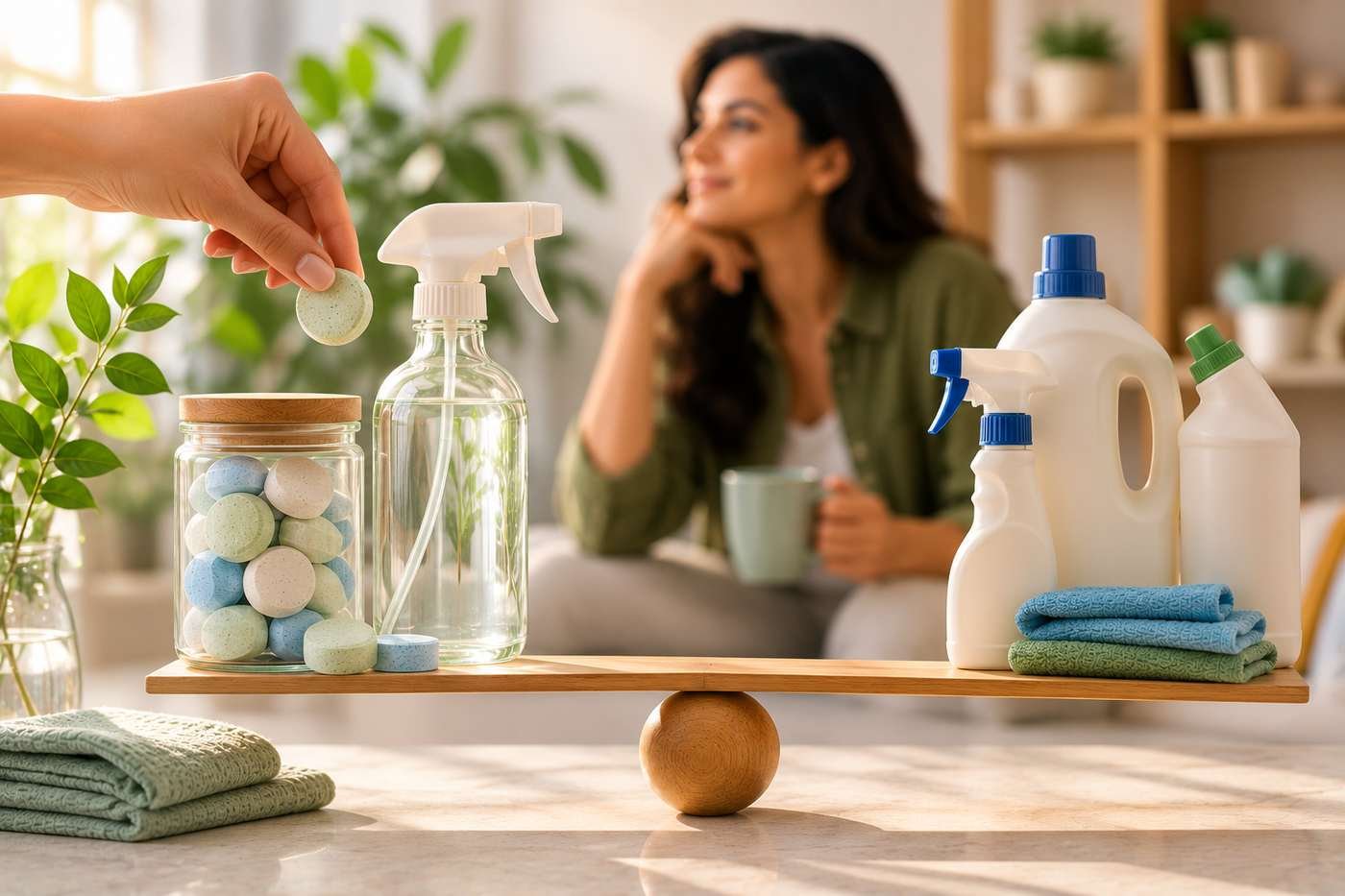
Cleaning Tablets vs Liquid Cleaners: Which Offers Better Value?
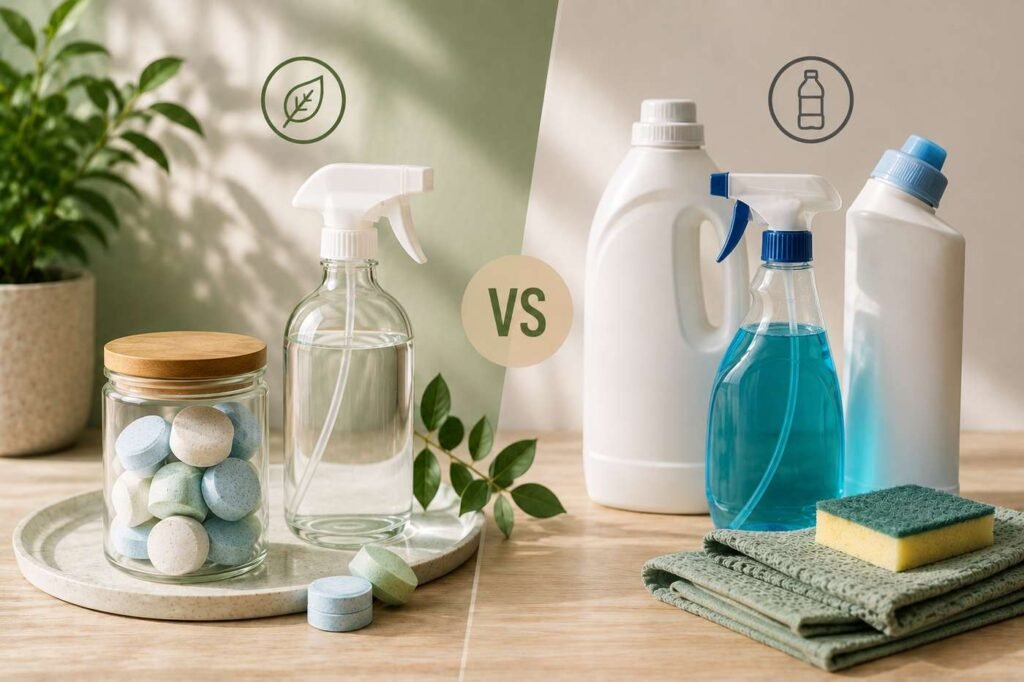
There are two different kinds of value here.
Liquid cleaners offer:
Immediate convenience
Open the bottle and use it.
Cleaning tablets can offer:
Refill-oriented convenience
Keep the bottle and prepare another solution when needed.
Neither automatically wins.
The right choice depends on what you value.
This is exactly why our previous article, [Cleaning Tablets vs Liquid Cleaners: What’s the Difference?], focuses on the differences in format rather than declaring one universally superior.
What About Packaging?
Packaging is another factor worth considering.
A traditional ready-to-use cleaner generally needs packaging capable of holding the finished liquid.
A tablet system can separate the concentrated product from the water until preparation.
That can change the amount and type of packaging involved.
But here’s where we should be careful.
It would be too simplistic to say:
Cleaning tablets automatically create less environmental impact.
They don’t necessarily.
The full picture depends on the product system, including:
- Tablet packaging
- Bottle material
- Number of reuses
- Manufacturing
- Transport
- Formulation
- Disposal
The EPA identifies concentrated formulas, efficient packaging and refillable bottles as characteristics that can contribute to more environmentally considerate cleaning-product design, but those are characteristics to evaluate—not automatic proof that a product is environmentally superior.
And environmental claims should be specific and supported rather than broad claims such as simply calling a product “eco-friendly.”
That’s a distinction THE SENSIBLE should keep making.
Look at the system, not the marketing label.
Does Reusing the Bottle Actually Matter?
Potentially, yes.
If you keep a bottle and repeatedly refill it with compatible cleaning tablets, you’re changing the purchasing cycle.
Instead of buying another bottle every time:
Keep → Refill → Reuse
That can be one of the strongest reasons to consider a tablet-based system.
But again, don’t confuse potential with a guarantee.
A reusable bottle only creates a meaningful difference if you actually reuse it.
And the refill system needs to be genuinely available.
The FTC’s environmental marketing guidance specifically cautions against unqualified “refillable” claims unless consumers have a way to refill the package.
So when you’re comparing products, ask:
Can I actually buy the refill?
Not just:
Does the package say refillable?
What If You Don’t Like Waste?
If reducing packaging is one of your priorities, the tablet format may be worth investigating.
But don’t stop at the shape of the product.
Look at the complete packaging system.
Ask:
- How is the tablet packaged?
- How is the bottle packaged?
- Can the bottle be reused?
- Are refill packs available?
- What materials are used?
- How is the packaging intended to be disposed of?
- Are environmental claims specific and supported?
This approach gives you a much more realistic picture.
And it prevents the common mistake of assuming that a “green-looking” product is automatically the greener option.
What If You Travel?
Cleaning tablets can also have a practical advantage when you’re travelling.
A compact tablet can be easier to carry than a full bottle of ready-to-use liquid.
But there are a few things to consider.
You still need:
- A compatible bottle
- Access to water
- A suitable place to prepare the solution
- Appropriate storage for unused tablets
And you should always follow the product’s handling and travel instructions.
The compact format can be useful, but whether it’s worth carrying depends on your trip and how much cleaning you actually expect to do.
Who Is Most Likely to Benefit From Cleaning Tablets?
Cleaning tablets may be particularly appealing if you:
1. Prefer reusable bottles
You like keeping the bottle and replacing only the concentrated product.
2. Have limited storage
You’d rather store compact refills than multiple liquid bottles.
3. Clean frequently
You regularly go through household cleaning products.
4. Like organised systems
You prefer having a repeatable routine rather than buying whatever cleaner happens to be available.
5. Don’t mind a small preparation step
Adding water and allowing the tablet to dissolve doesn’t bother you.
6. Want to explore refill-style cleaning
You’re interested in changing how you replenish household products.
Who Might Prefer Liquid Cleaners?
Cleaning tablets aren’t for everyone.
A ready-to-use liquid cleaner may suit you better if:
You want immediate use
You don’t want to prepare anything.
You rarely use the product
You may not benefit much from a refill-oriented system.
You dislike waiting for dissolution
Even a short preparation step feels inconvenient.
You prefer familiar products
There’s nothing wrong with sticking to a format that already works well for you.
You don’t want to manage bottles and refills
The simpler purchasing model may be more appealing.
The goal isn’t to convince everyone to switch.
It’s to help you understand whether you should.
What Should You Look for Before Buying?
If you’re considering cleaning tablets, here’s my practical buyer’s checklist.
1. Cleaning purpose
What exactly is the tablet designed to clean?
Don’t buy a product simply because it says “cleaning tablet.”
2. Surface compatibility
Which surfaces can you safely use it on?
Check the instructions.
3. Recommended dilution
How much water do you need?
This affects both preparation and cost-per-use calculations.
4. Finished solution volume
How much usable cleaning solution does one tablet produce?
This is important when comparing prices.
5. Bottle compatibility
Does the tablet work with the bottle you already have?
Or do you need to purchase a specific bottle?
6. Refill availability
Can you actually purchase additional tablets when you run out?
A refill system only works if refills are accessible.
7. Storage requirements
Does the product need to be kept especially dry?
Where will you store it?
8. Shelf-life information
Check the manufacturer’s information about storage and use.
9. Ingredients and claims
Look for clear information about what the product is designed to do.
Be particularly careful with broad claims such as “non-toxic,” “eco-friendly” or “100% green” unless the supporting evidence is clear. Environmental marketing claims should be truthful, specific and substantiated.
10. Cost per use
This is perhaps the most important number.
Don’t compare:
₹X per box
with:
₹Y per bottle
Compare the cost of producing the amount of cleaning solution you actually use.
A Simple Way to Calculate Whether Cleaning Tablets Are Worth It
You don’t need a spreadsheet.
Start with three numbers:
A = Price of the tablet pack
B = Number of usable tablets
C = Finished solution produced per tablet
Then:
Cost per prepared bottle = A ÷ B
If one tablet produces more or less than one standard bottle, adjust your comparison accordingly.
Then compare that number with the equivalent ready-to-use cleaner you normally buy.
Finally, add the non-financial factors:
Cost + Convenience + Storage + Performance + Packaging
That’s a much better measure of value than price alone.
Don’t Forget Your Time
There’s another cost that is difficult to put on a receipt:
your time.
Preparing a cleaning tablet solution takes a little more involvement than grabbing a ready-to-use bottle.
For many people, that time is negligible.
For others, convenience is worth paying for.
So ask yourself:
Would I rather spend a minute preparing a refill, or pay more for a ready-to-use bottle?
There is no universally correct answer.
Your preference is part of the value calculation.
What About Buying in Bulk?
Because tablets are compact, buying a larger quantity can seem attractive.
But don’t automatically assume bulk buying saves money.
Before purchasing a large supply, consider:
- How quickly you use the product
- How much storage space you have
- How the tablets need to be stored
- Their recommended shelf-life
- Whether you actually like the product
Try the format first.
Then decide whether buying more makes sense.
A cheap product you don’t enjoy using is still poor value.
The “Worth It” Test
Here’s the simplest test I would use.
Give the product a score from 1–5 on each:
| Factor | Score |
|---|---|
| Cleaning performance | /5 |
| Cost per use | /5 |
| Convenience | /5 |
| Storage | /5 |
| Bottle/reuse system | /5 |
| Preparation effort | /5 |
| Packaging | /5 |
| Overall fit for your routine | /5 |
You don’t need to publish the score.
It’s simply a way to make the decision more objective.
If a product scores well where you personally care most, it may be worth switching.
If it scores poorly on the things that matter most to you, don’t switch simply because tablets are trendy.
Are Cleaning Tablets Worth It for Everyone?
No.
And that’s actually a good thing to say.
A useful product doesn’t need to be universally suitable.
Cleaning tablets are simply another format.
They can be attractive because they combine:
Concentrated product + water added at home + reusable bottle potential + compact storage
But that format also introduces:
Preparation + dissolution + storage requirements
Whether the trade-off is worthwhile depends on you.
So, Are Cleaning Tablets Worth It?
For the right household, yes, they can be.
But the reason may not be the one you initially expect.
It may not be because the tablet is dramatically cheaper.
It may not be because it cleans dramatically better.
And it certainly shouldn’t be because someone told you that tablets are automatically “greener.”
The value may come from the combination of several smaller advantages:
- Compact storage
- Reusable bottles
- Refill convenience
- A predictable cleaning routine
- Concentrated format
- Potential packaging efficiencies
- The ability to prepare the product when needed
Those benefits can add up.
But only if they matter to you.
The Sensible Way to Decide
Don’t ask:
“Are cleaning tablets worth it?”
in isolation.
Ask:
“Are cleaning tablets worth it for the way I clean?”
If you clean frequently, have limited storage, like reusable bottles and don’t mind preparing a solution, the answer may be yes.
If you want something you can grab immediately and use without preparation, traditional liquid cleaners may still be the better fit.
Neither choice is wrong.
The sensible choice is the one that gives you the best combination of:
Performance + Cost + Convenience + Practicality
Final Takeaway

Cleaning tablets aren’t automatically worth it.
They’re worth it when their advantages match your priorities.
If you’re evaluating them as a buyer, look beyond the price of the tablet pack.
Look at the cost per prepared bottle.
Look at how often you clean.
Look at how much storage space you have.
Look at whether you like reusable bottles.
Look at how easy the preparation process is.
And, most importantly, make sure the product actually performs the cleaning jobs you need it to perform.
A cleaning tablet is not valuable simply because it’s small.
It’s valuable when the whole system makes your cleaning routine better.
That’s ultimately what “worth it” should mean.
Not cheaper at any cost.
Not greener by default.
Not more convenient for everyone.
Just better suited to the way you actually clean.
And if you’re ready to go one step further, the next question is a very practical one:
How Long Do Cleaning Tablets Last? Understanding Usage and Storage
Because once you decide that tablets are worth trying, you need to know how many you actually need, how to store them and how to plan your supply.
Frequently Asked Questions
1. Are cleaning tablets worth it?
They can be, depending on your cleaning habits and priorities. They may appeal to people who value compact storage, reusable bottles and refill-style cleaning, while ready-to-use liquid cleaners may be better for people who prioritize immediate convenience.
2. Are cleaning tablets cheaper than liquid cleaners?
Not necessarily. Compare the cost per prepared bottle or cleaning use, rather than simply comparing the price of a tablet pack with one bottle of liquid cleaner.
3. How do I calculate the cost of cleaning tablets?
Divide the price of the tablet pack by the number of usable tablets, then compare the resulting cost per tablet with the amount of finished cleaning solution each tablet produces.
4. Do cleaning tablets save money?
They can, depending on the product, dilution, bottle system and how frequently you use them. The most useful comparison is your actual cost per prepared bottle or cleaning session.
5. Are cleaning tablets more convenient than liquid cleaners?
It depends on what you mean by convenient. Liquid cleaners are immediately ready to use, while tablets can offer compact storage and refill-style convenience but require preparation.
6. Are cleaning tablets good for small homes?
They can be useful when storage space is limited because tablets can occupy less space than multiple bottles of ready-to-use liquid.
7. Do I need a special bottle for cleaning tablets?
Some products are designed around specific reusable bottles or bottle sizes. Always check the manufacturer’s instructions before using a bottle with a particular tablet.
8. Are cleaning tablets environmentally friendly?
The tablet format alone doesn’t prove that a product has a lower environmental impact. Consider the complete system, including formulation, packaging, bottle reuse, transport and disposal. Broad environmental claims should be supported by evidence.
9. How many cleaning tablets should I buy?
That depends on how frequently you clean and how much solution each tablet produces. Start with your actual usage rather than buying a large quantity simply because tablets are compact.
10. Do cleaning tablets expire?
Storage and shelf-life recommendations vary by formulation. Follow the manufacturer’s information about storage and expiry.
11. Are cleaning tablets worth switching to from liquid cleaners?
They may be if you value reusable bottles, compact storage and refill-style cleaning. If immediate, ready-to-use convenience is your highest priority, liquid cleaners may still suit you better.
12. What should I check before buying cleaning tablets?
Look at the intended cleaning task, surface compatibility, dilution, finished solution volume, bottle compatibility, refill availability, storage requirements, ingredients, product claims and cost per use.
Follow THE SENSIBLE
Want more practical guides on cleaning science, smarter household routines and tablet-based cleaning?
Follow THE SENSIBLE:
▶️ YouTube