Cleaning Tablets vs Liquid Cleaners: What’s the Difference?
If you’ve always bought household cleaning products from a supermarket shelf, you’re probably familiar with the traditional routine.
Pick up a bottle.
Open it.
Spray the cleaner.
Wipe the surface.
When the bottle is empty, buy another one.
But cleaning tablets are changing that familiar routine.
Instead of buying a bottle that is already filled with cleaning solution, you buy a concentrated tablet and add water at home.
That raises an obvious question:
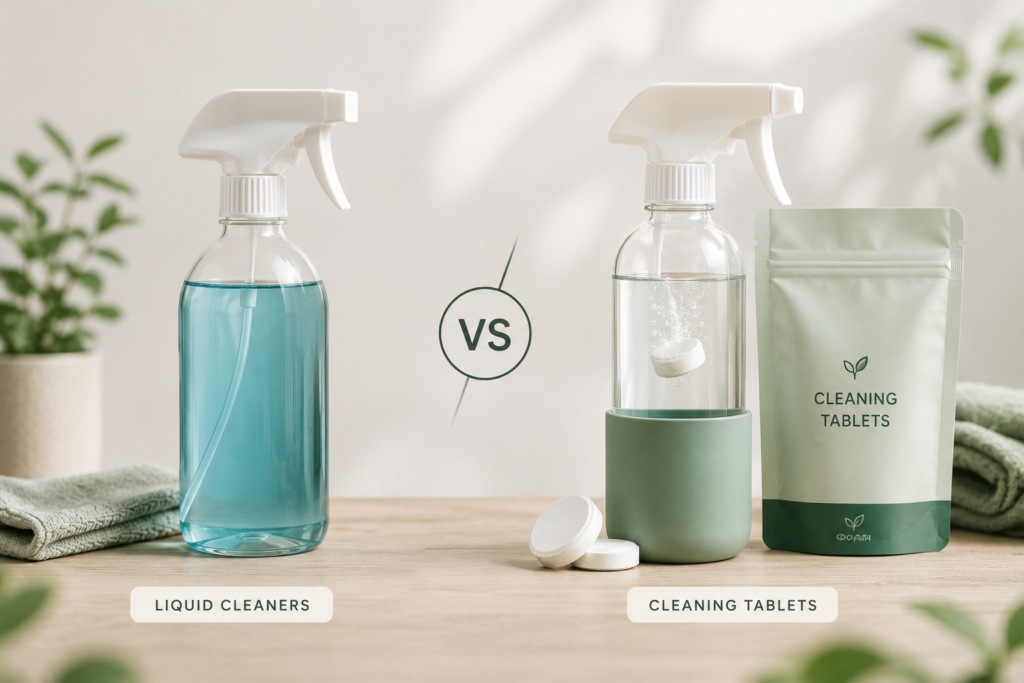
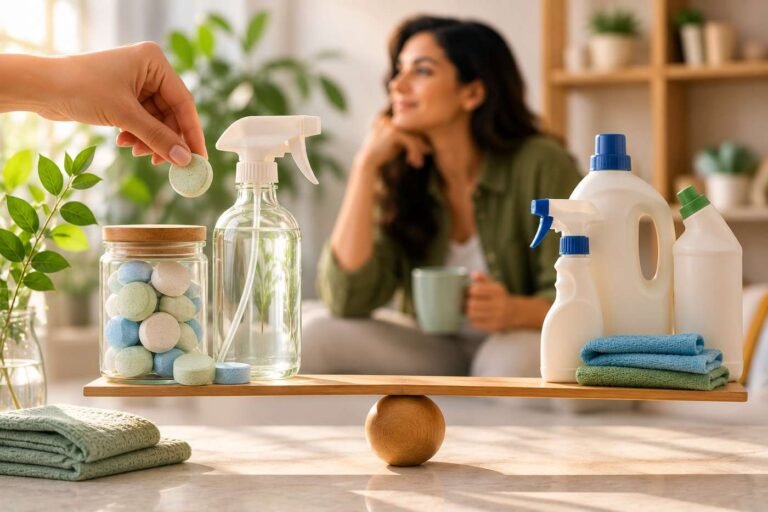
Cleaning tablets vs liquid cleaners — what’s actually the difference?
Is one better than the other?
Are cleaning tablets more convenient?
Do liquid cleaners work better?
What about storage, packaging and everyday use?
And perhaps most importantly, which format makes more sense for your home?
The answer isn’t as simple as saying one is “better.”
Both formats are designed to help you clean.
The bigger difference is how the cleaning product is formulated, packaged, stored, prepared and used.
In our previous articles, we looked at what cleaning tablets are, how cleaning tablets work and how to use cleaning tablets.
Now let’s put the two formats side by side.
What Are Liquid Cleaners?
Liquid cleaners are the format most people are familiar with.
They are generally sold as ready-to-use cleaning solutions inside a bottle.
The manufacturer has already prepared the cleaning formulation and combined it with the required amount of water or other liquid components.
You buy the bottle, open it and use the product according to its instructions.
The basic process is:
Buy → Open → Spray or Apply → Clean
There’s no preparation step at home.
That’s one of the biggest reasons liquid cleaners remain popular.
If you need to clean something immediately, the product is already ready to go.
Liquid cleaners also come in many different formulations.
You can find products designed for:
- Multi-surface cleaning
- Glass and mirrors
- Kitchens
- Bathrooms
- Floors
- Heavy-duty cleaning
- Other specialised household applications
The formulation and intended use vary from product to product.
So “liquid cleaner” is really a broad category rather than one single type of product.
What Are Cleaning Tablets?
As we covered in our beginner’s guide, cleaning tablets are concentrated cleaning products designed to be dissolved in water to create a cleaning solution.
Instead of purchasing the finished liquid, you purchase the concentrated cleaning component in tablet form.
The basic idea is:
Cleaning tablet + water = cleaning solution
The preparation process usually looks something like this:
Choose bottle → Add water → Add tablet → Allow it to dissolve → Clean
The exact amount of water, dissolution time and suitable surfaces depend on the specific product.
That’s why the manufacturer’s instructions always matter.
The important distinction is that the consumer completes part of the preparation process at home.
With a traditional ready-to-use cleaner, the manufacturer has already done that preparation before the bottle reaches you. With a tablet, you do it when you’re ready to use the product.
Cleaning Tablets vs Liquid Cleaners: The Biggest Difference
At first glance, the two formats may seem completely different.
One is a bottle of liquid.
The other is a small solid tablet.
But from a cleaning perspective, the more useful way to think about the difference is:
Where and when is the final cleaning solution prepared?
With a liquid cleaner:
The solution is prepared before you buy it.
With a cleaning tablet:
The final solution is prepared after you buy it.
That’s the fundamental difference.
Everything else — storage, packaging, refilling and preparation — follows from that.
Cleaning Tablets vs Liquid Cleaners: A Quick Comparison
| Feature | Cleaning Tablets | Liquid Cleaners |
|---|---|---|
| Product format | Concentrated tablet | Ready-to-use liquid |
| Water | Added at home | Already included |
| Preparation | Required | Usually not required |
| Bottle | Often reusable | Usually comes with the product |
| Storage | Compact tablets | Larger liquid bottles |
| Refilling | Designed around refills in many systems | Usually requires another bottle |
| Immediate use | Requires preparation | Ready immediately |
| Cleaning performance | Depends on formulation and correct dilution | Depends on formulation |
| Surface compatibility | Product-specific | Product-specific |
| Best suited to | People comfortable with preparation and refill systems | People who prefer grab-and-use convenience |
The important point is that the format alone doesn’t determine cleaning performance.
A cleaning tablet isn’t automatically more effective because it’s concentrated.
A liquid cleaner isn’t automatically better because it’s ready to use.
The formulation still matters.
1. Convenience: Which Is Easier?
This is probably where the difference is most noticeable.
Liquid cleaners
Liquid cleaners are extremely straightforward.
If your kitchen counter needs cleaning, you pick up the bottle and use it.
There’s no waiting.
There’s no measuring water.
There’s no dissolving.
For someone who values maximum immediate convenience, that’s a genuine advantage.
Cleaning tablets
Cleaning tablets add one preparation step.
You need to:
- Get the appropriate bottle.
- Add the recommended amount of water.
- Add the tablet.
- Allow it to dissolve.
- Use the finished solution.
As we explained in our How to Use Cleaning Tablets guide, the process is simple once you’re familiar with it, but it is still a step that doesn’t exist with a ready-to-use liquid cleaner.
So if your only definition of convenience is “I want to clean right now,” liquid cleaners have the advantage.
But convenience can mean different things.
For someone who prefers compact storage, reusable bottles and refill-style cleaning, the tablet format may be more convenient over the longer term.
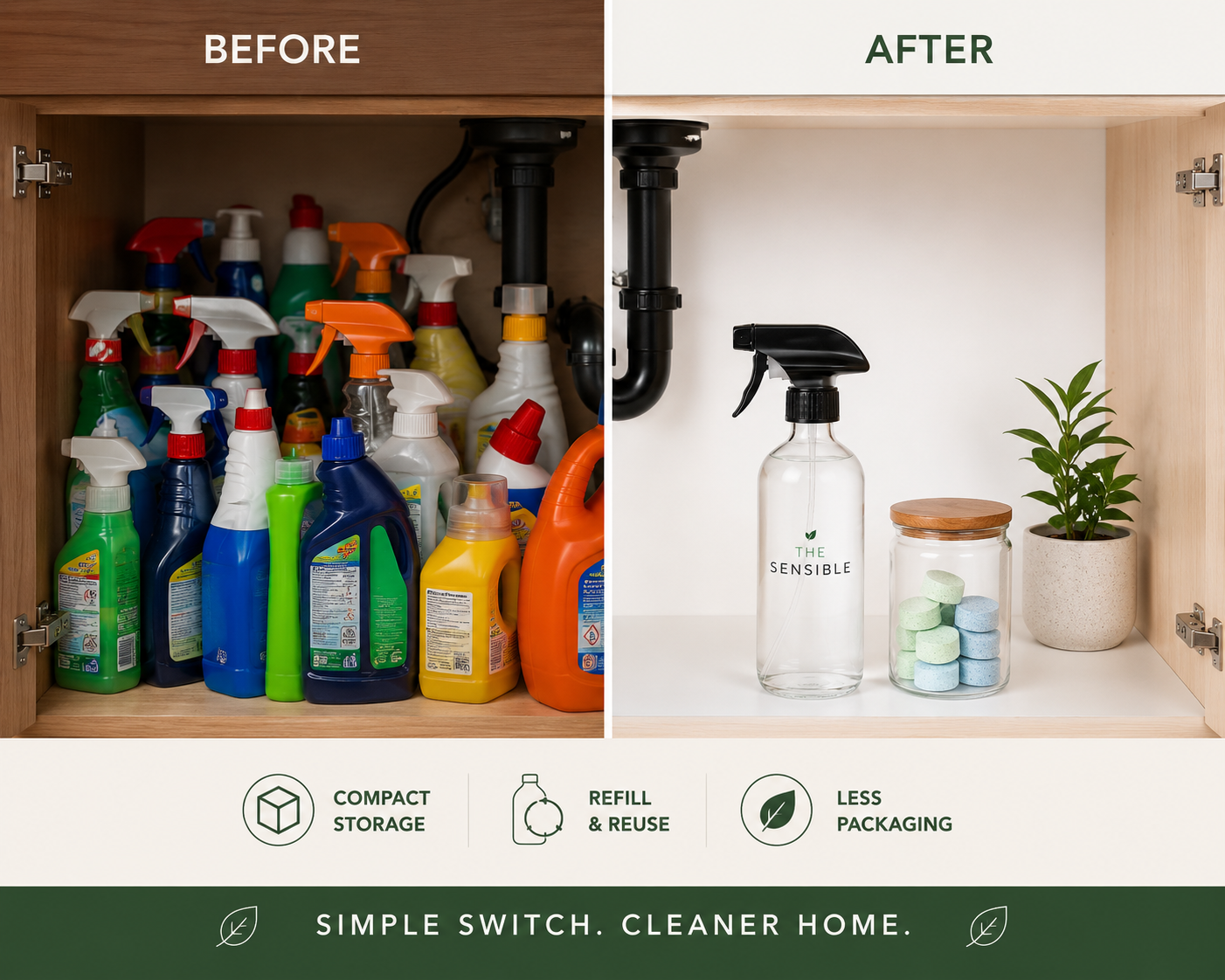
2. Storage: Tablets Have a Different Advantage
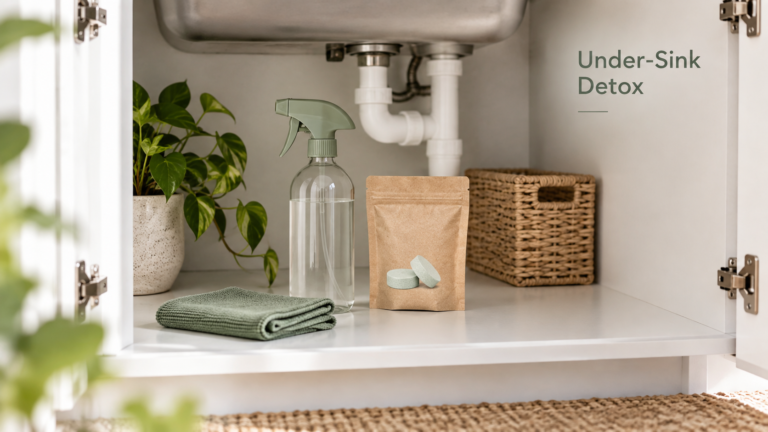
Think about the cleaning products under your kitchen sink.
You may have:
- Glass cleaner
- Bathroom cleaner
- Floor cleaner
- Kitchen cleaner
- Multi-surface cleaner
- Disinfectant
- Other household products
Many of these products are stored as relatively large bottles because the final product is already diluted and ready to use.
Cleaning tablets take a different approach.
The concentrated product can be stored separately from the water that will eventually become part of the cleaning solution.
That means a small pack of tablets can potentially occupy considerably less physical space than multiple bottles of ready-to-use cleaner.
This is one of the benefits of concentrated formats discussed in our earlier articles: tablet-based systems can make storage more compact, particularly for households with limited space.
The trade-off?
You need somewhere suitable to store the tablets.
And because they are designed to dissolve in water, they need to be kept protected from unwanted moisture according to the manufacturer’s storage instructions.
So:
Liquid cleaner: easier to grab, larger product to store.
Cleaning tablet: smaller product to store, but requires preparation.
3. Packaging: This Is Where the Formats Really Diverge
Packaging is another major difference between the two formats.
A traditional ready-to-use liquid cleaner generally needs packaging capable of containing the finished liquid.
That could include:
- A bottle
- A spray mechanism
- A cap
- A label
- Other packaging components
Once the bottle is empty, you generally purchase another packaged product.
A tablet-based system can be designed differently.
The bottle can be kept and the concentrated product can be supplied separately as a refill.
The basic model becomes:
Keep the bottle → Add water → Add tablet → Reuse
This is one reason tablet-based cleaning is often discussed alongside refill and reuse systems.
However, it’s important not to make the simplistic claim that every cleaning tablet automatically means less environmental impact.
The complete packaging system matters.
How the tablets are packaged, how often the bottle is reused and what materials are used all contribute to the bigger picture.
The sensible approach is to evaluate the whole system, not just the word “tablet.”
4. Reusable Bottles Change the Routine
One of the most interesting differences between cleaning tablets and traditional liquid cleaners is what happens to the bottle.
With many conventional cleaners, the bottle is part of the product you purchase each time.
With a tablet-based refill system, the bottle can become a reusable part of your cleaning setup.
You keep it.
You refill it.
You prepare another cleaning solution.
Then you repeat the process.
This changes the traditional cleaning-product cycle from:
Buy bottle → Use → Empty → Replace
to:
Keep bottle → Refill → Prepare → Use
Not every tablet system works exactly this way, so check the manufacturer’s instructions.
But when the system is designed around reusable bottles and refills, this becomes one of its defining characteristics.
5. Preparation: The Main Trade-Off
If there’s one area where liquid cleaners have a clear advantage, it’s preparation.
Liquid cleaner:
Open and use.
Cleaning tablet:
Prepare and use.
That’s not necessarily a disadvantage.
It’s simply a trade-off.
The preparation step may take a little more effort initially, but some people may prefer that in exchange for compact storage and a refill-oriented system.
Think of it like buying concentrated products in other parts of your household.
Sometimes you’re willing to add water yourself because it changes how the product is stored, transported or replenished.
The important question is:
Which kind of convenience matters more to you?
6. Cleaning Performance: Which One Works Better?
This is where we need to avoid a common misconception.
Cleaning tablets are not automatically less effective than liquid cleaners.
But they’re also not automatically more effective.
The format doesn’t tell you enough.
As we established in How Do Cleaning Tablets Work?, what really matters is the formulation, dilution, surface compatibility and correct use.
A well-formulated cleaning tablet can create an effective cleaning solution when prepared at the recommended dilution.
A well-formulated liquid cleaner can also perform effectively.
What matters is what the product has been designed to clean.
For example, a product intended for glass may have very different requirements from one designed for kitchen grease.
So the better comparison is not:
Tablet vs liquid
but:
Formulation vs formulation
and:
Use case vs use case.
7. Does Concentrated Mean More Powerful?
Not necessarily.
This is another important distinction.
A cleaning tablet is concentrated because the formulation is supplied in a compact form and prepared with water before use.
That does not automatically mean the final cleaning solution should be stronger than a conventional liquid cleaner.
The finished solution is supposed to be prepared at its intended dilution.
Adding less water doesn’t automatically make a better cleaner.
Adding more tablets doesn’t automatically make a better cleaner either.
The goal is to produce the intended cleaning solution consistently.
That’s why the amount of water matters so much when using cleaning tablets.
8. What About Shelf Life and Storage?
Liquid cleaners and tablets have different storage considerations.
A ready-to-use liquid cleaner has already been prepared and packaged.
Its storage conditions and shelf life depend on its specific formulation and packaging.
Cleaning tablets remain in their concentrated solid form until they are prepared.
This makes moisture protection particularly important.
As we covered in our earlier guides, unused cleaning tablets should be stored according to the manufacturer’s instructions and protected from unwanted moisture.
This is also something we’ll explore in greater detail in:
How Long Do Cleaning Tablets Last? Understanding Usage and Storage
That article will go deeper into how usage patterns and storage conditions can affect your supply.
9. Which Format Is Better for Small Homes?
If storage space is limited, cleaning tablets can have an interesting advantage.
Imagine trying to store five or six different bottles under a small kitchen sink.
Now imagine storing the equivalent cleaning products as compact tablet refills and preparing them in reusable bottles when needed.
The difference can be noticeable.
This doesn’t mean tablets are automatically the right answer for every small home.
But if storage efficiency matters to you, the format is worth considering.
Liquid cleaners, on the other hand, offer the advantage of being immediately ready to use.
So again, it comes down to what you value more.
10. Which Format Is Better for People Who Clean Frequently?
If you clean frequently, the refill model may become more interesting.
Think about how often you use your most common cleaners.
A household that regularly goes through multi-surface cleaner, bathroom cleaner or glass cleaner may appreciate having refill tablets available rather than repeatedly purchasing another full bottle.
The convenience comes from having a repeatable routine:
Bottle → Water → Tablet → Ready
Once you’ve done it several times, the preparation becomes familiar.
Our How to Use Cleaning Tablets guide explains this process in detail.
11. Which Format Is Better for People Who Want Maximum Simplicity?
If your priority is:
“I don’t want to prepare anything. I just want to grab a bottle and clean.”
A ready-to-use liquid cleaner may be the better fit.
There’s nothing wrong with that.
The tablet format isn’t designed to eliminate every possible inconvenience.
It changes the routine.
Some people will appreciate that change.
Others won’t.
A good cleaning product should fit the way you actually live rather than forcing you into a system you don’t enjoy using.
12. Are Cleaning Tablets More Sustainable?
This is where we should be particularly careful.
It’s tempting to say:
Tablet = sustainable
But that’s too simplistic.
The potential advantage comes from the overall refill-and-reuse model, not simply from the fact that the product is shaped like a tablet.
A tablet-based system may reduce the need to repeatedly purchase a new ready-to-use bottle if the same bottle is reused.
It can also change how the product is stored and transported because the concentrated product is separated from the water until preparation.
But the complete environmental picture depends on:
- Packaging materials
- Manufacturing
- Transportation
- Bottle reuse
- Product formulation
- How the product is used
- End-of-life disposal
That’s why THE SENSIBLE’s approach should be:
Less mess, more sensible choices — without exaggerated claims.
Cleaning Tablets vs Liquid Cleaners: Pros and Cons
Sometimes the simplest comparison is the most useful.
Cleaning Tablets — Potential Advantages
Compact
Tablets can take up less storage space than bottles of ready-to-use liquid.
Refill-friendly
Many tablet systems are designed around reusable bottles and separate refills.
Preparation at home
You add water when you are ready to create the cleaning solution.
Reusable bottle potential
The same bottle can potentially be used repeatedly with compatible refills.
Different storage model
You store the concentrated product rather than repeatedly storing finished liquid.
Cleaning Tablets — Potential Disadvantages
Preparation required
You need to add water and allow the tablet to dissolve.
Requires the right bottle
The product may be designed for a particular bottle size or dispensing system.
Storage matters
Tablets need to be protected from unwanted moisture.
Not every tablet is universal
Different formulations may be designed for different cleaning jobs and surfaces.
Liquid Cleaners — Potential Advantages
Ready to use
No preparation is normally required.
Familiar
Most households already understand the format.
Wide variety
There are liquid cleaners for almost every household cleaning task.
Immediate availability
You can open the bottle and start cleaning.
Follow us on : IG
Liquid Cleaners — Potential Disadvantages
Larger storage footprint
Bottles containing ready-to-use liquid can take up more space.
Bottle replacement
Depending on the system, each new purchase may come with another bottle.
Water is already part of the packaged product
The final product is transported and stored as a ready-to-use liquid.
Less refill-oriented
Traditional products are generally designed around buying another packaged bottle when the first one is empty.
So Which Is Better: Cleaning Tablets or Liquid Cleaners?
There isn’t one answer for everyone.
Instead, ask yourself what matters most.
Choose liquid cleaners if you value:
- Immediate use
- Maximum simplicity
- No preparation
- Familiar products
- Grab-and-clean convenience
Consider cleaning tablets if you value:
- Compact storage
- Reusable bottles
- Refill systems
- Preparing cleaning solution at home
- Keeping concentrated products on hand
- A different approach to packaging and replenishment
Neither format automatically wins every category.
And that’s the important conclusion.
What About The Sensible Approach?
At THE SENSIBLE, we’re interested in a simple question:
Can everyday cleaning be made a little more sensible?
Cleaning tablets are one possible answer.
Instead of repeatedly buying a bottle filled with ready-to-use cleaning solution, a tablet-based system lets you keep the bottle and prepare the solution when you need it.
It’s a small change to the routine.
But small changes can add up when you repeat them over and over.
The goal isn’t to tell everyone that traditional liquid cleaners are bad.
It’s to give people another option.
Understand the format. Understand the trade-offs. Then choose what works for you.
A Simple Way to Decide
Still unsure?
Try this five-question test.
1. Do I have limited storage space?
If yes, the compact format of tablets may appeal to you.
2. Do I like reusable products?
If yes, a refill-based tablet system may fit naturally into your routine.
3. Do I mind adding water before cleaning?
If no, the preparation step probably won’t bother you.
4. Do I prefer maximum convenience?
If yes, ready-to-use liquid cleaners may still be your preferred option.
5. Am I interested in reducing repeated packaging?
If yes, look closely at how the specific tablet system handles bottles, refills and packaging rather than relying on broad sustainability claims.
Final Takeaway
The difference between cleaning tablets vs liquid cleaners isn’t simply that one is solid and the other is liquid.
The bigger difference is when the final cleaning solution is prepared.
With a liquid cleaner:
The manufacturer prepares the finished solution → You buy it → You use it.
With a cleaning tablet:
You buy the concentrated formulation → Add water → Prepare the solution → Use it.
That difference creates a different experience around convenience, storage, packaging and refilling.
Liquid cleaners win when you want something that is ready immediately.
Cleaning tablets can be appealing when you want a compact, refill-friendly approach built around reusable bottles.
And when it comes to cleaning performance, don’t judge the format alone.
The formulation, dilution, intended use, surface compatibility and correct application matter more than whether the product started life as a tablet or a liquid.
So which should you choose?
There is no universal winner.
The best format is the one that fits your cleaning needs, storage space, habits and priorities.
And if you’re now wondering whether the tablet format is actually worth making the switch for, that’s the next question we’ll tackle.
Are Cleaning Tablets Effective? What to Consider Before Switching
Frequently Asked Questions
1. What is the difference between cleaning tablets and liquid cleaners?
Cleaning tablets are concentrated cleaning products that are dissolved in water before use. Liquid cleaners are generally sold as ready-to-use cleaning solutions.
2. Are cleaning tablets better than liquid cleaners?
Not necessarily. Each format has different advantages. Tablets may offer compact storage and refill-friendly use, while liquid cleaners offer immediate convenience.
3. Do cleaning tablets clean as well as liquid cleaners?
Cleaning performance depends primarily on the formulation, dilution, intended use and correct application rather than simply whether the product is a tablet or liquid.
4. Are cleaning tablets cheaper than liquid cleaners?
It depends on the product and how you calculate the cost. Compare the cost per prepared bottle or cleaning use, rather than simply comparing the price of a box of tablets with one bottle of liquid cleaner.
5. Do cleaning tablets require a reusable bottle?
Many tablet-based systems are designed to work with reusable bottles, but requirements vary. Always check the manufacturer’s instructions.
6. Do cleaning tablets need to be dissolved in water?
Yes. Cleaning tablets are generally designed to be dissolved or dispersed in the recommended amount of water before the resulting solution is used.
7. Are cleaning tablets easier to store?
They can be. Because they are concentrated and don’t contain the final volume of water, tablets can occupy less storage space than ready-to-use liquid bottles.
8. Are liquid cleaners more convenient?
For immediate cleaning, they can be. Ready-to-use liquid cleaners generally don’t require the preparation step associated with tablet-based systems.
9. Can I use cleaning tablets on the same surfaces as liquid cleaners?
Not automatically. Surface compatibility depends on the specific formulation. Always check the manufacturer’s instructions.
10. Are cleaning tablets more environmentally friendly?
Not automatically. The environmental impact depends on the complete product system, including formulation, packaging, manufacturing, transport, bottle reuse and disposal.
11. Do cleaning tablets contain less water?
The tablet itself is a concentrated format, and water is added during preparation. A ready-to-use liquid cleaner already contains its finished liquid components when purchased.
12. Should I switch from liquid cleaners to cleaning tablets?
That depends on your priorities. If you value immediate convenience, liquid cleaners may suit you. If compact storage, reusable bottles and refill-style cleaning appeal to you, cleaning tablets may be worth exploring.
Follow THE SENSIBLE
Want practical guides on cleaning, cleaning science and smarter household routines?
Follow THE SENSIBLE:
One Comment