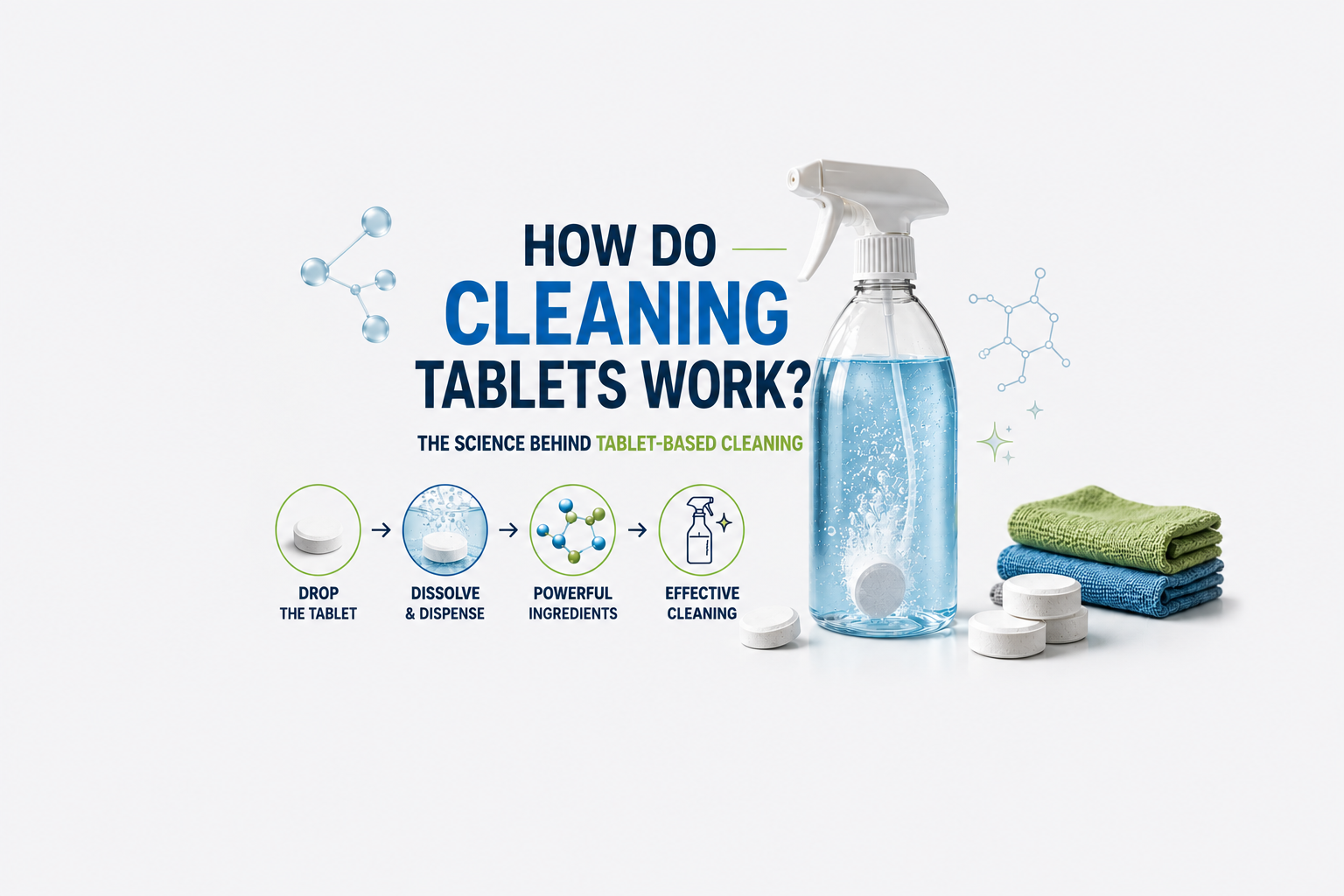
How Do Cleaning Tablets Work? The Ultimate Science Behind Tablet-Based Cleaning
If you have ever dropped a cleaning tablet into water and watched it fizz, dissolve or slowly disappear, you may have wondered:
“What is actually happening inside that tablet?”
At first glance, cleaning tablets can seem almost too simple.
You take a small solid tablet, add water, wait for it to dissolve, and suddenly you have a cleaning solution ready to use.
But there is more going on than simply putting a tablet in water.
A cleaning tablet is a carefully formulated mixture of cleaning ingredients compressed into a convenient solid format. When water is added, those ingredients are released into the solution and prepared for their intended cleaning purpose. If you’re new to the concept of tablet-based cleaning, our beginner’s guide to “What Are Cleaning Tablets?” explains what cleaning tablets are, how they are used, and what to consider before trying them.
The tablet format changes how the product is stored and prepared, but the actual cleaning still depends on the chemistry of the formulation.
So how does it work?
This guide explains what happens from the moment the tablet meets water to the moment you spray the finished solution onto a surface.
What Happens When You Add a Cleaning Tablet to Water? How do cleaning tablets work ?
The simplest way to understand the process is to break it into stages.
Tablet + Water → Dissolution → Ingredients disperse → Cleaning solution → Cleaning action
When the tablet comes into contact with water, the water begins penetrating the compressed material.
Depending on the formulation, some ingredients dissolve quickly while others may take longer to disperse.
The tablet gradually breaks apart and releases its ingredients into the surrounding water.
Eventually, the tablet has dissolved sufficiently to create the intended cleaning solution.
The exact process depends on the formulation.
Different cleaning tablets can contain different combinations of ingredients, different tablet sizes and different compression characteristics. As a result, not every tablet will dissolve at exactly the same speed or behave in exactly the same way.
This is why the manufacturer’s preparation instructions matter.
What Is Inside a Cleaning Tablet?
A cleaning tablet is not simply a block of ordinary cleaning liquid that has been dried.
It is a solid formulation containing ingredients selected for a particular cleaning purpose.
The exact ingredients vary depending on what the tablet is designed to do.
A household cleaning tablet may contain different types of ingredients that perform different roles.
These can include:
- Surfactants
- Acids or alkaline ingredients
- Builders or water-conditioning ingredients
- Fragrance
- Cleaning aids
- Binding or tablet-forming ingredients
- Ingredients that help the tablet dissolve or break apart
Not every cleaning tablet contains all of these ingredients, and the proportions can vary significantly.
The important point is that the tablet format and the cleaning formulation are two different things.
The tablet is the delivery format.
The formulation determines what the resulting cleaning solution can actually do.
What Are Surfactants and Why Are They Important?
One of the most important groups of ingredients in many cleaning products is surfactants.
Surfactants help water interact more effectively with substances such as oils, grease and dirt.
To understand why that matters, think about what happens when you try to clean a greasy surface using plain water.
Water alone may remove some loose dirt, but grease and oily residues do not mix easily with water.
Surfactants help bridge that gap.
They can reduce surface tension and help loosen, surround and disperse certain soils so that they can be removed from the surface.
This is one reason surfactants are widely used in cleaning formulations.
A Simple Way to Think About Surfactants
Imagine a countertop with a thin layer of oily residue.
Water tends to remain relatively separate from that oily material.
A suitable cleaning formulation containing surfactants can interact with both the water and oily soil.
When you wipe the surface, the loosened material can then be carried away with the cleaning solution and the cloth.
This is one of the fundamental principles behind many everyday cleaning products.
Does the Tablet Itself Do the Cleaning?
Not exactly.
The tablet is primarily a convenient concentrated format for delivering the formulation.
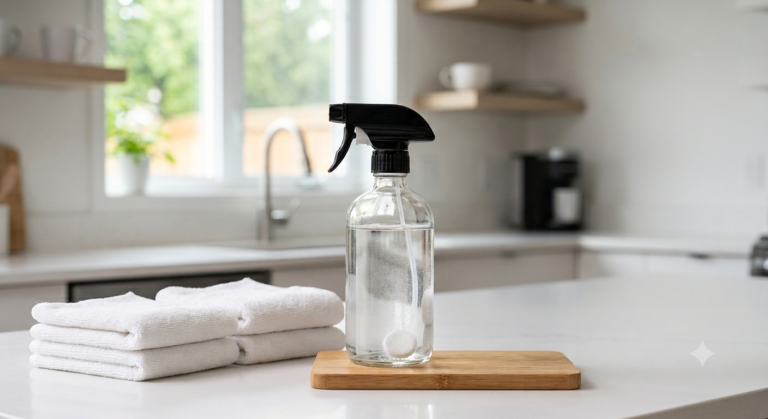
Once the tablet has been dissolved in the recommended quantity of water, the resulting solution contains the ingredients that perform the cleaning work.
Think about it this way:
The tablet is the package for the formulation.
The prepared solution is what you actually use for cleaning.
This distinction is important because two cleaning tablets can look almost identical but produce very different cleaning solutions.
A glass-cleaning tablet, for example, may be formulated differently from a kitchen cleaner designed to deal with grease.
The appearance of the tablet tells you very little about its cleaning performance.
The formulation does.
Why Do Some Cleaning Tablets Fizz?
This is one of the most noticeable things about some cleaning tablets.
You add the tablet to water and suddenly you see bubbles.
It can look a little like an effervescent vitamin tablet.
But why does this happen?
Some formulations contain ingredients that react when they come into contact with water.
A common example of an effervescent system involves an acid and a bicarbonate.
When these ingredients dissolve and react in the presence of water, they can release carbon dioxide gas.
That gas appears as bubbles.
The bubbling can help break apart the tablet and distribute its ingredients through the water.
However, not every cleaning tablet needs to fizz.
Some tablets may dissolve relatively quietly.
So don’t use bubbling as the only way to judge whether a cleaning tablet is working.
A tablet can still be functioning even if you do not see dramatic fizzing.
Is Fizzing What Makes the Cleaner Effective?
No.
This is an important distinction.
The visible fizz can be interesting, but bubbles themselves are not the primary measure of cleaning performance.
The actual cleaning ability depends on the formulation and how its ingredients interact with the type of soil being cleaned.
A tablet could fizz dramatically and still be poorly suited to a particular cleaning task.
Another tablet could dissolve with very little visible bubbling and perform extremely well for its intended purpose.
So when evaluating a cleaning tablet, focus on:
- What it is designed to clean
- Its formulation
- Recommended dilution
- Surface compatibility
- Correct usage
- Cleaning performance
rather than simply how much it bubbles.
Why Does the Amount of Water Matter?
This is one of the most important things to understand about cleaning tablets.
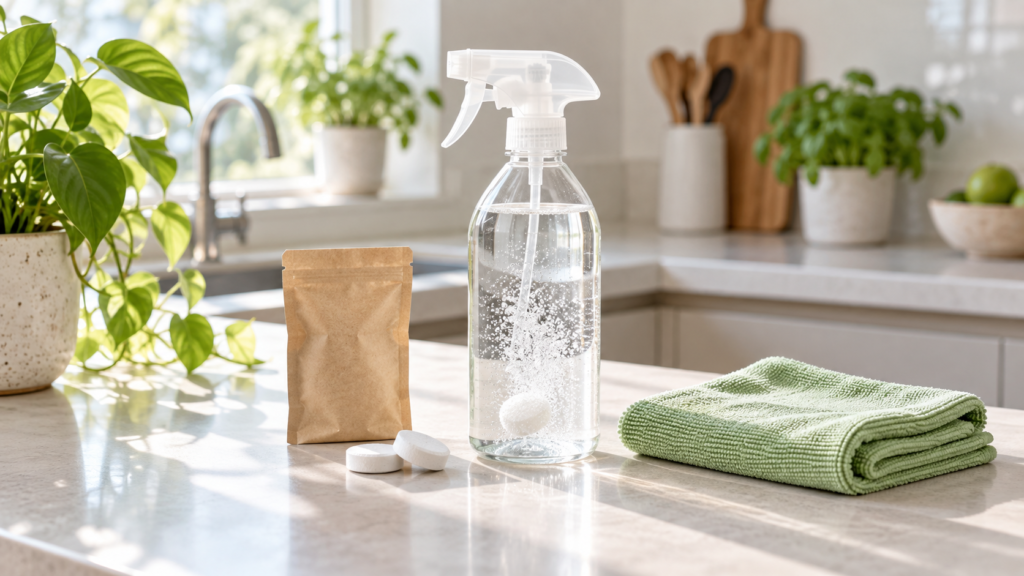
A tablet is generally formulated to be used with a specific amount of water.
For example, if a manufacturer specifies one tablet for a particular bottle size, that dilution is part of the product design.
The goal is to produce the intended concentration of cleaning ingredients in the finished solution.
Adding significantly more water changes that concentration.
Using significantly less water changes it too.
This means you shouldn’t assume:
“More concentrated must mean better.”
It isn’t necessarily true.
A cleaning formulation is designed to work within a particular range of conditions.
Following the recommended dilution helps ensure that you are using the product as intended.
What Happens If You Add Too Much Water?
Suppose a tablet is designed to produce a particular volume of cleaning solution.
If you add substantially more water than recommended, the ingredients become more diluted.
That can change the concentration of the active cleaning components in the final solution.
As a result, the product may not perform in the way the manufacturer intended.
This is why the water quantity isn’t simply a convenience instruction.
It is part of the formulation.
What Happens If You Add Too Little Water?
The opposite can also be a problem.
Using substantially less water than recommended can result in a more concentrated solution.
That doesn’t automatically mean better cleaning.
The resulting concentration may be different from what the formulation was designed for and may also affect how the product should be used on particular surfaces.
So the best approach is simple:
Follow the recommended dilution.
Don’t try to improve a cleaning product by changing the formulation yourself.
Why Does a Cleaning Tablet Take Time to Dissolve?
You may notice that some tablets disappear almost immediately while others take several minutes.
There are several reasons for this.
The dissolving behaviour can depend on:
- Tablet size
- Ingredients
- Compression
- Water temperature
- Water volume
- Tablet structure
- Formulation design
A tablet has to break apart and release its ingredients into the water.
Some ingredients may dissolve quickly while others may require more time.
This is why a product might specify a particular preparation period.
Should You Crush the Tablet?
Unless the manufacturer specifically recommends it, there is generally no reason to crush a cleaning tablet.
The tablet has been designed with a particular structure and formulation.
Breaking it apart yourself could change how quickly it dissolves and may also create unnecessary dust or handling concerns.
It’s better to let the tablet work as intended.
Does Water Temperature Affect Cleaning Tablets?
Water temperature can affect how quickly some solid ingredients dissolve.
In general, warmer water can make certain materials dissolve faster.
But that does not mean you should automatically use hot water with every cleaning tablet.
Different formulations can have different requirements.
Some products may specify room-temperature water.
Others may recommend a particular temperature.
Always follow the manufacturer’s instructions.
If the instructions do not recommend hot water, don’t assume that heating the water will make the product better.
What Happens After the Tablet Has Dissolved?
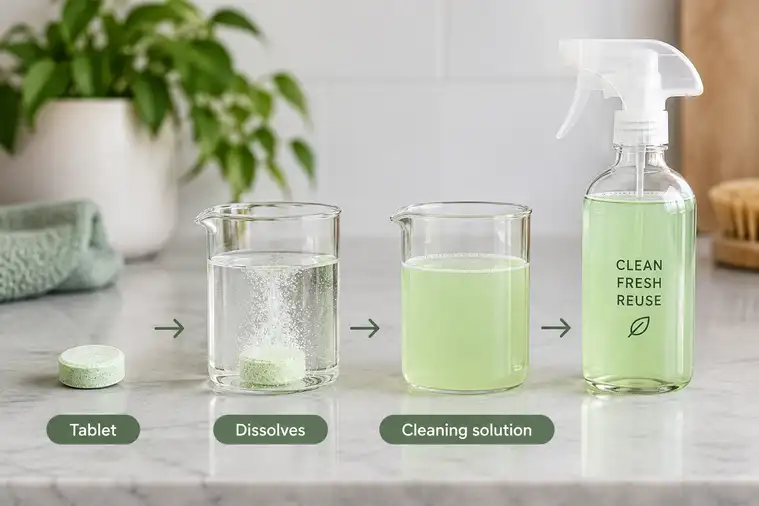
Once the tablet has dissolved sufficiently, the ingredients are distributed throughout the water.
You now have a prepared cleaning solution.
When that solution is applied to an appropriate surface, the cleaning process begins.
The exact process depends on the formulation and the type of dirt being removed.
A simplified version looks like this:
Step 1: The solution wets the surface
The liquid spreads across the area being cleaned.
Step 2: Cleaning ingredients interact with the soil
Surfactants and other formulation components can interact with dirt, oils and residues.
Step 3: Soil is loosened
The cleaning solution helps detach unwanted material from the surface.
Step 4: Wiping removes the loosened material
A cloth, sponge or other appropriate cleaning tool physically removes the loosened dirt.
Step 5: The surface is left cleaner
The result depends on the formulation, the surface, the type of soil and how the product is used.
This is why cleaning is a combination of chemistry and physical action.
The cleaner doesn’t necessarily do everything on its own.
Your wiping action matters too.
Why Does Wiping Matter?
It is easy to think of cleaning products as if they magically dissolve dirt the moment they touch it.
Real-world cleaning is usually more practical than that.
A cleaning solution can help loosen and suspend unwanted material, but the cloth or sponge still plays an important role in physically removing it.
Think of cleaning a kitchen counter.
You spray the solution.
The formulation interacts with the residue.
You wipe.
The cloth picks up the loosened material.
The surface becomes cleaner.
This is why the right product + the right surface + the right cleaning method generally matters more than simply using more product.
Do Cleaning Tablets Work Differently From Liquid Cleaners?
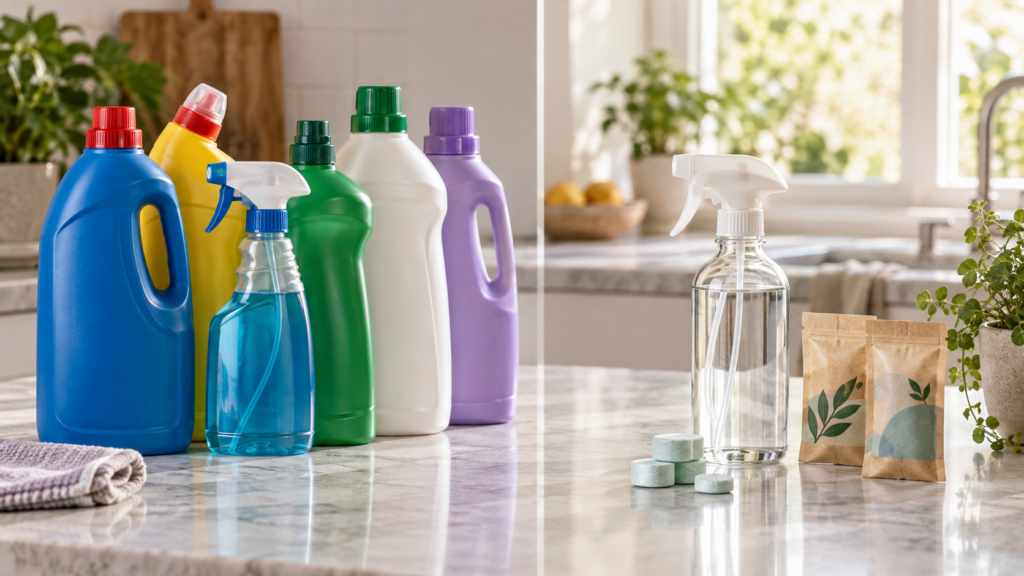
The tablet and the liquid may look completely different, but once a tablet has been properly dissolved, the cleaning process can be based on the same fundamental types of cleaning chemistry found in liquid products.
The biggest difference is when the water is added.
With a conventional ready-to-use cleaner:
The manufacturer adds the water before you buy it.
With a tablet:
You add the water at home.
This changes the storage and preparation format without necessarily changing the fundamental purpose of the cleaning ingredients.
This is why it is useful to separate two questions:
How is the product delivered?
and
What does the formulation do?
The first describes the format.
The second describes the cleaning chemistry.
Cleaning Tablets vs Cleaning Concentrates
Cleaning tablets and liquid concentrates are sometimes grouped together because both can reduce the amount of water that needs to be packaged with the product.
But they are not the same format.
Cleaning tablets
- Solid format
- Water is added at home
- Requires dissolution
- Can be designed for reusable bottle systems
- Compact to store
Liquid concentrates
- Concentrated liquid
- Water is added according to instructions
- Does not require tablet dissolution
- Usually requires a suitable measuring or dispensing method
Both approaches have advantages and disadvantages.
The right choice depends on what you value in your cleaning routine.
Why Are Cleaning Tablets Stored Dry?
The simple answer is:
Because water activates the dissolution process.
If a tablet is designed to dissolve when it encounters water, unwanted moisture during storage can be a problem.
Humidity can affect some tablet formulations, potentially causing them to soften, break down or lose their intended characteristics.
This is why many cleaning tablets come in packaging designed to help protect them from moisture.
Once again, the specific storage instructions depend on the product.
Keep tablets dry and follow the manufacturer’s recommendations.
Can Cleaning Tablets Lose Their Effectiveness?
Like other formulated cleaning products, cleaning tablets have storage and shelf-life considerations.
Exposure to moisture, inappropriate temperatures or poor storage conditions can affect some products.
This is another reason not to leave tablets sitting in an open or damp environment.
A bathroom cabinet, for example, may contain significant humidity.
If the manufacturer’s instructions recommend keeping the tablets in a dry location or their original packaging, follow those instructions.
Proper storage helps protect the product before you are ready to use it.
Why Are Different Cleaning Tablets Formulated Differently?
Because different cleaning problems require different approaches.
Consider the difference between:
A dusty glass surface
and
A greasy kitchen surface.
They aren’t the same cleaning challenge.
Glass cleaners may prioritize characteristics such as clean rinsing and minimizing visible residue.
Kitchen cleaners may be formulated with ingredients suited to dealing with oily or food-related residues.
Bathroom cleaners may be designed around a different type of soil altogether.
This is why the phrase “one tablet cleans everything” should be treated carefully.
A product can be versatile without being universally suitable for every surface and every type of dirt.
What Makes a Cleaning Tablet Effective?
There isn’t one magic ingredient.
Effective cleaning generally comes from a combination of formulation and correct use.
Some of the important factors include:
The formulation
The ingredients need to be appropriate for the intended cleaning task.
The concentration
The final solution needs to be prepared at the recommended dilution.
The surface
The product needs to be suitable for the material being cleaned.
The type of soil
Dust, grease, fingerprints, food residue and mineral deposits can require different cleaning approaches.
Contact time
Some products may need to remain on the surface for a specified period before wiping.
Mechanical action
Wiping and agitation help physically remove loosened material.
Water quality
The characteristics of the water used can sometimes influence how cleaning formulations behave.
The important takeaway is that cleaning performance is a system, not simply a property of the tablet itself.
Are Cleaning Tablets Just Compressed Powder?
Not necessarily.
While a cleaning tablet can contain powdered or granular ingredients, the final tablet is a deliberately formulated product.
The ingredients need to be combined in a way that allows the tablet to:
- Remain stable during storage
- Be handled conveniently
- Break apart or dissolve when required
- Release its ingredients into water
- Produce the intended cleaning solution
The physical structure of the tablet therefore matters as well.
A good tablet isn’t simply about putting ingredients under pressure.
It involves balancing formulation, compression, stability and dissolution.
Why Does the Same Tablet Sometimes Behave Differently?
You might notice that a tablet dissolves differently depending on where or how you prepare it.
That’s because dissolution can be affected by the conditions around the tablet.
For example:
- Water temperature can vary.
- Water volume can vary.
- Water composition can vary.
- The tablet may have been exposed to humidity.
- The tablet may have been stored differently.
- The bottle may have different dimensions or water movement.
This doesn’t necessarily mean something is wrong.
However, if the product consistently behaves differently from the manufacturer’s instructions, check the preparation method and storage conditions.
Common Mistakes When Using Cleaning Tablets
Understanding how the chemistry works also makes it easier to avoid common mistakes.
1. Guessing the Water Quantity
Don’t fill the bottle approximately and assume it is close enough.
Use the recommended amount.
2. Adding Multiple Tablets
Adding extra tablets doesn’t automatically mean better cleaning.
Use the recommended quantity unless the manufacturer specifically instructs otherwise.
3. Using the Wrong Bottle
If the product specifies a particular bottle size or type, follow the instructions.
4. Using the Solution on an Unapproved Surface
Always check surface compatibility.
5. Storing Tablets Where They Get Wet
Moisture can affect tablet stability.
Keep them stored as instructed.
6. Mixing Cleaning Products
Never assume that combining two cleaning products will improve performance.
Do not mix cleaning products unless the manufacturer explicitly says that doing so is safe.
Different ingredients can react with each other in unexpected ways.
Does More Foam Mean Better Cleaning?
Not necessarily.
Foam is one of those things that consumers often associate with cleaning power.
But more foam does not automatically mean better cleaning.
Foaming behaviour depends on the formulation and the surfactants used.
Some effective cleaning products produce lots of foam.
Others produce very little.
The amount of visible foam is therefore not a reliable standalone measure of cleaning performance.
What matters is whether the formulation is appropriate for the intended cleaning task and whether it performs as expected.
The Science Is Simple. The Formulation Is Not.
The basic idea behind cleaning tablets is easy to understand:
Add water. Dissolve the tablet. Clean.
But creating a tablet that behaves consistently involves considerably more thought.
The formulation needs to balance several things at once:
- Cleaning performance
- Dissolution
- Stability
- Tablet strength
- Storage
- Handling
- Fragrance, where applicable
- Final solution characteristics
- Surface compatibility
A tablet that dissolves instantly may not necessarily be ideal if it cannot survive normal handling or storage.
A tablet that is extremely hard may be inconvenient if it takes too long to dissolve.
The goal is to find the right balance.
That is where formulation science becomes important.
Cleaning Tablets: A Simple Idea Built on Cleaning Chemistry
The appeal of cleaning tablets is easy to understand.
Instead of purchasing a bottle that already contains a ready-to-use cleaning solution, you start with a concentrated solid formulation and add water when you need it.
Once dissolved, the ingredients perform the cleaning functions for which the product was designed.
The process can be summarized as:
1. Concentrated formulation
The cleaning ingredients are incorporated into a solid tablet.
2. Water is added
The tablet is placed into the recommended amount of water.
3. Dissolution begins
Water penetrates the tablet and releases its ingredients.
4. Ingredients disperse
The formulation becomes distributed throughout the water.
5. Cleaning solution is ready
The prepared solution can be used according to the product instructions.
6. Cleaning takes place
The solution interacts with the soil while wiping or other mechanical action helps remove it.
That’s the science behind the simple-looking tablet.
So, How Do Cleaning Tablets Actually Work?
At their core, cleaning tablets work by delivering a concentrated cleaning formulation in a solid format that can be prepared with water before use.
The tablet dissolves.
Its ingredients disperse through the water.
Surfactants and other formulation components interact with dirt and residues.
The solution helps loosen and remove unwanted material.
And the cleaning tool—usually a cloth, sponge or mop—finishes the physical removal.
The tablet itself isn’t magic.
And it isn’t supposed to be.
It is simply a different way of delivering cleaning chemistry.
The interesting part is how much thought goes into making that small tablet behave consistently when it meets water.
Final Takeaway
Cleaning tablets may look simple, but there is real formulation science behind how they work.
The basic process is:
Cleaning tablet + water → dissolution → cleaning solution → cleaning action
When the tablet meets water, it breaks down and releases its ingredients into the solution.
Depending on the formulation, you may see bubbling or fizzing, but visible fizz is not what determines cleaning performance.
What really matters is the formulation, dilution, surface compatibility and correct use.
The amount of water matters because it determines the concentration of the finished solution.
The time required for dissolution matters because the tablet needs to release its ingredients properly.
And the cleaning itself depends on both chemistry and physical action.
Once you understand these basics, cleaning tablets become much less mysterious.
They are not simply “magic tablets that turn into cleaner.”
They are concentrated cleaning formulations designed to be prepared with water and used for a specific cleaning purpose.
And that brings us to the next practical question:
How exactly should you use a cleaning tablet once you have one?
That is what we’ll cover next in:
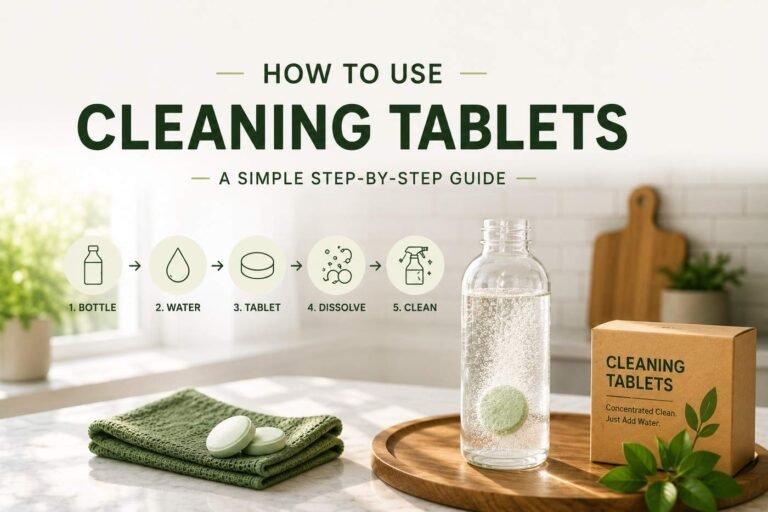
How to Use Cleaning Tablets: A Simple Step-by-Step Guide
Frequently Asked Questions
1. How do cleaning tablets work?
Cleaning tablets contain a concentrated cleaning formulation in solid form. When added to the recommended amount of water, the tablet dissolves and releases its ingredients into the solution, which can then be used for its intended cleaning purpose.
2. Why do some cleaning tablets fizz?
Some formulations contain ingredients that react in water and release carbon dioxide, creating visible bubbles. Fizzing can help the tablet break apart and disperse its ingredients, but not every cleaning tablet needs to fizz.
3. Does more fizz mean better cleaning?
No. Visible fizz is not a reliable measure of cleaning performance. The formulation, concentration, surface compatibility and intended cleaning task are more important.
4. Why does the amount of water matter?
The tablet is formulated to produce a cleaning solution at a particular dilution. Using significantly more or less water can change the concentration of the finished solution.
5. How long do cleaning tablets take to dissolve?
Dissolving time varies according to the formulation, tablet structure and preparation conditions. Always follow the manufacturer’s instructions rather than assuming every tablet will dissolve at the same speed.
6. Can I use hot water to dissolve cleaning tablets faster?
Not unless the manufacturer recommends it. Water temperature can affect dissolution, but different formulations have different requirements. Follow the product instructions.
7. Are cleaning tablets just compressed powder?
Not necessarily. They are formulated solid products designed to remain stable during storage and then break down or dissolve appropriately when prepared with water.
8. Do cleaning tablets clean by themselves?
The cleaning solution does the chemical part of the cleaning process, but physical action such as wiping also plays an important role in removing loosened dirt and residues.
9. Can I use a cleaning tablet on every surface?
No. Surface compatibility depends on the specific formulation. Always check the manufacturer’s instructions before using the solution on a particular material.
10. Can I add extra tablets for stronger cleaning?
You should not assume that more product means better cleaning. Follow the recommended tablet quantity and dilution instructions.
11. Why should cleaning tablets be kept dry?
Because moisture can begin affecting a tablet before you are ready to use it. Follow the manufacturer’s storage instructions and protect the tablets from unwanted moisture.
12. Are cleaning tablets better than liquid cleaners?
Neither format is automatically better for everyone. Cleaning tablets offer a different approach based on concentrated formulations, water added at home and, in some systems, reusable bottles and refills.
5 Comments