How Cleaning Tablets Remove Grease: The Surprising Science
Ever wonder how a tiny, concentrated tablet smaller than a coin can tackle stubborn kitchen grease?
It’s not magic. It’s chemistry.
Meet the Molecular Bouncers: Surfactants
Oil and water don’t naturally mix well. To get greasy residue off a counter, you need something that helps water interact with that oil.
That’s where surfactants come in.
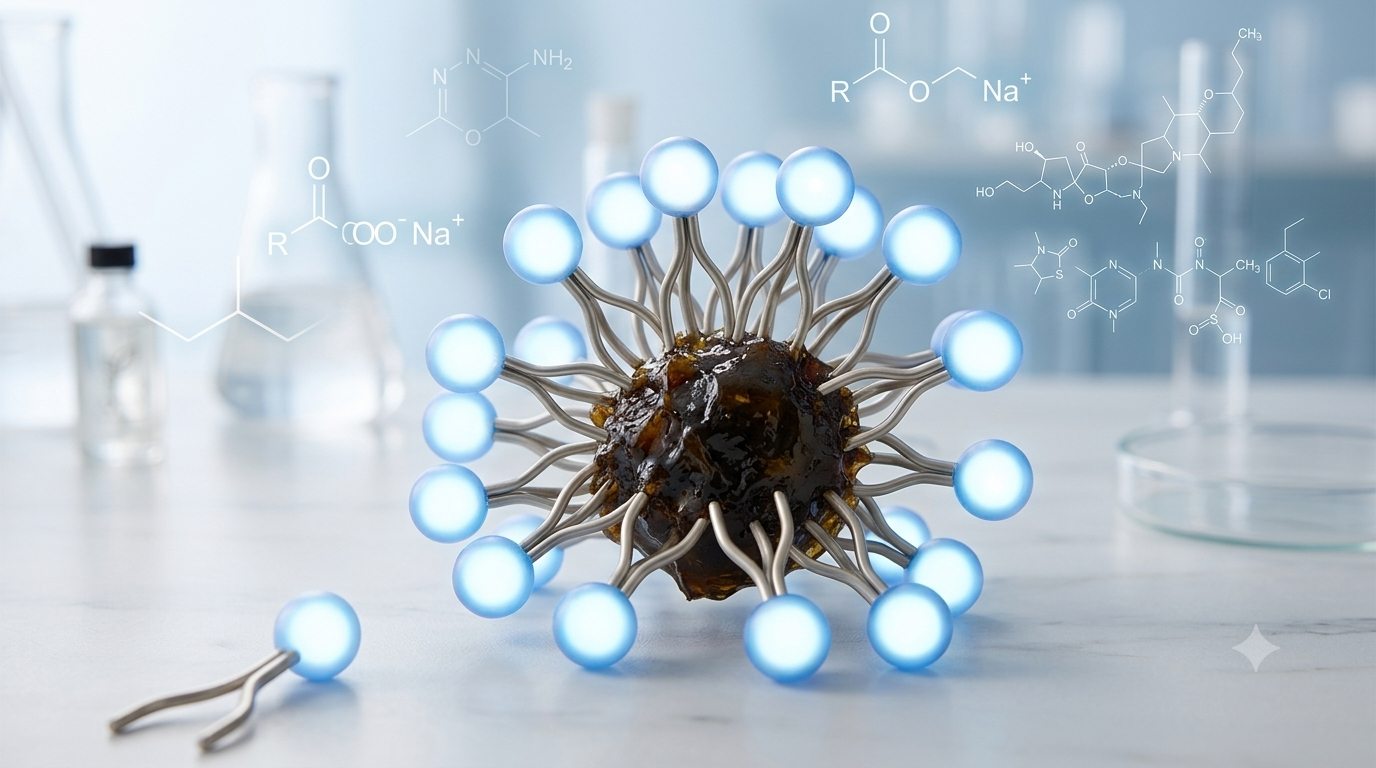
Think of surfactant molecules like microscopic bouncers with two different sides:
- The Water Lover (Head): Interacts with water.
- The Oil Hunter (Tail): Is attracted to oils and greasy soils.
When you spray a properly prepared cleaning solution onto a greasy surface, the surfactants help loosen and surround oily residue. Their oil-loving tails interact with the grease while their water-loving heads remain associated with the surrounding water.
Then comes the part people often underestimate:
You wipe.
The cloth picks up the loosened grease, dirt and cleaning solution and carries them away from the surface.
That tiny tablet did not magically destroy the mess.
It helped turn ordinary water into a cleaning solution designed to deal with it.
Why Water Is Just the Taxi (why ship water?)
In a conventional ready-to-use spray, much of what you see inside the bottle is the liquid medium carrying the cleaning ingredients.
With a concentrated cleaning tablet, you can take a different approach.
Instead of transporting the complete prepared cleaning solution every time, the cleaning formulation can be stored in a compact solid format.
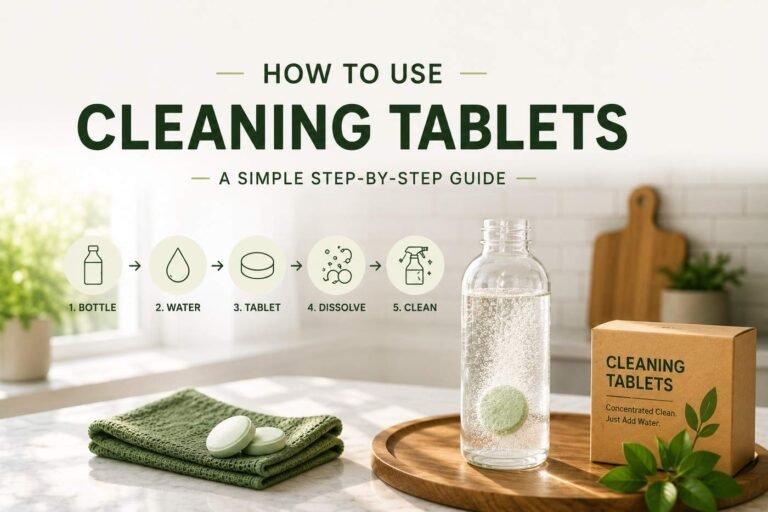
You add the specified amount of water at home.
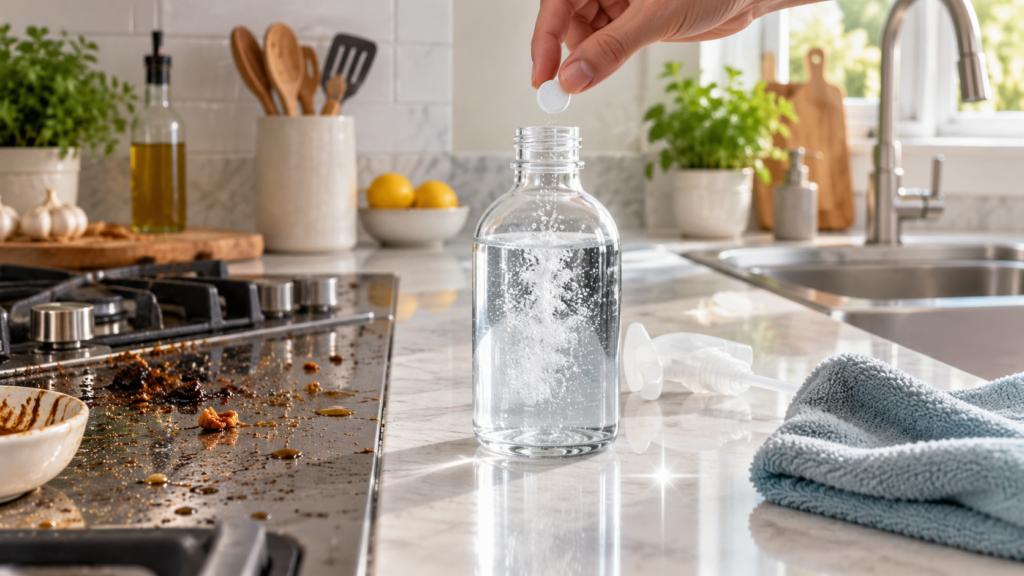
Drop in the tablet.
Let it dissolve.
And the cleaning chemistry gets to work.
Put smart chemistry to work.
So What Is Actually Inside a Cleaning Tablet? How Cleaning Tablets Remove Grease: The Surprising Science?
A cleaning tablet may look simple from the outside.
Small.
Dry.
Compact.
Maybe white, blue, green or another colour.
But inside is a carefully designed combination of ingredients chosen for a particular cleaning task.
Depending on the formulation, that can include:
- Surfactants
- Builders
- Water-conditioning ingredients
- Acids or alkaline components
- Binding ingredients
- Dissolution aids
- Fragrance
- Other cleaning agents
Not every tablet contains the same ingredients.
And that matters.
A kitchen-cleaning tablet designed for greasy surfaces may be formulated differently from a tablet intended for glass, bathrooms or floors.
The tablet is the delivery format.
The formulation determines what the resulting cleaner can actually do.
Tiny Tablet, Concentrated Chemistry
One reason cleaning tablets seem surprising is their size.
How can something so small produce an entire bottle of cleaner?
Because the finished cleaner does not need to be stored inside the tablet.
The water comes later.
Think about a conventional bottle of ready-to-use cleaner.
Inside you have:
Water + cleaning ingredients
With a tablet system, you separate those two components.
The tablet carries the concentrated formulation.
You provide the water when you are ready to use it.
So the comparison is not:
Tiny tablet vs giant bottle of cleaner
It is closer to:
Concentrated formulation + your water vs pre-diluted formulation + manufacturer-added water
Once you see it that way, the tablet starts looking far less mysterious.
What Happens the Moment the Tablet Hits Water?
Drop a cleaning tablet into the recommended amount of water.
The process begins almost immediately.
Stage 1: Water enters the tablet
Water starts penetrating the compressed structure.
Stage 2: The tablet starts breaking apart
Different ingredients begin dissolving or dispersing.
Stage 3: Cleaning ingredients spread through the water
Surfactants and other formulation components become distributed throughout the solution.
Stage 4: The concentration reaches its intended level
Assuming you used the correct amount of water, the solution is prepared at the concentration the product was designed for.
Stage 5: You now have a usable cleaner
Once preparation is complete according to the instructions, the solution is ready for its intended surfaces.
The tablet has essentially changed from a compact storage format into a working cleaning solution.
Why Do Cleaning Tablets Fizz?
This is probably the most satisfying part.
Drop the tablet.
Bubbles appear.
Fizzing starts.
The tablet seems to come alive.
Some formulations use an effervescent system.
A common approach involves an acid and a bicarbonate-containing ingredient.
When water allows those ingredients to interact, they can release carbon dioxide.
That is what creates the bubbles.
Fizzing can help the tablet break apart and disperse.
But there is an important distinction:
Fizz is not the same thing as cleaning power.
A tablet that creates a dramatic bubbling show is not automatically a better cleaner.
And a tablet that dissolves quietly is not automatically weaker.
The real cleaning happens because of the formulation that remains after the tablet has dissolved.
Surfactants Are Doing the Interesting Work
Let’s return to our molecular bouncers.
Surfactants have a structure that makes them unusually useful for cleaning greasy soils.
One end is relatively compatible with water.
The other is more compatible with oils.
That gives surfactants the ability to operate at the boundary between the two.
When the cleaner reaches a greasy countertop, surfactants help the water spread and interact with oily material that plain water would struggle to remove efficiently.
As mechanical action is added through wiping, greasy soil can be broken into smaller droplets and dispersed into the solution.
At sufficient concentrations, surfactant molecules can organize around oily material in structures called micelles.
genui{“learning_viz”:{“type_id”:”DETERGENT_MICELLE_GREASE”,”initial_values”:{“relativeDetergentAmountPercent”:40}}}
In simplified terms:
Oil-loving portions face toward the grease.
Water-loving portions face toward the surrounding water.
That helps keep oily material dispersed while you remove it from the surface.
Why Plain Water Struggles With Kitchen Grease
Try wiping an oily pan with plain water.
You will immediately notice the problem.
The water moves.
The grease mostly stays.
That happens because grease and water have very different chemical characteristics.
Cooking oil does not simply dissolve into water.
You need something that helps bridge the gap.
Surfactants provide that bridge.
This is why adding the right cleaning chemistry changes the behaviour of the water dramatically.
Suddenly the liquid can:
Spread better.
Interact with grease.
Help loosen oily residue.
Keep some of that loosened material dispersed.
And make it easier for your cloth to carry it away.
Your Cloth Deserves More Credit
We tend to give the spray bottle all the attention.
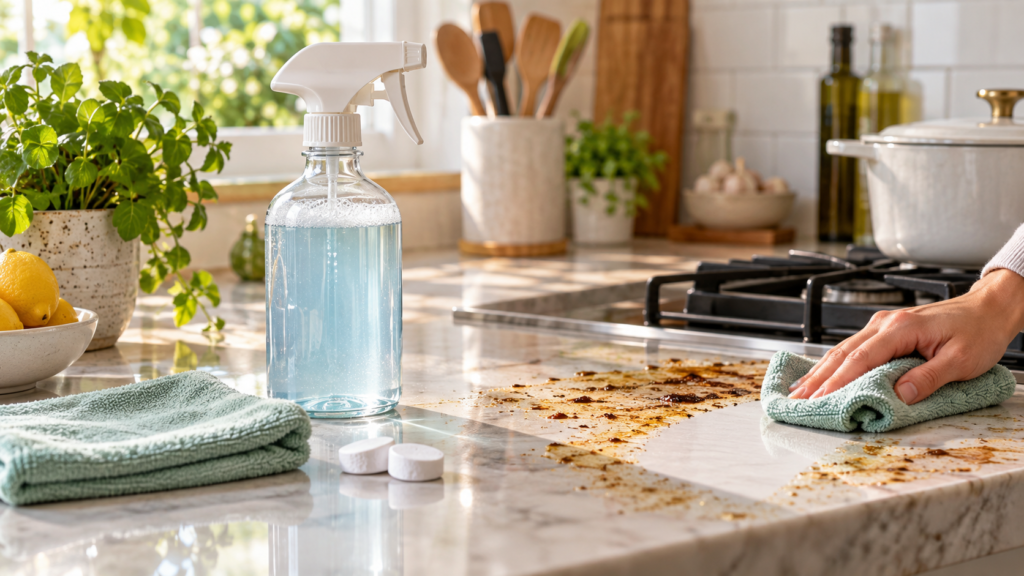
Spray.
Wait.
Wipe.
Surface clean.
But the cloth is doing serious work.
The formulation helps loosen the soil.
The cloth physically removes it.
This is known as mechanical action, and it is one of the fundamental parts of cleaning.
Think about a greasy countertop.
Cleaner alone
The chemistry interacts with the residue.
But some loosened material may remain on the surface.
Cloth alone
You may physically remove some grease, but you could also smear it across a larger area.
Cleaner + cloth
The formulation helps loosen and disperse the greasy soil while the cloth carries it away.
That combination is what makes the system work.
Why Microfiber Works So Well
A microfiber cloth contains extremely fine fibres.
Those fibres create a large surface area that can pick up:
- Fine dust
- Moisture
- Loosened grease
- Food residue
- Other particles
Rather than simply pushing dirt around, a good microfiber cloth can trap material within its structure.
That makes it a useful partner for a cleaning solution.
The cleaner does not need to do everything.
Neither does the cloth.
They work together.
What About That Caked-On Stove Grease?
Fresh cooking oil is relatively easy to deal with.
Old grease is another story.
Heat.
Time.
Dust.
Food residue.
Repeated cooking.
All of these can transform a thin film of oil into sticky, stubborn grime.
This is why the area around the stove can be one of the most difficult parts of the kitchen to clean.
A suitable kitchen-cleaning formulation helps by improving the interaction between the cleaning solution and oily material.
But chemistry alone may not be enough.
You may also need:
Contact time + appropriate wiping or scrubbing
The exact instructions depend on the product and surface.
That is important because aggressive scrubbing can damage certain finishes.
Cleaning Is Really a Team Sport
There is a useful way to think about cleaning science.
Performance usually depends on four things:
Chemistry
The cleaner itself.
Time
How long the cleaner interacts with the soil.
Mechanical action
Wiping, scrubbing or brushing.
Temperature
Which can influence how some soils and formulations behave.
Professional cleaning science often describes this relationship through the Sinner’s Circle.
The important lesson for household cleaning is simple:
You do not always need more chemical.
Sometimes the better answer is:
Give the product a little more time.
Use the right cloth.
Wipe more effectively.
Or choose a cleaner better suited to the mess.
Why More Tablet Does Not Mean More Power
This is important.
If one cleaning tablet is designed for a specific amount of water, using two tablets does not automatically give you twice the cleaning performance.
You have changed the formulation concentration.
That can potentially cause:
- More residue
- More product waste
- Greater rinsing requirements
- Different surface behaviour
- Unnecessary chemical use
The manufacturer designs the tablet around a specific dilution.
So follow it.
One tablet designed for 500 ml does not become “premium strength” just because you use 250 ml.
It becomes a different concentration from the one the product was designed around.
Why the Water Quantity Matters So Much
Imagine a tablet containing a fixed amount of surfactants and other ingredients.
Put it into the recommended quantity of water.
You get the intended concentration.
Now double the water.
Those same ingredients are distributed through twice as much liquid.
The solution becomes more dilute.
Use half the water.
The solution becomes more concentrated.
Neither change automatically improves cleaning.
The manufacturer chooses the dilution based on how the formulation is intended to perform.
This is why one of the simplest rules for cleaning tablets is also one of the most important:
Do not eyeball the water.
Are Cleaning Tablets Just Compressed Soap?
No.
“Soap” and “cleaning formulation” are not interchangeable terms.
A tablet can contain several functional ingredient categories working together.
Surfactants may help with oily soils.
Builders may support cleaning performance.
Water-conditioning ingredients may help manage minerals.
Acidic or alkaline ingredients may be used depending on the intended cleaning task.
Other ingredients can affect:
- Tablet stability
- Dissolution
- Fragrance
- Handling
- Final solution characteristics
Creating a good cleaning tablet is therefore not simply a matter of compressing a pile of detergent powder into a circle.
The tablet needs to:
Remain stable in storage.
Survive normal handling.
Dissolve appropriately.
Release its ingredients consistently.
And produce the intended cleaning solution.
Why Kitchen Dirt Is Particularly Difficult
“Kitchens are dirty” is too simplistic.
Kitchen grime is chemically complicated.
You can encounter:
Cooking oils
Greasy and hydrophobic.
Food proteins
Egg, dairy, meat and other residues.
Sugars
Sticky once dried.
Starches
Can form stubborn films.
Dust
Which can stick to existing grease.
Burnt residue
Potentially much harder to remove than fresh food.
Mineral marks
Particularly around sinks and taps.
This is why one type of chemistry cannot necessarily solve every kitchen problem equally well.
An everyday multi-surface cleaner might handle ordinary grease and food residue.
A heavily burnt oven surface may require a different product.
A hard-water deposit near the sink may need another approach again.
Smart cleaning starts with identifying the mess.
Visit us on: INSTAGRAM
Why Surfactants Also Help With Wetting
Surfactants do more than interact with oil.
They can also reduce the surface tension of water.
That helps the cleaning solution spread more easily.
Instead of forming isolated droplets, the liquid can cover more of the dirty area.
That matters because cleaning chemistry cannot interact effectively with soil it never reaches.
Better wetting means better contact between:
Cleaner + dirt + surface
That can make the overall cleaning process more effective.
Does More Foam Mean More Surfactant Power?
Not necessarily.
Consumers often associate:
More foam = stronger cleaner
But foam depends on the specific surfactants and formulation.
Some highly effective cleaners generate relatively little foam.
Other formulas create a dramatic amount.
Foam itself mainly tells you that air bubbles are being stabilized.
It does not directly tell you how much grease is being removed.
So when choosing or judging a cleaner:
Look at performance.
Not the bubble show.
The Difference Between Cleaning and Disinfecting
This is another important distinction.
A product that removes grease is not automatically a disinfectant.
Cleaning is primarily about removing:
- Dirt
- Grease
- Residue
- Organic material
- Other unwanted soil
Disinfection has a different purpose and requires products formulated and labelled accordingly.
Some situations may require both.
But they are not interchangeable concepts.
Do not assume that because your countertop looks shiny it has been disinfected.
And do not assume every kitchen surface needs constant disinfection either.
Follow the relevant product instructions.
Why Leaving a Cleaner on the Surface Can Matter
Sometimes spraying and immediately wiping is enough.
Sometimes the product instructions tell you to wait.
That waiting period is known as contact time or dwell time.
The formulation may need time to:
Penetrate residue.
Loosen grease.
Interact with deposits.
Perform another intended function.
Immediately wiping the product away may give the chemistry less opportunity to work.
But there is a flip side.
Leaving a cleaner sitting indefinitely is not automatically better.
It can lead to:
Drying.
Residue.
Surface damage.
Staining.
Always use the recommended contact time.
Why Repeated Light Cleaning Beats the Giant Kitchen Rescue
There is an easier way to deal with kitchen grime.
Do not let it become giant kitchen grime.
Fresh grease is generally easier to clean than old, baked-on grease.
A quick wipe after cooking can prevent layers from forming.
That means:
Less scrubbing.
Less product.
Less time.
Less frustration.
This is one of the most useful principles in cleaning:
Maintenance usually requires less chemistry than restoration.
The cleanest kitchen is not necessarily the one that gets an enormous deep clean every month.
It may simply be the one where small messes are removed before they become difficult.
So Why Send Water Across the Country?
This brings us back to cleaning tablets.
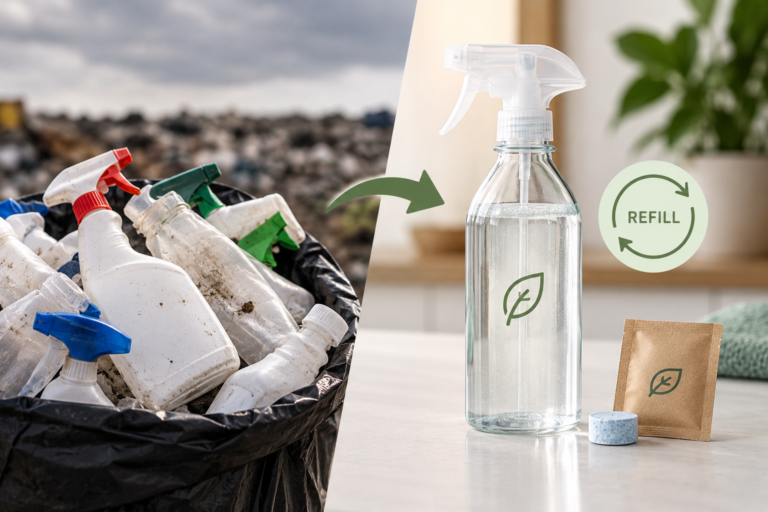
A conventional ready-to-use spray arrives with the water already inside.
That means the complete diluted solution needs to be:
Manufactured.
Bottled.
Packed.
Stored.
Transported.
Warehoused.
Delivered.
With a concentrated refill system, some of that equation changes.
The concentrated formulation travels.
The reusable bottle stays in your home.
Water is added when the cleaner is prepared.
Of course, tablets still require manufacturing, packaging and transportation.
They are not impact-free.
But they create a different system:
Move the concentrated chemistry instead of repeatedly moving the entire prepared bottle.
The Bottle Does Not Do the Cleaning Either
Another useful distinction:
The bottle is just the delivery equipment.
It holds the solution.
It helps you dispense it.
That means the bottle does not necessarily need replacing when the solution runs out.
If the bottle remains:
Safe.
Compatible.
Functional.
Clean.
then a refill system can allow it to keep doing its job.
Think about the logic:
You do not throw away your bucket every time the water is emptied.
You do not throw away your mop when the floor cleaner runs out.
Why should a functional spray bottle automatically become waste when its first cleaner is finished?
Tiny Tablet. Bigger System.
The real innovation in a cleaning tablet is not simply making the cleaner small.
It is separating:
The durable component
from
The consumable component.
The bottle can stay.
The cleaning formulation gets replaced.
Water can be added at home.
A tiny refill can therefore support an entire cleaning routine.
That changes:
Storage.
Transportation.
Packaging.
Dosing.
Refilling.
And potentially the number of full-sized bottles moving through a household.
The Kitchen Cupboard Gets Simpler Too
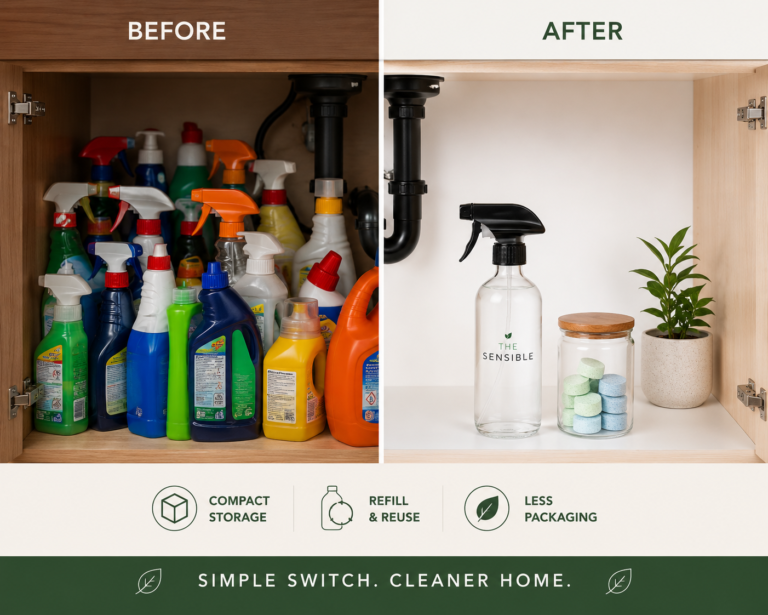
Traditional cleaning storage can become bulky quickly.
Kitchen cleaner.
Extra kitchen cleaner.
Backup spray.
Degreaser.
Another cleaner you bought on sale.
A tablet system can reduce some of that bulk.
Instead of several replacement bottles, you might have:
One reusable bottle + compact refills
depending on the cleaning jobs you need to cover.
That makes refill formats especially interesting for:
Small apartments.
Minimalist homes.
Compact kitchens.
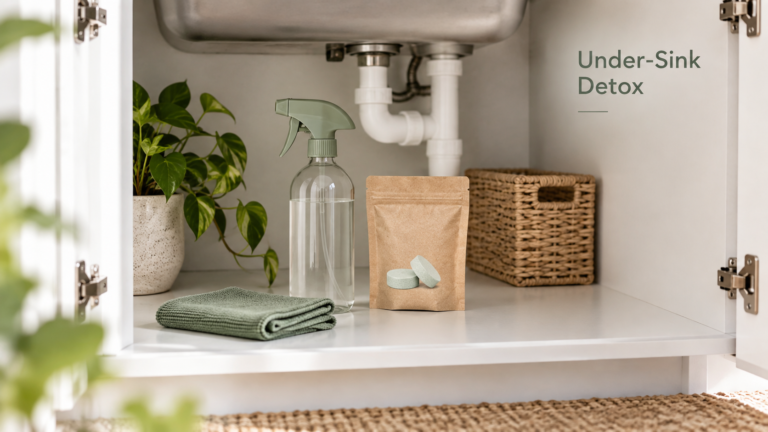
Under-sink organisation.
People who simply dislike clutter.
Sometimes the sustainability benefit and the convenience benefit point in the same direction.
Smart Chemistry Doesn’t Mean Stronger Chemistry
A useful cleaning product is not necessarily the harshest formulation available.
The goal is not maximum chemical strength.
The goal is:
Enough cleaning performance for the intended job without unnecessary excess.
That means:
Correct surfactants.
Correct concentration.
Correct pH.
Correct contact time.
Correct surface compatibility.
Correct mechanical action.
Cleaning science is about balance.
Not aggression.
What Actually Makes a Cleaning Tablet Effective?
Not the size.
Not the colour.
Not the smell.
Not the fizz.
Not the number of bubbles.
A cleaning tablet works well when several things come together.
Good formulation
The ingredients need to suit the intended cleaning task.
Correct dilution
The tablet needs the specified amount of water.
Proper dissolution
The formulation needs to disperse adequately.
Surface compatibility
The resulting solution must be appropriate for the material being cleaned.
Correct application
Enough solution.
Not too much.
Mechanical action
A good cloth or tool needs to physically remove loosened soil.
Regular cleaning
Mess is easier to remove before it becomes heavily baked on.
That is what good cleaning actually looks like.
The Sensible Take
The most interesting part of cleaning tablets is not watching one fizz.
It is realizing how much of everyday cleaning comes down to a small amount of carefully selected chemistry.
You do not need a huge bottle to hold that chemistry before you use it.
You need:
The formulation.
The correct amount of water.
A suitable bottle.
A cloth.
And the right technique.
That tiny tablet is not performing magic.
It is simply putting concentrated cleaning science into a compact format.
Surfactants help bridge the gap between water and grease.
Water carries those ingredients across the surface.
Mechanical action removes the loosened material.
And the reusable bottle gives the finished solution somewhere to live.
Small tablet. Smart chemistry. Big cleaning job.
Frequently Asked Questions
How can a tiny cleaning tablet clean an entire bottle?
The tablet contains a concentrated cleaning formulation. Water is added separately to create the finished cleaning solution at the intended concentration.
What are surfactants?
Surfactants are surface-active ingredients that help water interact with substances such as oils and grease, making those soils easier to loosen, disperse and remove.
Why doesn’t plain water remove grease easily?
Water and oils do not naturally mix well. Surfactants help bridge the interaction between water and oily soil.
What are micelles?
Micelles are structures formed by surfactant molecules in water. Their oil-compatible portions can associate with oily material while their water-compatible portions face the surrounding water.
Is fizzing responsible for the cleaning?
No. Fizzing can help some tablets break apart and disperse, but cleaning performance depends primarily on the resulting formulation and how it is used.
Does more foam mean better grease removal?
No. Foam is not a reliable measure of cleaning power.
Can I use two tablets to make a stronger kitchen cleaner?
Do not do so unless the manufacturer specifically instructs it. Changing the tablet-to-water ratio changes the intended concentration.
Why should I use the recommended amount of water?
The amount of water determines the concentration of cleaning ingredients in the final solution.
Does wiping really matter?
Yes. Cleaning chemistry helps loosen and disperse soil, while the cloth or other cleaning tool physically removes that material from the surface.
Are cleaning tablets suitable for every kitchen surface?
Not automatically. Always check the product’s surface compatibility and manufacturer’s directions.
Why are cleaning tablets so small?
Because the tablet contains the concentrated formulation rather than an entire bottle of pre-diluted cleaning solution.
Are cleaning tablets just soap?
No. Depending on the product, a tablet can contain several types of cleaning and formulation ingredients designed for a specific purpose.
Final Takeaway
A tiny cleaning tablet can look almost too simple.
Drop it into water.
Wait.
Spray.
Wipe.
Done.
But zoom in far enough and an entire cleaning system appears.
Surfactants help the solution interact with grease.
Water carries the formulation.
The correct dilution establishes the intended concentration.
Contact time gives the chemistry an opportunity to work where needed.
And your cloth provides the mechanical action that physically removes the mess.
The tablet itself is simply the concentrated delivery format.
And that may be the most interesting part.
You do not necessarily need a large bottle of pre-prepared liquid to store effective cleaning chemistry.
Sometimes you just need the important part:
The cleaning formulation.
Add water when you need it.
Put smart chemistry to work.
And let that tiny tablet do a surprisingly big job.


One Comment