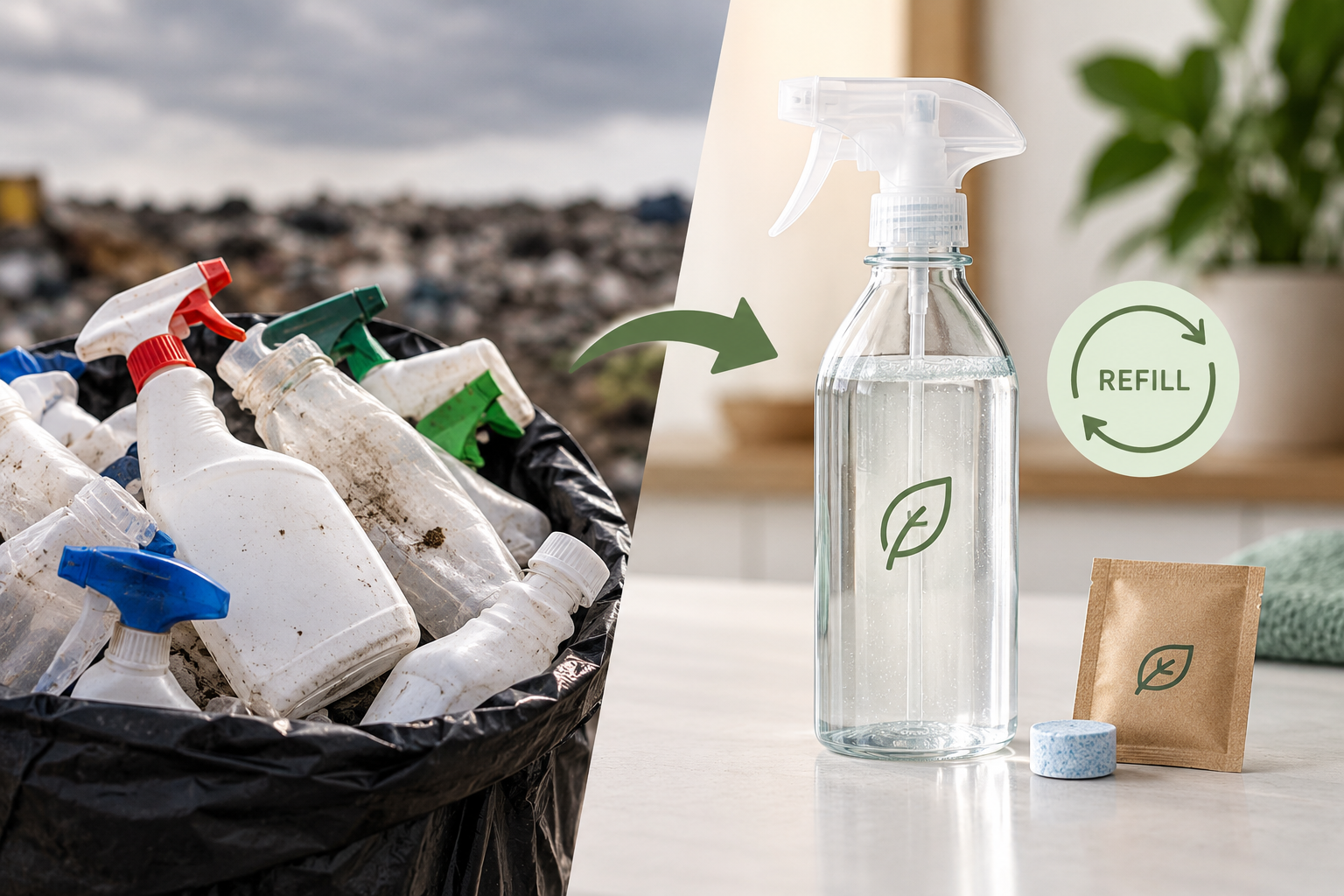
Plastic Spray Bottle Waste: Why Reuse Beats Throwing Away
How Reusable Cleaning Bottles Can Reduce Plastic Spray Bottle Waste?
Plastic is weirdly good at its job.
It resists moisture. It survives drops. It can sit under a kitchen sink for years without falling apart. It can be moulded into lightweight, practical bottles that are easy to hold, transport and use.
In other words, plastic was designed to last.
And then somewhere along the way, we decided to use this incredibly durable material for products we throw away almost immediately.
Buy a surface cleaner.
Spray it around the house.
Finish the liquid.
Throw away the bottle.
Buy another bottle.
Repeat.
That is the part that makes very little sense.
A plastic bottle may remain in the environment for centuries. UNEP has cited estimates of up to around 450 years for a plastic bottle to decompose, although the exact time depends on the material and environmental conditions. Even decomposition does not necessarily mean plastic simply disappears; it can fragment into smaller plastic particles.
Yet the useful life of the cleaning liquid inside that bottle might be measured in weeks or months.
Centuries of material durability. Weeks of actual use.
That mismatch is worth talking about.
And perhaps the most sensible solution isn’t discovering another complicated way to recycle the bottle.
Perhaps it starts one step earlier:
What if we simply stopped throwing the bottle away?
We Need to Talk About the Cleaning Bottle
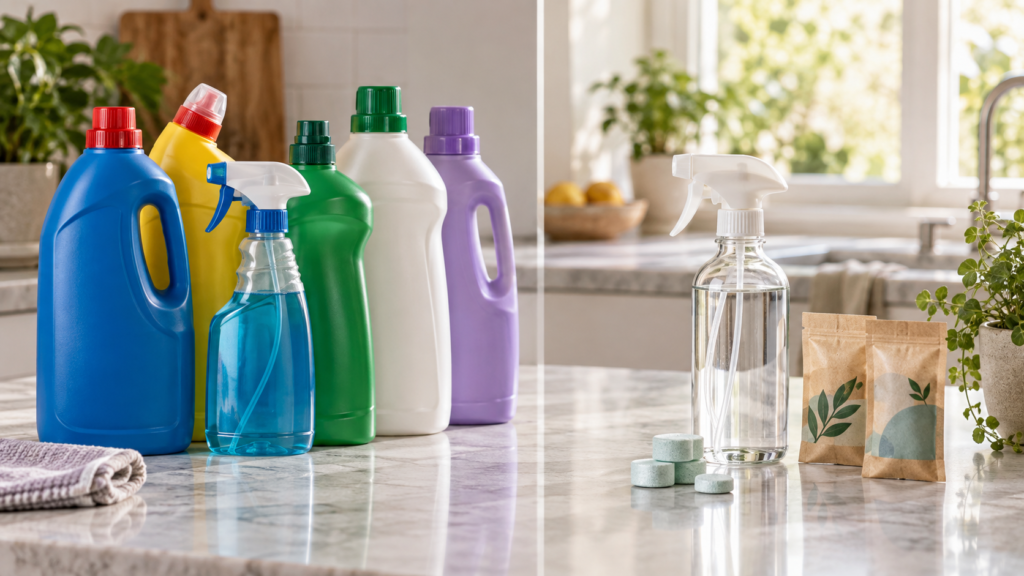
Walk into almost any supermarket cleaning aisle.
What do you see?
Rows and rows of bottles.
Kitchen cleaner in a bottle.
Bathroom cleaner in another bottle.
Glass cleaner in another.
Multi-surface cleaner in another.
Floor cleaner in another container.
Different colours. Different fragrances. Different labels.
But underneath all that branding, the basic purchasing model is surprisingly similar.
You’re buying:
Cleaning formulation + water + packaging
When the cleaning solution runs out, the entire package is commonly replaced.
That feels normal because it is what many of us grew up doing.
But normal and sensible aren’t always the same thing.
The bottle didn’t suddenly stop working because the cleaner ran out.
The trigger didn’t necessarily stop spraying.
The container didn’t suddenly become structurally useless.
In many cases, what you actually ran out of was simply the cleaning formulation inside it.
So why replace everything?
Why Plastic Spray Bottle Waste Is a Bigger Problem Than It Looks
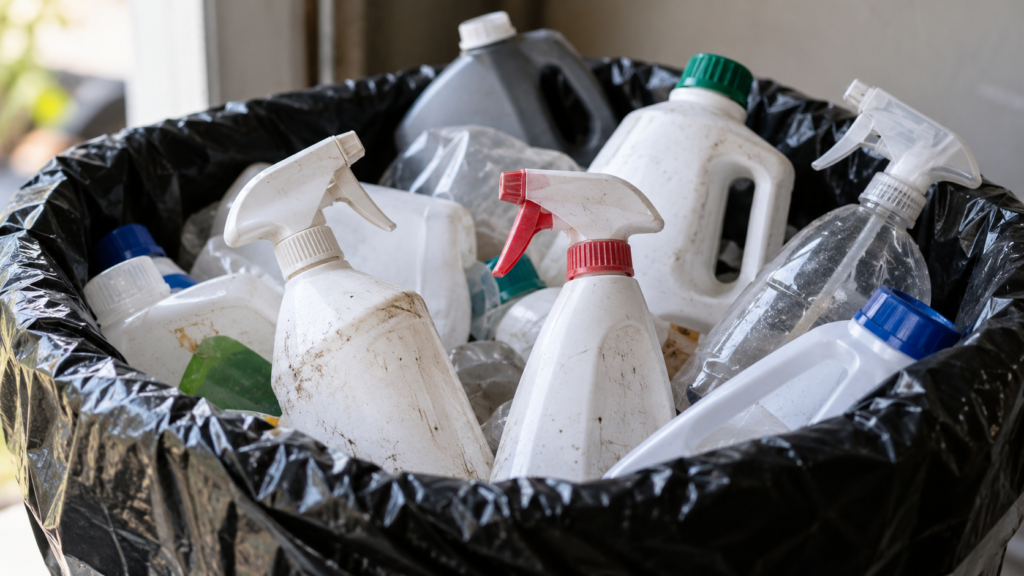
Plastic conversations often become extremely simplified.
Plastic = bad.
Anything without plastic = good.
Reality is more complicated.
Plastic became incredibly common for a reason.
It is lightweight.
It is durable.
It can resist water.
It can protect products during storage and transport.
It can be manufactured into highly functional shapes.
The EPA describes plastic products as versatile, durable and lightweight—properties that explain why plastics became widespread across packaging, transportation, construction and many other industries.
Durability itself isn’t the problem.
In fact, durability can be extremely useful.
The strange part is taking a material designed to survive years of use and building a system around using it once or a handful of times before disposal.
Imagine buying a stainless-steel water bottle every time you finished the water inside it.
Drink.
Throw bottle away.
Buy another.
Drink.
Throw bottle away.
It would sound ridiculous.
You’d probably ask:
Why don’t you just refill the bottle?
Exactly.
The Real Question: Why Are We Shipping the Water Again?
Most ready-to-use household cleaning products are liquids.
And liquid cleaning products require packaging capable of holding that liquid during manufacturing, transportation, storage and use.
But here’s the interesting thing about concentrated cleaning formats.
Water doesn’t always need to travel with the cleaning formulation.
There is already water available in most homes.
That creates a different possibility.
Instead of transporting a complete bottle of prepared cleaning solution every time, certain products can separate the concentrated formulation from the water.
That is the basic idea behind cleaning tablets.
A cleaning tablet contains a concentrated formulation designed to be prepared with a specified quantity of water.
Instead of:
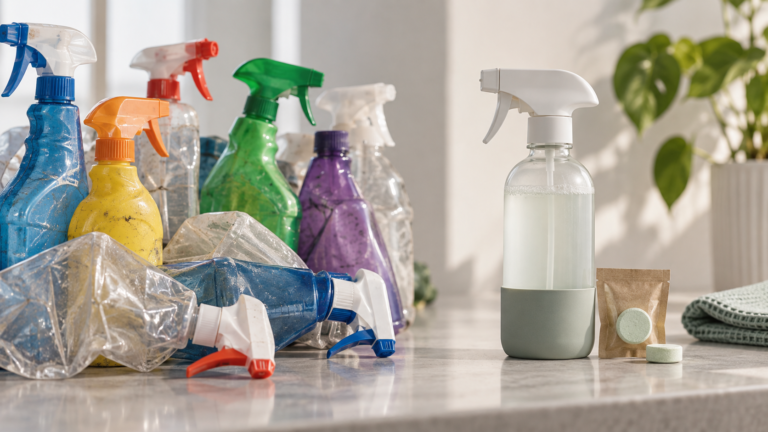
Buy bottle → finish bottle → replace bottle
the routine can become:
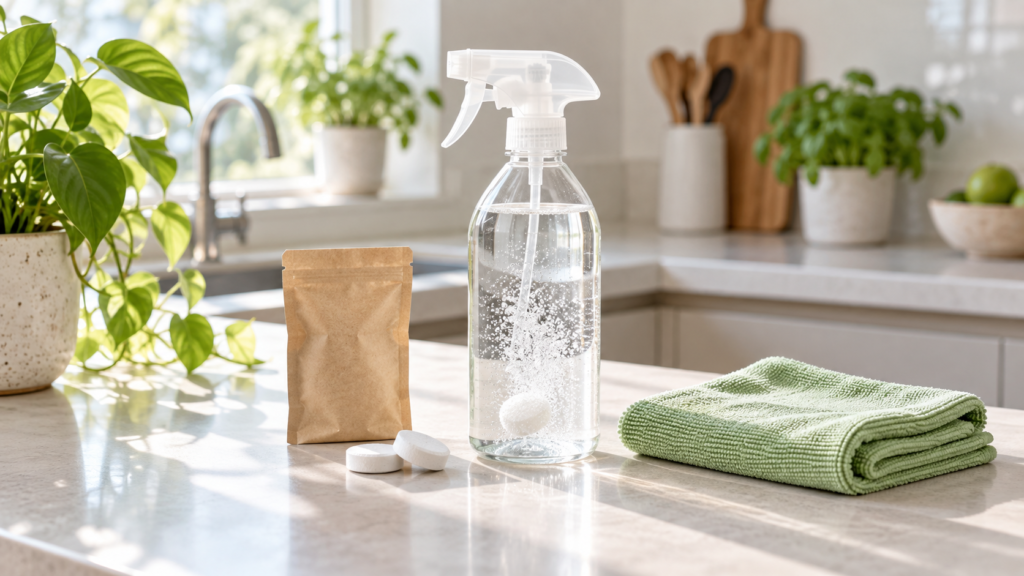
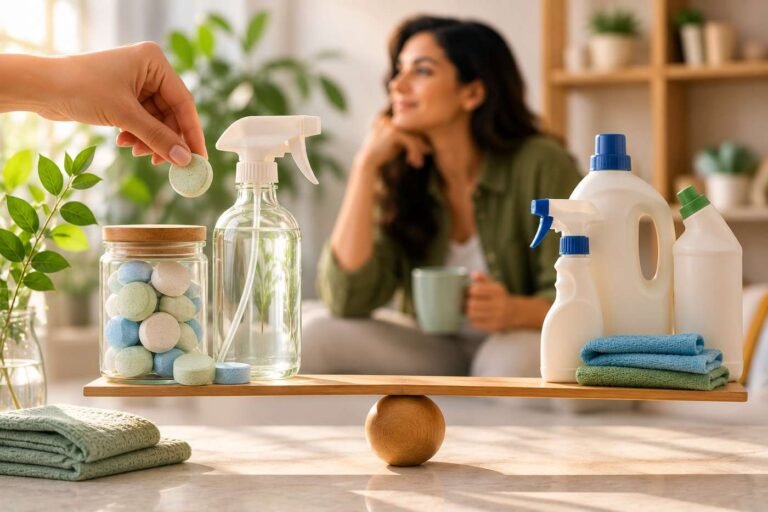
Keep bottle → add water → add refill → prepare cleaner → reuse bottle
The cleaner still exists.
The bottle still exists.
The cleaning routine still exists.
What changes is the refill model.
If you’re new to the format, our guide to What Are Cleaning Tablets? A Beginner’s Guide explains the concept in more detail.
Meet the “Forever Bottle” Mindset
Let’s clarify something immediately.
“Forever bottle” doesn’t literally mean the bottle will survive until the year 2526.
Everything wears out eventually.
Spray mechanisms can fail.
Bottles can crack.
Parts can become damaged.
Some materials may need replacement.
The point is the mindset.
A bottle should be treated as a durable object instead of disposable packaging whenever the product design safely allows repeated use.
Think:
Keep it until it actually needs replacing.
Not:
Replace it because the liquid inside ran out.
That is a surprisingly important difference.
The container becomes part of your cleaning equipment.
Like your mop.
Your bucket.
Your broom.
Your microfiber cloth.
Your vacuum cleaner.
You wouldn’t throw away your mop every time the floor-cleaning liquid finished.
So why should the spray bottle automatically be disposable?
The Bottle Has Already Done the Hard Part
Think about everything required before a cleaning bottle reaches your home.
Raw materials need to be sourced.
The bottle needs to be manufactured.
The trigger mechanism needs to be produced.
Different components need to be assembled.
The bottle needs to be filled.
Labels may need to be printed and attached.
The finished product needs to be packed.
Boxes need to be transported.
Products need to move through warehouses.
Then through distribution.
Then eventually into stores or homes.
And after all of that…
we empty the liquid and potentially start the process again with another bottle.
Reusing the existing bottle changes the logic.
The durable part of the product remains in service.
Only the consumable part gets replenished.
That is much closer to how we treat durable products in almost every other part of life.
But Can’t We Just Recycle the Bottle?
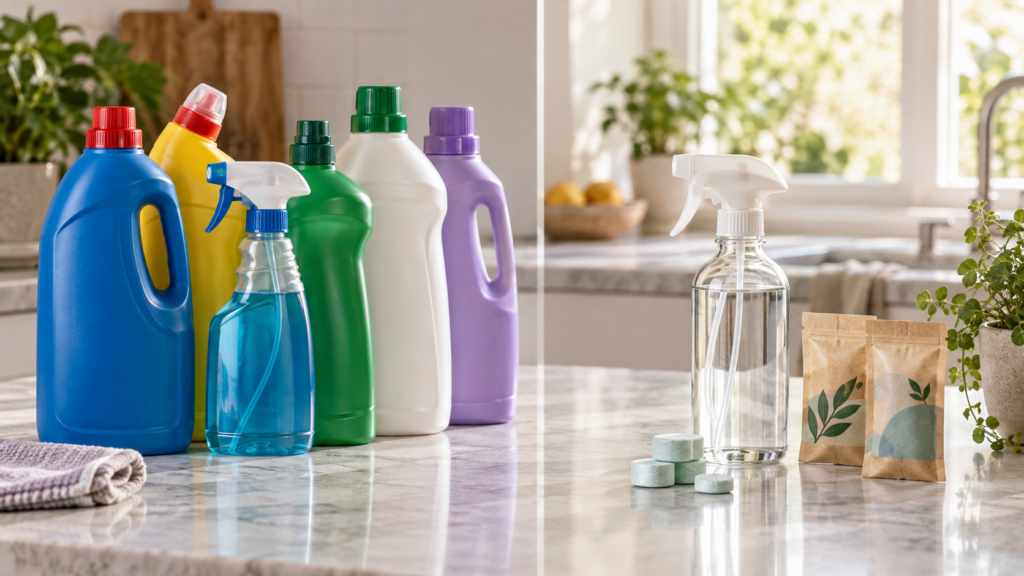
Recycling matters.
But recycling should not automatically be our first solution to everything.
The familiar phrase is:
Reduce. Reuse. Recycle.
That order matters.
The US EPA’s waste-management hierarchy prioritises source reduction and reuse ahead of recycling.
Why?
Because recycling still requires a system.
The material has to be:
collected,
transported,
sorted,
cleaned,
processed,
and converted into usable material again.
And simply placing something in a recycling bin doesn’t guarantee that it will actually become another product.
The global numbers show how significant this problem remains.
According to the OECD’s Global Plastics Outlook, approximately 353 million tonnes of plastic waste were generated globally in 2019. Only about 9% was ultimately recycled, while nearly half went to sanitary landfill and another significant portion was incinerated or mismanaged.
That’s a strong reason to think beyond:
“Can this be recycled?”
and ask:
“Did this need to become waste yet?”
Those are two very different questions.
Spray Bottles Are More Complicated Than They Look
A normal plastic bottle can already present recycling challenges depending on its material and the recycling infrastructure available locally.
But spray bottles can become even more complicated because the trigger mechanism may contain multiple materials.
Look closely at a spray head.
It isn’t necessarily one simple piece of plastic.
It can contain:
plastic components,
small internal mechanisms,
different polymer types,
and sometimes metal components such as springs.
Multi-material items can be more difficult for recycling systems than clean, single-material packaging.
The EPA specifically notes that plastic recycling acceptance varies between local systems and that even having a resin-identification code does not guarantee that an item is recyclable in your area.
So the popular assumption—
“I’ll just throw it in recycling, problem solved”
—isn’t always accurate.
Different cities and recycling facilities have different capabilities.
The better instruction is always:
Check your local recycling rules.
But there’s another possibility.
If the bottle and trigger are still functioning…
don’t recycle them yet either.
Reuse them.
Recycling a Perfectly Usable Bottle Is Still Replacing a Perfectly Usable Bottle
This is the part we don’t talk about enough.
Suppose your cleaner finishes today.
Your bottle works perfectly.
You put it into recycling.
Congratulations—you disposed of it more responsibly than throwing it into general waste.
But tomorrow you purchase another cleaner.
Which comes inside…
another bottle.
You’ve still replaced something that was functioning.
Recycling can help deal with waste once it exists.
Reuse can help delay the point at which the object becomes waste at all.
That is why a refill model can be so interesting.
The best bottle isn’t necessarily the bottle that gets recycled quickly.
It may be the bottle you don’t need to replace for a long time.
Enter Cleaning Tablets
Cleaning tablets rethink what exactly needs to be purchased again.
Instead of repeatedly purchasing a container full of prepared liquid, you purchase a concentrated refill.
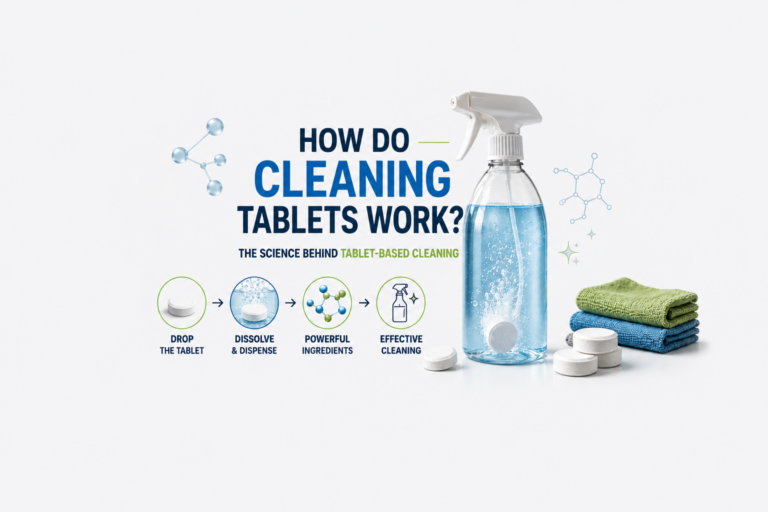
The general routine can be remarkably simple:
1. Keep the bottle
Use a suitable reusable bottle designed or recommended for the cleaning formulation.
2. Add the recommended amount of water
Follow the manufacturer’s instructions rather than guessing the dilution.
3. Add the cleaning tablet
Drop in the tablet according to the preparation instructions.
4. Allow it to dissolve
Different formulations can have different dissolution times.
5. Use the cleaner
Once prepared correctly, use the solution for its intended cleaning task.
When the solution eventually runs out?
The bottle doesn’t automatically go into the bin.
You prepare the next refill.
If you want the detailed version, read our guide on How to Use Cleaning Tablets: A Simple Step-by-Step Guide. The basic idea is straightforward: bottle, water, tablet, dissolve and use.
One Bottle. Many Refills.
Now the maths becomes interesting.
Imagine two cleaning routines.
Routine A: Replace the complete bottle
Every time your surface cleaner finishes, you purchase another full spray bottle.
If you finish six bottles in a year, that’s potentially six separate containers entering your household.
Repeat the routine for several years and the packaging adds up.
Routine B: Refill the existing bottle
You start with a suitable reusable bottle.
Cleaner finishes.
Bottle stays.
You prepare another refill.
Cleaner finishes.
Bottle stays again.
You prepare another refill.
Instead of the bottle being the recurring purchase, the cleaning formulation becomes the recurring purchase.
That is the structural change.
And it seems obvious once you see it.
The durable part remains durable.
The consumable part remains consumable.
This Is Bigger Than “Eco-Friendly”
Sustainability marketing sometimes makes environmentally conscious products sound like a lifestyle sacrifice.
Use something less convenient.
Accept worse performance.
Follow ten new steps.
Feel guilty if you forget.
That’s not particularly compelling.
A better system should make sense even before environmental benefits enter the conversation.
Reusable cleaning formats can offer a few very practical advantages.
Less bulky storage
A stack of full cleaning bottles occupies considerable cupboard space.
Concentrated refills can be significantly more compact.
Fewer bottles entering the home
Instead of continually bringing home another spray bottle, the same compatible bottle can potentially be reused.
Simpler replenishment
You replace the part that has actually run out: the formulation.
Less packaging turnover
The durable container stays in use instead of becoming waste simply because its contents are finished.
That isn’t environmentalism built around guilt.
It is simply more efficient product design.
And Then There’s Transportation
Consider a conventional bottle of ready-to-use cleaner.
A significant portion of the product’s physical volume is liquid.
Liquid has weight.
Weight and volume matter in transportation.
More liquid means larger, heavier products moving through:
factories,
distribution centres,
trucks,
warehouses,
retail shelves,
and delivery networks.
Concentrated formats approach the problem differently.
Instead of transporting the complete prepared cleaning solution every time, the consumer adds the required water at the point of use where the product is designed for this method.
This doesn’t make transport impact disappear.
The tablets still need ingredients.
They still need manufacturing.
They still need packaging.
They still need delivery.
But the format changes what is being transported.
That’s important.
Good sustainability conversations should compare complete systems rather than pretending any physical product has zero impact.
“Zero Waste” Sounds Great. Reality Needs More Nuance.
Here’s where brands—including sustainable brands—need to be careful.
It is tempting to say:
Zero waste.
Zero environmental impact.
Zero landfill.
Those phrases sound great.
But most physical products create some environmental impact somewhere in their lifecycle.
Cleaning tablets still require ingredients.
Refills still require protective packaging.
Reusable bottles need to be manufactured.
Products need to be transported.
And eventually even a reusable bottle may reach the end of its useful life.
So rather than claiming perfection, a more useful question is:
Can we use substantially less unnecessary material and keep durable products in circulation for longer?
That’s the direction that matters.
Sustainability isn’t always about reaching literal zero.
Often, it is about designing away obvious waste.
The Best Packaging Might Be Packaging You Already Own
Packaging innovation usually looks futuristic.
New polymers.
New materials.
New recycling technology.
New biodegradable compounds.
New container designs.
Some of those innovations may be valuable.
But one of the simplest packaging innovations is barely an innovation at all:
Use the container again.
We already do this naturally with many objects.
Water bottles.
Lunch boxes.
Storage containers.
Coffee mugs.
Soap dispensers.
Why should cleaning bottles automatically be different?
Sometimes the smartest packaging breakthrough isn’t inventing a revolutionary new bottle.
It is giving the existing bottle another job tomorrow.
And another next month.
And another after that.
What Makes a Good Reusable Cleaning Bottle?
Not every old container should automatically be reused for every cleaning formulation.
Safety and product compatibility matter.
A refill system should ideally be designed around a bottle suitable for repeated use with the specific formulation.
Important considerations include:
Durability:
Can the bottle withstand repeated normal use?
Compatibility:
Is the bottle material suitable for the cleaning formulation?
Useful trigger design:
Does the spray mechanism deliver the product properly?
Easy cleaning:
Can the container be rinsed or cleaned according to the manufacturer’s instructions?
Clear identification:
Can users easily tell what product is inside?
Never put household cleaning products into drink containers or other packaging that could create confusion.
And don’t mix different cleaning products simply because they use the same bottle shape.
A reusable system only works when reuse is done correctly.
Refill Doesn’t Mean “Make Up Your Own Chemistry”
Another important distinction.
Cleaning tablets aren’t an invitation to start experimenting.
One tablet + half the water doesn’t automatically create “double strength.”
Two tablets don’t automatically clean twice as well.
Hot water isn’t automatically better.
Mixing two different cleaners isn’t a clever cleaning hack.
A cleaning tablet is a formulated product designed around specific preparation instructions.
Use the recommended amount of water.
Use the intended bottle.
Use the correct tablet.
Follow the dissolution instructions.
Use the product only on suitable surfaces.
Our step-by-step guide explains why the tablet-to-water ratio matters: changing the amount of water changes the concentration of the final cleaning solution.
The goal is convenient refilling—not kitchen chemistry.
The Real Upgrade Is Changing What We Consider Disposable
For decades, the packaging itself became psychologically connected to the product.
Surface cleaner = spray bottle.
Bathroom cleaner = another bottle.
Glass cleaner = another bottle.
When the liquid disappeared, we mentally classified the entire object as “finished.”
But it wasn’t finished.
The contents were finished.
That’s the behaviour refill systems challenge.
Instead of asking:
“Do I need another bottle of cleaner?”
you ask:
“Do I need another refill for my bottle?”
Small difference in language.
Big difference in product design.
What Would Happen If Refill Became Normal?
Imagine a cleaning aisle designed around reuse.
Instead of enormous rows of mostly ready-to-use bottles, you might see:
durable starter bottles,
compact concentrated refills,
clearly labelled formulations,
and simple preparation instructions.
Your cleaning cupboard might contain several bottles—but those bottles stay there for years rather than constantly rotating in and out.
Buying another cleaner wouldn’t necessarily mean buying another container.
“Refill” would become the default behaviour.
“Replace the bottle” would happen only when the bottle was actually worn out or damaged.
That is what circular thinking can look like at household scale.
Not futuristic.
Not complicated.
Just:
Use durable things like durable things.
But Does One Household Really Matter?
One bottle can feel insignificant.
That’s understandable.
Global plastic waste is measured in hundreds of millions of tonnes.
What difference does one kitchen cleaner make?
But household consumption happens at scale.
One family.
One apartment building.
One neighbourhood.
One city.
Millions of homes.
One unnecessary replacement doesn’t look dramatic.
Repeated billions of times, everyday habits become industries.
The OECD reported that global plastic waste more than doubled from 156 million tonnes in 2000 to 353 million tonnes in 2019.
The plastic problem wasn’t created by one spectacular decision.
It developed through enormous numbers of ordinary products moving through ordinary routines.
That also means ordinary routines are a reasonable place to rethink the system.
Durability Should Be an Advantage, Not a Problem
Plastic’s durability is often discussed exclusively as an environmental weakness.
And once plastic becomes waste, that durability absolutely can become a problem.
But before disposal?
Durability can be useful.
If something can last, let it last.
A reusable plastic bottle used repeatedly is serving a very different role from an identical bottle treated as disposable packaging.
The material hasn’t changed.
The relationship with the material has.
That distinction matters.
The goal shouldn’t simply be:
Plastic disappears faster.
Another useful goal is:
Useful plastic becomes waste slower.
Keep the Bottle. Replace What Actually Ran Out.
That’s really the entire argument.
A spray bottle can be a durable object.
The cleaning solution inside it is consumable.
Treating both as equally disposable doesn’t make much sense.
The conventional model says:
Bottle + cleaner → use → dispose → replace everything.
The refill model says:
Bottle + cleaner → use → keep bottle → replace cleaner.
Nothing revolutionary happened.
We simply stopped throwing away the durable part.
And that may be exactly the point.
The Sensible Way to Think About Cleaning
At The Sensible, we’re interested in a straightforward question:
Can everyday cleaning be designed with less unnecessary stuff?
Not by making cleaning complicated.
Not by asking people to become chemistry experts.
Not by pretending a physical product can have absolutely zero environmental impact.
Just by looking at familiar habits and asking whether they still make sense.
A plastic bottle can remain around for an extraordinarily long time.
So perhaps we shouldn’t design its useful life around how quickly someone finishes 500 ml of cleaner.
Perhaps the bottle gets to stay.
The formulation gets replaced.
The routine continues.
Keep the bottle. Refill the cleaner. Repeat.
Because when a material can last for years, treating it like a disposable wrapper was never particularly sensible in the first place.
Frequently Asked Questions
How long does a plastic bottle take to decompose?
There isn’t one exact decomposition time for every plastic product because different polymers and environmental conditions behave differently. UNEP has cited estimates suggesting that a plastic bottle can take up to around 450 years to decompose. Plastic can also fragment into progressively smaller particles rather than simply disappearing.
Are plastic spray bottles recyclable?
It depends on the bottle, trigger mechanism and your local recycling system. Different plastic types and multi-material components can affect recyclability. A recycling symbol or resin identification number does not guarantee that your local facility accepts the item, so check local guidelines.
Why reuse a spray bottle instead of recycling it?
Reuse can extend the useful life of an existing product before recycling becomes necessary. Waste-management frameworks such as the EPA hierarchy prioritise reduction and reuse ahead of recycling.
What are cleaning tablets?
Cleaning tablets are concentrated cleaning formulations that are prepared with a specified amount of water to create a finished cleaning solution. Depending on the system, this can allow the same suitable bottle to be reused across multiple refills.
How do cleaning tablets reduce the need for new bottles?
Instead of purchasing a new ready-to-use bottle each time the cleaner finishes, a compatible tablet-based system allows the user to prepare another batch in a reusable bottle.
Can I reuse any old spray bottle with cleaning tablets?
Not automatically. Use a bottle suitable for the specific product and follow the manufacturer’s instructions. Bottle material, size and trigger compatibility can matter.
Is using cleaning tablets completely zero waste?
No physical product should automatically be assumed to create zero waste or zero environmental impact. Tablets still require ingredients, manufacturing, packaging and transportation. The potential advantage is reducing unnecessary packaging turnover and extending the useful life of compatible bottles.
Are cleaning tablets difficult to use?
Generally, the routine is simple: use the correct bottle, add the recommended amount of water, add the tablet, allow it to dissolve, and use the solution according to the manufacturer’s instructions. Your existing cleaning-tablet guide covers this process step by step.
What’s the simplest rule to remember?
Don’t replace a perfectly useful bottle just because the cleaner inside it has run out.
Keep the durable part.
Refill the consumable part.
That’s the forever-bottle mindset.

3 Comments