Are Cleaning Tablets Effective? What to Consider Before Switching
If you’ve been reading about cleaning tablets, you’ve probably reached the question that matters most.
Are cleaning tablets effective?
It’s a reasonable question.
A traditional cleaning product arrives as a bottle of ready-to-use liquid. You spray it, wipe the surface and move on.
A cleaning tablet looks very different.
It’s small, solid and concentrated. You add water, wait for it to dissolve and then use the resulting cleaning solution.
So it’s natural to wonder:
Can something that starts as a tiny tablet really clean as well as a bottle of liquid cleaner?
The answer is:
A cleaning tablet can be effective, but the tablet format itself does not determine cleaning performance.
What matters is the formulation, dilution, intended cleaning task, surface, type of soil and how the product is used.
That distinction is important.
In our first article, What Are Cleaning Tablets? A Beginner’s Guide, we explained that cleaning tablets are concentrated cleaning products designed to be dissolved in water to create a cleaning solution.
Then, in How Do Cleaning Tablets Work?, we looked at what happens when the tablet meets water and how its ingredients become part of the finished solution.
And in How to Use Cleaning Tablets: A Simple Step-by-Step Guide, we covered the practical side — choosing the right bottle, adding the correct amount of water, allowing the tablet to dissolve and using the finished solution correctly.
Now we’re ready for the next question:
Does the finished solution actually do a good job of cleaning?
Let’s look at what really determines cleaning effectiveness.
What Does “Effective” Mean in Cleaning?
Before we decide whether cleaning tablets are effective, we need to define what effective actually means.
A cleaning product isn’t necessarily effective because it can remove every possible type of dirt from every possible surface.
Different cleaning products are designed for different jobs.
Think about the difference between:
- Dust on a table
- Fingerprints on glass
- Food residue on a kitchen counter
- Grease around a stovetop
- Soap residue in a bathroom
- Mineral deposits caused by hard water
These are different cleaning challenges.
A product designed for everyday surface cleaning may perform very well at its intended job without being designed to tackle heavy grease or mineral buildup.
So instead of asking:
Are cleaning tablets effective?
the better question is:
Are cleaning tablets effective for the cleaning jobs they are designed to handle?
That’s a much more useful way to evaluate them.
What Actually Makes a Cleaning Product Effective?
Cleaning performance isn’t usually the result of one magic ingredient.
It comes from the interaction between the formulation and the way the product is used.
The EPA describes cleaning ingredients according to their functions: for example, surfactants can help reduce surface tension and aid cleaning, solvents can help dissolve or suspend materials, and chelating agents can help manage water hardness.
In simple terms, a cleaning product may need to do several things:
- Reach the soil
- Interact with it
- Loosen or suspend it
- Allow it to be removed
- Leave the surface in the intended condition
And the physical action of wiping, scrubbing or mopping is also part of the process.
This is why the tablet itself isn’t the whole story.
The tablet is the delivery format.
The formulation inside it is what ultimately becomes the cleaning solution.
1. The Formulation Matters More Than the Shape
This is probably the most important thing to understand about cleaning tablets.
A tablet is simply a physical format.
You can have two tablets that look almost identical but are designed for completely different cleaning tasks.
One might be intended for glass.
Another might be designed for kitchen surfaces.
Another could be formulated for bathrooms.
The fact that all three are tablets tells you very little about their cleaning performance.
What matters is what’s in the formulation and what the product has been designed to do.
This is the same reason you shouldn’t compare a glass cleaner and a kitchen degreaser simply because both happen to be liquids.
Format tells you how the product is delivered. Formulation tells you what it is designed to do.
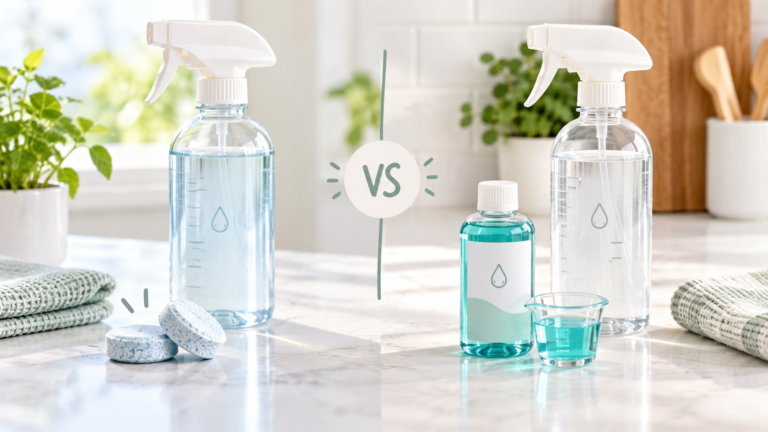
That’s the distinction we explored in Cleaning Tablets vs Liquid Cleaners: What’s the Difference?.
2. The Type of Dirt Matters
Not all dirt behaves in the same way.
A light layer of dust can often be removed relatively easily.
Oily fingerprints are different.
Grease is different again.
And mineral deposits from hard water may require a completely different approach.
This means a cleaning tablet should be judged against the type of soil it is intended to clean.
For example:
Everyday dust and residue
A general-purpose cleaner may be designed for routine surface cleaning.
Fingerprints and light oils
The formulation may need to interact effectively with oily residues.
Kitchen grease
A product intended for kitchen cleaning may be formulated with the types of ingredients appropriate for oily and food-related residues.
Bathroom buildup
Bathroom cleaning can involve soap residue, body oils and mineral deposits, depending on the surface and location.
So if a tablet is marketed for everyday multi-surface cleaning, don’t assume that means it is a specialist heavy-duty degreaser.
Versatility does not mean universal suitability.
3. The Surface Matters
The same cleaning product shouldn’t automatically be used on every material.
Glass, stainless steel, ceramic, finished wood, stone, laminate and plastic can all have different cleaning requirements.
This is why surface compatibility matters when evaluating a cleaning product.
A product can be effective at removing a particular type of soil and still be unsuitable for a particular surface.
The EPA similarly advises consumers to check product labels for compatible and incompatible surfaces and to follow product directions.
So before you decide that a cleaning tablet is “good” or “bad,” ask:
Was it actually intended for this surface?
That’s a much fairer test.
4. Dilution Can Make a Big Difference
This is particularly important with cleaning tablets.
The tablet is designed to be prepared with a specified amount of water.
That means the tablet-to-water ratio matters.
Imagine a tablet designed to produce a particular volume of cleaning solution.
If you add considerably more water, you change the concentration.
If you add considerably less, you also change the concentration.
That doesn’t mean:
Less water = better cleaning.
The product is formulated around its intended dilution.
This is why our [How to Use Cleaning Tablets] guide stresses following the recommended amount of water.
The EPA also emphasizes using products at the correct dilution where dilution is specified.
Consistency matters.
If you want to judge how effective a cleaning tablet is, prepare it exactly as instructed.
5. Correct Use Matters
Even a well-formulated cleaning product can give disappointing results if it’s used incorrectly.
For cleaning tablets, common problems can include:
- Using too much water
- Using too little water
- Not allowing the tablet to dissolve properly
- Using the wrong tablet for the task
- Using the solution on an unsuitable surface
- Applying too little product
- Using the wrong cleaning tool
- Ignoring product instructions
This is why we wrote Blog #3.
If you haven’t read it yet, [How to Use Cleaning Tablets: A Simple Step-by-Step Guide] walks through the preparation process in detail.
The EPA similarly recommends reading and following product directions, including application method, dilution and other instructions.
A product should be judged under the conditions for which it was designed.
6. Contact Time Can Matter
For ordinary household cleaning, you may simply apply a cleaner and wipe.
But some cleaning products have specific contact-time requirements, particularly products making sanitizing or disinfecting claims.
Contact time refers to how long a product needs to remain on the surface under the specified conditions.
If a product’s instructions specify a contact time, follow it.
Don’t assume that immediately wiping the product away produces the same result.
For EPA-registered disinfectants, the label provides the directions for use, including where the product can be used, how it should be applied and how long it needs to remain on the surface.
This also highlights an important distinction:
Cleaning is not the same as disinfecting.
A product designed for everyday cleaning should not automatically be described as a disinfectant.
Don’t confuse those claims.
7. Physical Action Is Part of Cleaning
Here’s something people sometimes forget when evaluating cleaning products.
The cleaner doesn’t do all the work.
Imagine spraying a cleaning solution onto a dirty kitchen counter.
The chemistry interacts with the soil.
Then your cloth physically removes the loosened material.
The same principle applies when you mop a floor or wipe a bathroom surface.
So cleaning performance is influenced by both:
Chemistry + Physical action
That’s why the type and condition of your cleaning tool can matter.
A dirty cloth, unsuitable sponge or inadequate wiping technique can affect the result.
This is another reason why a fair comparison should involve the same basic cleaning method whenever you’re comparing two products.
Does More Fizz Mean Better Cleaning?
This is one of the easiest mistakes to make with cleaning tablets.
Drop a tablet into water.
It fizzes.
It bubbles.
The water moves.
It looks active.
So you might naturally think:
More fizz means more cleaning power.
But that’s not a reliable conclusion.
As we explained in [How Do Cleaning Tablets Work?], some formulations can produce visible bubbling or fizzing when they interact with water, but the amount of visible fizz does not tell you how effective the final cleaning solution will be.
A dramatic-looking tablet isn’t necessarily a better cleaner.
And a tablet that dissolves relatively quietly isn’t necessarily a weak one.
Judge the cleaning result, not the show in the bottle.
Are Cleaning Tablets as Effective as Liquid Cleaners?
This is probably the question you were really asking.
And the honest answer is:
The format alone doesn’t tell you.
A liquid cleaner can be highly effective.
A cleaning tablet can also be highly effective.
A poorly formulated liquid cleaner can perform poorly.
A poorly formulated tablet can perform poorly.
The important comparison is the formulation and intended use, not whether the starting product was a solid or liquid.
This follows directly from the distinction we made in Blog #4.
With a conventional ready-to-use cleaner, the manufacturer prepares the final liquid before you buy it.
With a tablet, you complete the preparation by adding water at home.
The delivery format changes.
The underlying cleaning purpose does not necessarily change.
So if you’re comparing a tablet with a liquid cleaner, compare:
Tablet formulation vs liquid formulation
rather than:
Tablet vs liquid
Can Cleaning Tablets Handle Everyday Cleaning?
For products designed for everyday household cleaning, this is where the format can be particularly relevant.
Consider the cleaning tasks most households perform regularly:
- Wiping tables
- Cleaning counters
- Removing fingerprints
- Cleaning bathroom surfaces
- Cleaning glass and mirrors
- Wiping appliances
- Mopping floors
- Removing everyday dust and residue
These aren’t necessarily extreme cleaning challenges.
They’re routine tasks.
A cleaning tablet formulated for a particular everyday application can be evaluated based on how well it performs that job.
The key word is particular.
A glass-cleaning tablet should be judged on glass.
A bathroom cleaner should be judged on bathroom surfaces for which it is intended.
A multi-surface cleaner should be judged against the surfaces and soils it claims to handle.
What About Heavy-Duty Cleaning?
This is where expectations matter.
Don’t assume that every cleaning tablet is a heavy-duty cleaner.
A concentrated format doesn’t automatically mean a product is designed for the toughest cleaning jobs.
Heavy grease, baked-on food, hard-water deposits and other stubborn soils may require formulations specifically designed for those challenges.
So before buying a cleaning tablet, ask:
What is it actually designed to clean?
If the answer is everyday household surfaces, judge it on those surfaces.
If you need specialist cleaning performance, look for a product specifically formulated for that task.
How to Test Whether a Cleaning Tablet Works for You
If you’re considering switching, you don’t need to make the decision based on marketing claims alone.
You can evaluate the product against your actual cleaning routine.
Choose one everyday task.
For example:
Cleaning a kitchen counter.
Then:
- Prepare the cleaning solution exactly according to the instructions.
- Use a suitable surface.
- Use the recommended amount of solution.
- Use the same type of cleaning cloth you normally use.
- Clean the surface in your normal way.
- Look at the result.
Ask yourself:
- Did the dirt come away easily?
- Was there visible residue?
- Was the surface left looking clean?
- Did the product leave unwanted streaks?
- How much effort did you need?
- Was the preparation process acceptable?
- Would you use it again?
That’s a much more useful test than judging a tablet by how impressive it looks while dissolving.
What Should You Check Before Buying Cleaning Tablets?
If you’re considering making the switch, here’s the checklist I’d use.
1. What cleaning job is it designed for?
Look for a clear intended use.
Multi-surface?
Glass?
Kitchen?
Bathroom?
Floor?
Choose according to what you actually need.
2. What is the recommended dilution?
Find out how much water is required to prepare the finished solution.
This also helps you compare products more fairly.
3. What surfaces are compatible?
Check the manufacturer’s instructions.
Don’t assume that “multi-surface” means every surface in your home.
4. What does the product actually claim?
Be careful with vague marketing language.
There’s a difference between:
cleans
sanitizes
disinfects
deodorizes
These claims don’t all mean the same thing.
If a product makes a disinfecting claim, look for the appropriate regulatory information and follow its label directions. EPA-registered disinfectants, for example, have specific approved directions and claims on their labels.
5. How should the tablets be stored?
Because moisture can affect some tablet formulations, storage instructions matter.
Look for clear guidance on keeping the tablets dry and protected.
6. How long does the prepared solution last?
Don’t assume that a tablet dissolved in water has the same storage life as the original dry tablet.
Check the manufacturer’s instructions for the finished solution.
7. Is the formulation transparent?
If ingredient information is available, look at it.
Different ingredients serve different functions in cleaning formulations. EPA’s Safer Choice program, for example, evaluates ingredients according to their functional roles and health/environmental characteristics rather than simply judging a product by its format.
What About Environmental Claims?
This is another area where it’s worth looking beyond the marketing headline.
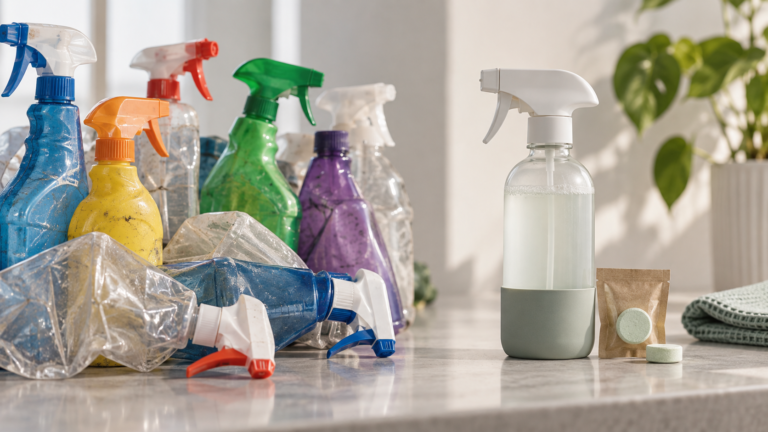
A tablet-based system can have potential packaging and transportation advantages because the concentrated product is separated from the water until preparation.
A refill system can also allow the same bottle to be reused.
But that doesn’t mean:
Every cleaning tablet is automatically environmentally better.
The overall system matters.
Consider:
- The tablet packaging
- The bottle
- How many times the bottle is reused
- The formulation
- Manufacturing
- Transport
- Disposal
EPA’s greener-product guidance specifically identifies concentrated formulas, efficient packaging, refillable bottles and clear use/disposal information among characteristics that can contribute to more environmentally considerate cleaning-product design.
So the sensible approach is to look at the whole product system, not just the word “tablet.”
Does “Concentrated” Mean Better?
Not automatically.
Concentrated simply describes the format or strength before dilution.
Once you add the recommended amount of water, the product becomes the intended cleaning solution.
Using less water doesn’t automatically make it better.
Using two tablets instead of one doesn’t automatically make it better.
In fact, changing the recommended dilution means you’re no longer necessarily using the formulation as designed.
This is why correct dilution is one of the simplest factors you can control.
Can Cleaning Tablets Lose Their Effectiveness?
They can be affected by poor storage, depending on the formulation.
Remember what we learned in Blog #2:
Water activates the dissolution process.
That’s useful when you’re preparing the product.
But unwanted moisture during storage can be a problem for some tablet formulations.
Humidity or inappropriate storage conditions can affect the physical characteristics of tablets before use.
So if the manufacturer says to keep the tablets dry or in their original packaging, follow those instructions.
This also leads naturally into one of our upcoming articles:
[How Long Do Cleaning Tablets Last? Understanding Usage and Storage]
We’ll look at usage patterns, storage conditions and how to plan your supply.
What About Water Quality?
Water itself can vary.
Depending on where you live, your household water may contain different levels of dissolved minerals.
This can affect some cleaning formulations and cleaning tasks.
Hard water can be particularly relevant for bathroom cleaning because mineral deposits can build up on surfaces.
That’s one reason a cleaning product designed for everyday surface cleaning shouldn’t automatically be expected to remove every type of mineral buildup.
It’s also one of the reasons we’re going to explore hard-water cleaning separately later in THE SENSIBLE’s content series.
Should You Switch to Cleaning Tablets?
Now we can return to the original question.
Are cleaning tablets effective?
They can be.
But the answer depends on the specific product and the job you’re asking it to do.
If you’re considering switching, don’t ask only:
“Is this a tablet?”
Ask:
What is the formulation designed to do?
Then ask:
- Is it suitable for my surfaces?
- Is it designed for the dirt I normally clean?
- Is the dilution straightforward?
- Can I prepare it correctly?
- Is the bottle system practical?
- Are the storage instructions manageable?
- Does it fit my cleaning routine?
- Does it deliver the result I expect?
Those questions will tell you much more than the product format alone.
The Biggest Lesson: Don’t Judge a Cleaner by Its Format
A bottle doesn’t guarantee effectiveness.
A tablet doesn’t guarantee effectiveness either.
The shape of the product is only one part of the story.
What matters is the complete system:
Formulation → Dilution → Surface → Soil → Contact/Application → Physical Cleaning
Get those factors right, and the cleaning format becomes much less important than it first appears.
This is why our previous article, [Cleaning Tablets vs Liquid Cleaners: What’s the Difference?], focused on separating the format from the formulation.
The tablet is simply another way of delivering cleaning chemistry.
So, Are Cleaning Tablets Worth Trying?
If you regularly perform everyday household cleaning and like the idea of a concentrated, refill-oriented format, cleaning tablets may be worth trying.
But don’t switch simply because someone tells you that tablets are automatically better.
Try them for the jobs they are designed for.
Follow the preparation instructions.
Use the correct dilution.
Use them on compatible surfaces.
Then judge the results based on your own cleaning routine.
That’s the sensible way to evaluate any cleaning product.
Final Takeaway
So, are cleaning tablets effective?
They can be.
But there is no magic in the tablet shape itself.
Cleaning performance depends on the formulation, dilution, surface compatibility, type of soil and correct use.
A well-designed cleaning tablet can produce a useful cleaning solution when prepared and used as intended.
A poorly suited tablet won’t suddenly become effective simply because it is concentrated.
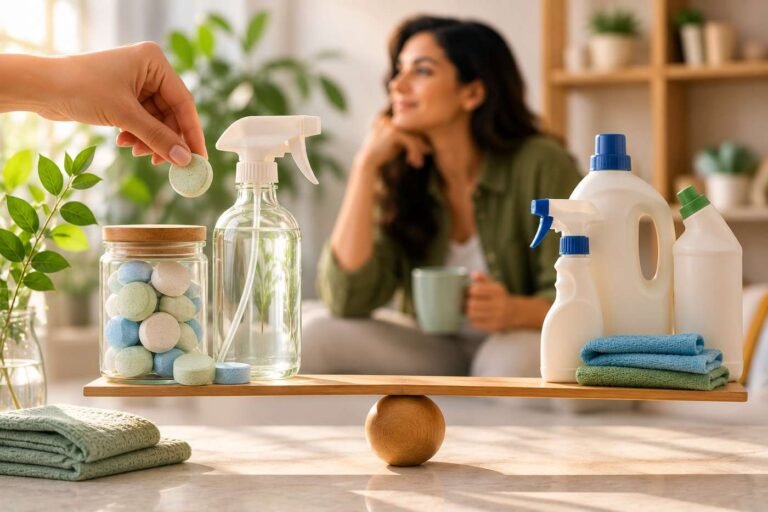
And a liquid cleaner isn’t automatically better just because it comes ready to use.
The real comparison is:
Product formulation + intended use + correct application
not:
Tablet vs liquid.
If you’re thinking about switching, start with the cleaning jobs you perform most often.
Choose a product designed for those jobs.
Follow its instructions.
And judge it by the results.
That’s a much more sensible way to decide whether cleaning tablets belong in your home.
And if you’ve decided the performance makes sense, there’s one more question worth asking:
Are Cleaning Tablets Worth It? A Practical Buyer’s Guide
That’s where we’ll look beyond performance and examine the cost, convenience, storage, usage frequency and overall value of switching.
Frequently Asked Questions
1. Are cleaning tablets effective?
They can be effective when the formulation is appropriate for the cleaning task and the product is prepared and used according to its instructions. Performance depends on factors such as formulation, dilution, surface compatibility, the type of soil and cleaning technique.
2. Do cleaning tablets work as well as liquid cleaners?
The format alone doesn’t determine cleaning performance. A well-formulated tablet can produce an effective cleaning solution for its intended use, just as a well-formulated liquid cleaner can.
3. Does more fizz mean a cleaning tablet works better?
No. Visible fizzing is not a reliable measure of cleaning performance. What matters more is the formulation, concentration, intended use and correct application.
4. What makes a cleaning tablet effective?
The formulation, correct dilution, suitable surface, appropriate cleaning task and correct use all contribute to cleaning performance.
5. Can cleaning tablets remove grease?
It depends on the formulation. A tablet designed specifically for kitchen cleaning may be more appropriate for oily residues than a product intended for general surface cleaning.
6. Can cleaning tablets remove hard-water stains?
Not necessarily. Hard-water deposits may require a product specifically formulated for mineral buildup. Check the intended use before relying on a general-purpose tablet for this type of cleaning.
7. Can I use cleaning tablets on every surface?
No. Surface compatibility depends on the specific formulation. Always check the manufacturer’s instructions before using a cleaning solution on a particular material.
8. Does using less water make a cleaning tablet stronger?
It changes the concentration, but that doesn’t mean the resulting solution will clean better. Follow the recommended dilution.
9. Can I add two tablets for stronger cleaning?
Don’t assume that more product means better cleaning. Follow the manufacturer’s recommended tablet quantity and dilution.
10. Can cleaning tablets disinfect surfaces?
Only products specifically formulated, tested and appropriately labelled for disinfection should be relied upon for disinfecting claims. Don’t assume that a general cleaning tablet is a disinfectant. EPA-registered disinfectants have specific label directions and approved claims.
11. How should cleaning tablets be stored?
Follow the manufacturer’s instructions. In general, tablets intended to dissolve in water should be protected from unwanted moisture and stored appropriately.
12. Should I switch from liquid cleaners to cleaning tablets?
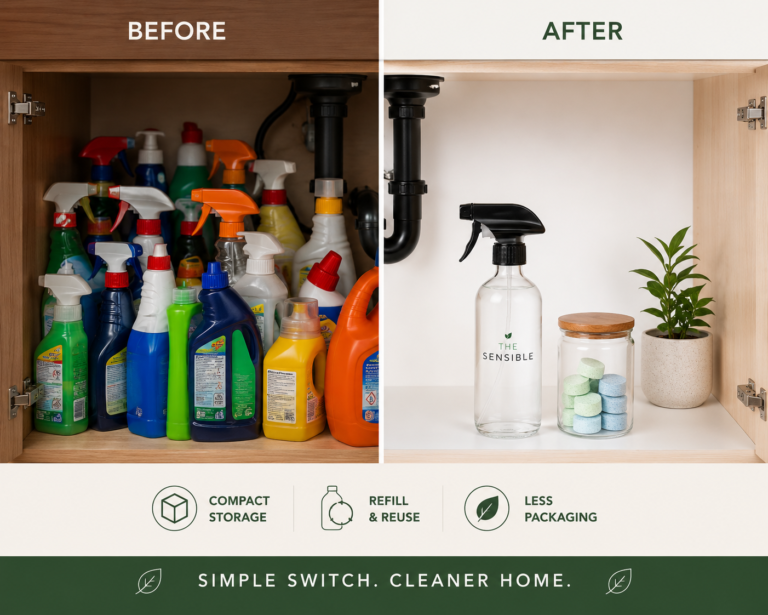
It depends on your cleaning needs and priorities. Tablets may appeal to people who prefer concentrated products, compact storage and refill-oriented systems, while ready-to-use liquid cleaners may suit people who prioritize immediate convenience.
Follow THE SENSIBLE
Want practical guides on cleaning science, smarter household routines and tablet-based cleaning?
Follow us:
▶️ YouTube

One Comment