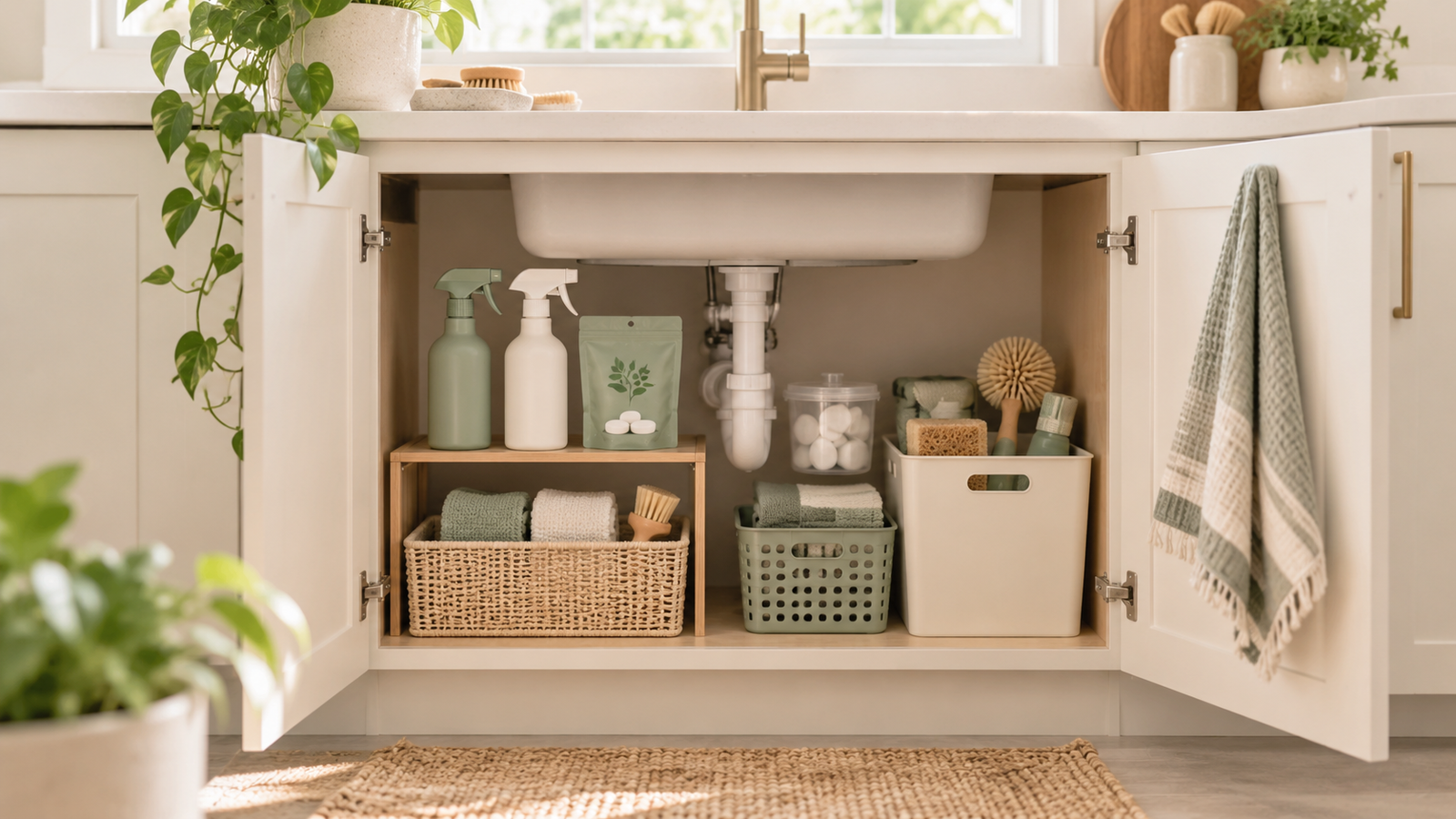
The Minimalist Under-Sink Standard: What Actually Deserves a Place in Your Cleaning Cabinet?
Open the cabinet under your sink.
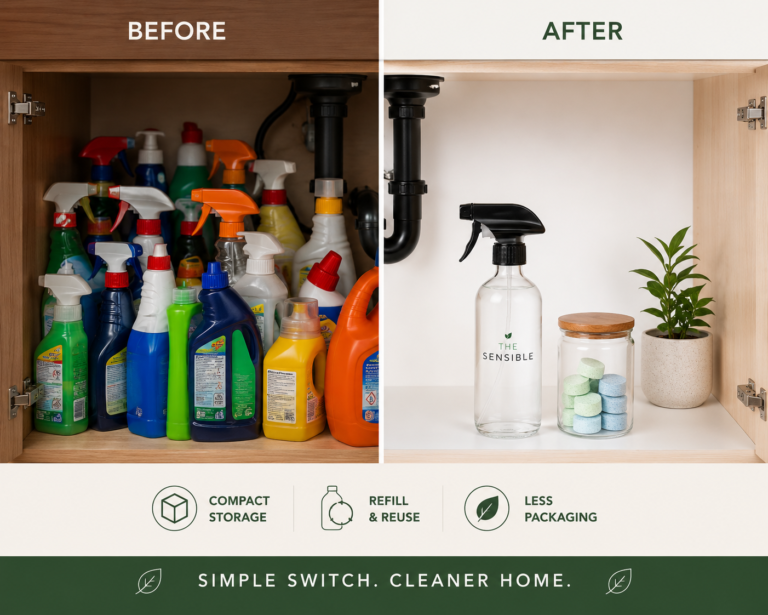
Now look at under sink organization,
Not with the quick glance you give it while grabbing a spray bottle.
Actually look.
How many products are in there?
A glass cleaner. A kitchen cleaner. A bathroom spray. A floor cleaner. A stainless-steel polish. A disinfectant. A drain product. A half-empty bottle you forgot about. A duplicate cleaner you bought because you couldn’t find the first one. Maybe a few mystery products pushed to the back.
For a space that is supposed to help us clean, the under-sink cabinet often becomes one of the messiest places in the house.
And the problem usually isn’t that we need more storage.
It is that we have too many products doing too many overlapping jobs.
That is where the idea of The Minimalist Under-Sink Standard comes in.
The goal is not to make your cabinet look like a magazine photo.
It is not about replacing everything with matching beige bottles.
And it is definitely not about throwing away useful products just to own fewer things.
The idea is simpler:
Every product under your sink should have a clear purpose.
If it does not, it probably does not deserve the space.
A minimalist under-sink setup should help you clean faster, buy more intentionally, store products more safely, and avoid unnecessary duplicates.
The best cleaning cabinet is not the one with the most products.
It is the one where every product earns its place.
What Is the Minimalist Under-Sink Standard?
The Minimalist Under-Sink Standard is a simple rule for cleaning storage:
Keep only the products, tools, and refills you actually use and understand.
That means your cabinet should contain:
- A small number of versatile everyday cleaners
- Specialised products only where they are genuinely needed
- A few reliable cleaning tools
- Compact refills where possible
- Clearly stored backups
- No unnecessary duplicates
- No mystery bottles
- No products kept “just in case” for years
Minimalism in cleaning is not about chasing the smallest possible number.
It is about eliminating overlap.
If five bottles can reasonably become two, simplify.
If one product has a unique job, keep it.
If a product has not been touched in two years and you forgot what it is for, that is a different story.
The standard is functional, not aesthetic.
Why Under-Sink Cabinets Become So Chaotic
The mess usually builds slowly.
Nobody wakes up and decides:
“I would like 17 cleaning products under my sink.”
It happens one purchase at a time.
You buy a bathroom spray.
Then a stronger bathroom spray.
Then a glass cleaner.
Then a multi-surface cleaner.
Then a kitchen degreaser.
Then a cleaner specifically marketed for appliances.
Then a different one for tiles.
Then a disinfectant.
Then another bottle because the first one is almost empty.
Over time, the cabinet becomes a collection of past purchases rather than a working cleaning system.
And because everything is hidden behind a closed door, it is easy to forget what is already there.
That creates a cycle:
Messy cabinet → poor visibility → duplicate purchases → more clutter
Minimalism breaks that cycle by making every item visible and intentional.
The First Rule: Function Before Category
A common reason cleaning cupboards become overcrowded is that products are sold by category.
Bathroom cleaner.
Kitchen cleaner.
Glass cleaner.
Tile cleaner.
Counter cleaner.
Appliance cleaner.
The labels make every job feel separate.
But your cabinet should not be organised around marketing categories.
It should be organised around what each product actually does.
Ask:
What is this for?
What surfaces can I use it on?
Does another product already cover the same job?
Is this genuinely different?
That simple shift helps expose duplication quickly.
Two differently branded sprays may be doing almost the same thing.
Three products may all be suitable for routine surface cleaning.
If they overlap heavily, you probably do not need all three long-term.
visit us on : INSTAGRAM
Step 1: Empty the Cabinet Completely
The fastest way to understand the problem is to take everything out.
Do not organise around the clutter.
Reset the space.
Put every bottle, cloth, sponge, refill, brush, glove, and backup product somewhere visible.
Then look at what you actually own.
You may notice:
- Two or three versions of the same cleaner
- Nearly empty bottles
- Products you stopped using
- Cleaning tools you forgot existed
- Old cloths and worn sponges
- Refills separated from the product they belong to
- Bottles with unclear labels
- Products you bought once for a specific problem
This is the point where your real cleaning system becomes visible.
Before that, it was just storage.
Step 2: Sort Everything by Purpose
Use simple groups.
Everyday cleaning
These are the products you use regularly.
Examples might include:
- Multi-surface cleaner
- Kitchen cleaner
- Glass cleaner
- Floor cleaner
Specialised cleaning
These have a specific job.
Examples could include:
- Limescale remover
- Oven cleaner
- Wood care product
- Natural stone cleaner
- Stainless-steel product
Cleaning tools
- Microfiber cloths
- Brushes
- Sponges
- Gloves
- Scrub pads
Refills
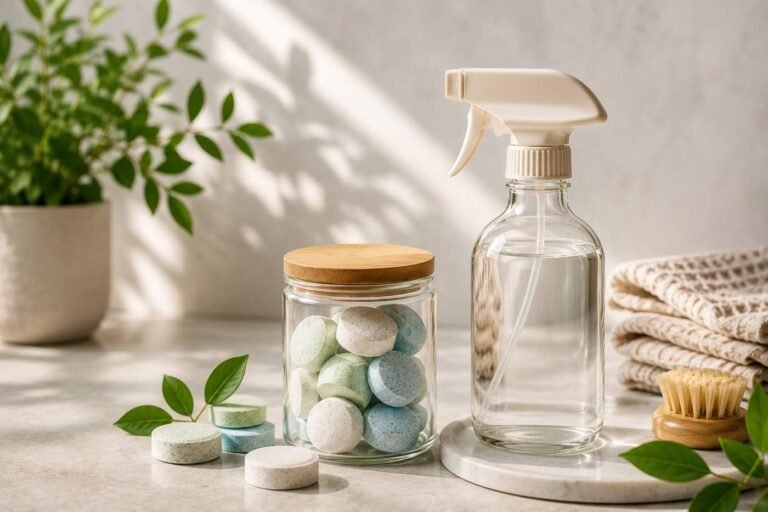
- Cleaning tablets
- Concentrates
- Refill pouches
Backups
Only unopened products you actually expect to use soon.
Unknown or unused
Anything you no longer understand, trust, or use.
Once sorted, duplication becomes much easier to identify.
Step 3: Identify Your Core Cleaning Products
A minimalist cabinet should have a core kit.
Not a huge collection.
A small number of products that handle most routine tasks.
A practical setup might include:
1. One everyday multi-surface cleaner
For compatible routine surfaces such as sealed counters, tables, and cabinets.
2. One bathroom-specific product
Useful where soap scum, mineral buildup, or other bathroom soil requires a different formulation.
3. One glass cleaner
Only if your everyday cleaner does not perform well on glass or is not suitable for it.
4. One floor cleaner
Chosen based on your flooring type.
5. One specialist cleaner
Only where your home genuinely requires it.
That might be enough for many households.
Some homes will need more.
Some will need less.
The point is not to hit a specific number.
The point is to stop assuming every surface deserves its own bottle.
The One-Product-Per-Problem Rule
A simple standard helps:
One clear problem. One clear product.
If you need a product for glass, keep one.
If you need a bathroom cleaner, keep one.
If you need a specialised product for natural stone, keep one.
What you want to avoid is:
Three bathroom sprays.
Two nearly identical glass cleaners.
Four multi-surface cleaners.
Multiple unopened backups.
When a product has a clear role, it is easy to justify.
When three products have the same role, something is probably unnecessary.
Step 4: Separate Everyday Cleaners From Specialists
Not every cleaner needs to be within arm’s reach.
Products you use every few days should be easy to access.
Products you use once every few months can live further back.
This simple separation improves usability.
Front of cabinet
Keep:
- Everyday surface cleaner
- Cloths
- Frequently used brush or sponge
- Dishwashing or kitchen essentials
Middle or side zone
Keep:
- Bathroom cleaner
- Floor product
- Glass cleaner
Back or upper shelf
Keep:
- Rare specialist cleaners
- Limited backup stock
- Extra refills
The space should reflect frequency of use.
Your cabinet is not a warehouse.
It is a working system.
Step 5: Get Rid of the “Mystery Bottle” Problem
Every cleaning cabinet seems to have one.
A bottle with a damaged label.
A cleaner transferred into an unmarked container.
A product nobody remembers buying.
That is not just clutter.
It can also create confusion.
Cleaning products should be clearly identifiable.
Never store them in beverage bottles or food containers.
Never keep unknown mixtures.
And avoid transferring products unless the manufacturer’s instructions allow it and the new container is properly labelled and suitable.
Minimalism is partly about reducing visual clutter.
But it is also about increasing clarity.
If you cannot identify what is inside a bottle, it has no place in a well-organised cleaning system.
Step 6: Stop Treating Backups Like Inventory
Buying in bulk can be useful.
But under-sink storage often turns into accidental stockpiling.
You see a discount.
You buy three bottles.
Then another sale appears.
You buy two more.
Soon, half the cabinet is unopened stock.
That creates two problems:
Storage becomes crowded.
And you stop seeing what you already own.
A better rule:
Keep only a realistic backup quantity.
For frequently used products, one backup may be enough.
For products available easily, you may not need a backup at all.
The ideal quantity depends on your household.
But unless you live far from stores or have a special reason to stockpile, your kitchen cabinet probably does not need to function like a distribution centre.
Step 7: Use Refills to Reduce Bulk
One of the easiest ways to simplify storage is to reduce how many full bottles you keep.
This is where refill systems can help.
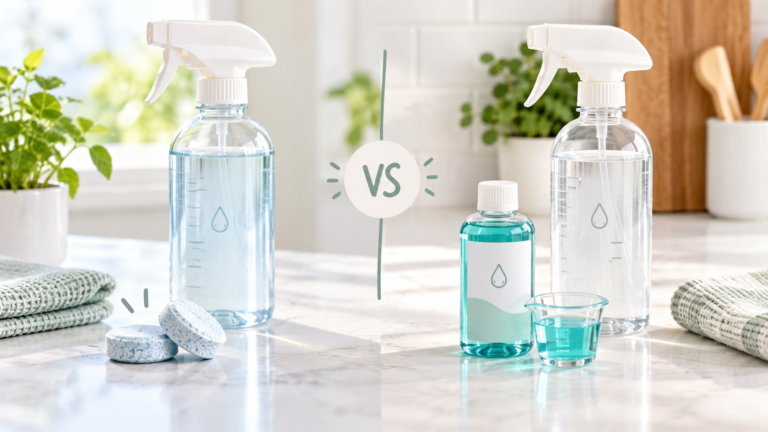
Traditional ready-to-use cleaners require storing an entire bottle of liquid.
Refill formats can be more compact.
Examples include:
- Cleaning tablets
- Powder concentrates
- Liquid concentrates
- Refill pouches
The benefit is straightforward.
Instead of storing several bulky replacement bottles, you can keep one durable bottle and smaller refills.
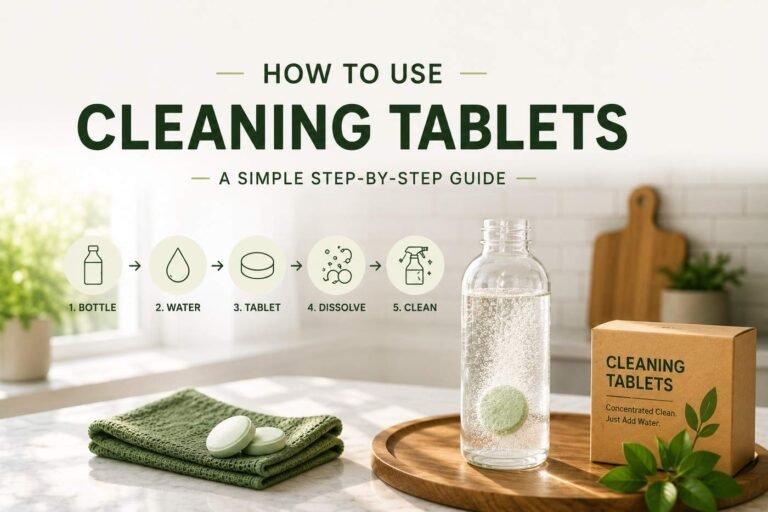
A compatible tablet-based routine may look like this:
Keep bottle → add water → add refill → dissolve → use
That can dramatically reduce the physical space required for backups.
The bottle stays.
The consumable part gets replaced.
That is exactly the kind of system minimalism benefits from.
Why Cleaning Tablets Fit the Minimalist Standard
Cleaning tablets are particularly interesting from a storage perspective.
A tablet is concentrated.
It does not contain the full amount of water used in the finished cleaner.
That means several refills can fit into a relatively small package.
Compared with storing multiple full-sized spray bottles, that can be much more space-efficient.
Instead of:
Three large replacement cleaners
you may be able to store:
One bottle + a small pack of tablets
depending on the product system.
That is not just visually cleaner.
It is physically more efficient.
And in a small kitchen, every bit of under-sink space matters.
Compact Refills Change the Cabinet
Think about the shape of a conventional cleaning bottle.
Tall.
Wide.
Often awkward.
Now multiply that by six.
A huge amount of cabinet volume gets consumed by packaging.
Compact refills change the storage equation.
They can sit:
In a small box.
In a drawer.
On a narrow shelf.
In a dry labelled container.
This can free up space for:
- Cloths
- Brushes
- Gloves
- Trash bags
- Dishwashing supplies
- Floor-cleaning tools
You do not necessarily need a bigger cabinet.
You may simply need less bulky product storage.
Step 8: Store Cloths Properly
A minimalist cabinet is not just about bottles.
Cleaning cloths also create clutter.
Many homes have:
Old T-shirts.
Half-dry rags.
Random microfiber cloths.
A sponge stuffed behind a bottle.
Instead, keep a small dedicated set.
For example:
- 2–3 general microfiber cloths
- 1 glass cloth
- 1 bathroom cloth
- 1 heavier cleaning cloth
Wash and dry them properly.
Do not store wet cloths crumpled under the sink.
Damp fabric in a closed cabinet can become unpleasant quickly.
A cloth should return to storage clean and dry.
Step 9: Limit Your Cleaning Tools
Cleaning tools multiply just like products.
Scrub brush.
Toothbrush.
Sponge.
Another sponge.
Three scrub pads.
A random brush from an old kit.
A cleaning cupboard can become just as cluttered with tools as bottles.
Keep the ones you actually use.
A simple setup might include:
- One dish or general scrub brush
- One small detail brush
- A few cloths
- A sponge or scrub pad
- Gloves
- A floor tool stored elsewhere if too large
That is enough for most routine tasks.
Specialist tools are fine if they have a real purpose.
But unnecessary duplicates are still unnecessary.
Step 10: Use Containers Carefully
Storage bins can help.
But they can also hide clutter.
Buying six new baskets before decluttering is a common mistake.
You end up with:
Clutter inside nicer containers.
The correct order is:
Remove unnecessary items first. Organise second.
After decluttering, simple containers can be useful.
One basket for cloths.
One for refill packs.
One for small tools.
One area for daily-use cleaners.
That is enough.
You should be able to see what you own without pulling out five boxes.
The Visibility Rule
A good under-sink cabinet follows one simple principle:
You should be able to see almost everything at a glance.
If products are hidden four rows deep, you will forget they exist.
That leads to duplicates.
Visibility helps you know:
What is running low.
What you already have.
Which products are unused.
When a refill is needed.
A minimalist cabinet is easier to manage because inventory becomes obvious.
You do not need an app.
You need visibility.
The Two-Minute Inventory Check
Once a month, open the cabinet and check:
What is almost empty?
What has not been used?
What needs replacing?
What has been duplicated?
Are cloths clean?
Are refills dry?
Are any containers leaking?
Is anything expired or damaged?
This takes less than two minutes.
But it prevents the cabinet from slowly becoming chaotic again.
Minimalism is not a one-time decluttering exercise.
It is a maintenance standard.
The “Use It Before Replacing It” Rule
If you currently have an overcrowded cabinet, do not throw everything away to achieve a minimalist look.
That creates unnecessary waste.
Instead:
Use products you already own safely and as directed.
Finish duplicates one by one.
Do not repurchase overlapping products.
Gradually reduce the number of items.
This creates a much more sensible transition.
Minimalism should reduce waste.
Not create a giant disposal event.
What Should You Never Combine?
Simplifying products does not mean mixing them.
Do not pour similar-looking cleaners together.
Do not combine half-empty bottles to save space.
Do not create homemade blends from multiple commercial products.
Different cleaning formulations can react with each other.
Use products one at a time according to their instructions.
A minimalist cabinet contains fewer products.
It does not contain mystery mixtures.
The Best Cabinet Is Easy to Clean Too
Under-sink cabinets can collect:
- Leaks
- Dust
- Product residue
- Water
- Dirt from stored tools
A crowded cabinet makes cleaning the cabinet itself difficult.
When there are fewer items, maintenance becomes easier.
You can remove everything quickly.
Wipe the shelf.
Check for leaks.
Put items back.
Minimalism reduces cleaning effort inside the very space dedicated to cleaning.
That is a useful kind of irony.
Watch Out for Leaks
Cleaning bottles can occasionally leak.
Triggers may loosen.
Caps can drip.
Refill pouches may get damaged.
That is why storing products upright matters.
A washable tray under liquid cleaners can also help contain minor spills.
Check the cabinet floor periodically.
If there is unexplained moisture, do not assume it came from a bottle.
The sink plumbing itself may be leaking.
Under-sink storage should never make it difficult to inspect pipes.
Keep plumbing visible where possible.
Do Not Block the Plumbing
This sounds simple, but it matters.
Under the sink, pipes need space.
Overpacked cabinets can make it harder to notice:
Leaks.
Condensation.
Loose connections.
Moisture damage.
Keep some open space around the plumbing.
Do not wedge bottles tightly against pipes.
Minimalism improves more than aesthetics here.
It can also make maintenance easier.
Keep Moisture-Sensitive Refills Dry
Cleaning tablets and some concentrated refill formats may need protection from humidity.
Do not automatically store them directly beside wet sponges or leaking pipes just because they are cleaning products.
Follow the manufacturer’s storage instructions.
A dry drawer or utility cupboard may be better than under the sink.
Especially in humid climates.
Compact refills give you flexibility.
They do not have to live in the same place as every other cleaning item.
The Minimalist Under-Sink Standard for Small Apartments
Small homes benefit the most from intentional storage.
If cabinet space is limited, prioritise:
Level 1: Daily essentials
Keep only what you use weekly.
Level 2: Specialist products
Keep only products with a unique purpose.
Level 3: Refills
Choose compact formats where practical.
Level 4: Tools
Limit to a small working set.
Level 5: Backups
Keep minimal stock.
Small spaces become difficult when every category expands.
A minimalist standard prevents expansion.
The Minimalist Under-Sink Standard for Families
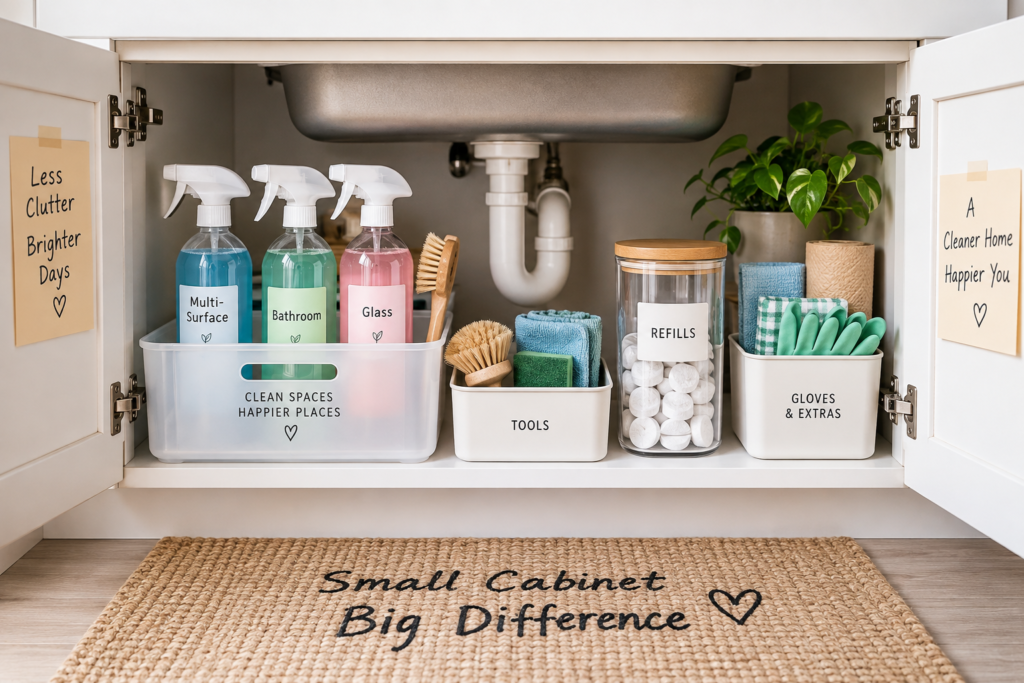
Larger households may need more supplies.
But the principles remain the same.
The goal is not to force a family of five into the same setup as one person living alone.
Instead, ask:
Do we use this?
Does it serve a unique purpose?
Do we need this much backup?
Can refills reduce storage?
Can everyday products be consolidated?
A larger household may need more volume.
It does not automatically need more categories.
The Minimalist Under-Sink Standard for Indian Homes
Indian kitchens often have unique storage challenges.
Under-sink areas may need to accommodate:
- Cleaning supplies
- Dishwashing products
- Garbage bags
- Buckets
- Scrubbers
- Floor-cleaning tools
- Water-related plumbing
- Extra household storage
Space is valuable.
This makes compact systems especially useful.
A few practical priorities can help:
Use upright storage.
Keep the floor area clear.
Avoid storing moisture-sensitive products near leaks.
Use baskets selectively.
Keep frequently used items accessible.
Store refills in dry areas.
Limit duplicate products.
And remember:
You do not need a separate cleaner for every room.
Does Minimalism Mean One Cleaner for Everything?
No.
That is one of the biggest misconceptions.
Minimalism does not mean pretending all cleaning jobs are identical.
Different surfaces and types of dirt can require different formulations.
The right standard is:
Use as few products as practical without compromising suitability or safety.
If your stone surface needs a specific product, keep it.
If your floor requires a certain cleaner, use it.
If your everyday cleaner works safely across several surfaces, let it replace unnecessary duplicates.
Minimalism works when function comes first.
The Multi-Surface Cleaner as the Anchor Product
For many homes, a good multi-surface cleaner can become the centre of the system.
It may handle:
- Tables
- Sealed counters
- Cabinets
- Desks
- Shelves
- Other compatible surfaces
That can eliminate the need for several separate sprays.
But always check the label.
Avoid assuming a multi-surface product is suitable for:
Natural stone.
Unsealed wood.
Screens.
Electronics.
Delicate finishes.
Speciality metals.
Versatility is useful.
Universality is rare.
Why Fewer Products Can Improve Cleaning Consistency
When you have too many products, you spend time deciding.
Which bottle?
Which surface?
Which cleaner did I use last time?
A smaller system reduces decision-making.
You know:
Everyday dirt → everyday cleaner.
Bathroom buildup → bathroom product.
Glass → glass product if required.
Floor → floor cleaner.
That makes cleaning faster.
And products are more likely to be used correctly because you actually understand them.
A simple system beats a complicated cabinet you barely know how to use.
Minimalism Can Reduce Accidental Overbuying
One hidden cost of clutter is forgetting inventory.
You cannot see the bathroom cleaner.
So you buy another.
You forget the refill pack behind the bottles.
So you order another.
You buy a new spray because the old one looks almost empty.
A visible cabinet prevents this.
When you know what you have, you buy less accidentally.
That is one of the most practical financial benefits of minimalism.
Not huge savings overnight.
Just fewer unnecessary purchases.
The Standard: Every Product Must Earn Its Space
Here is the simplest test.
Pick up each item.
Ask:
What job does this do?
Then:
Do I already have another product doing the same job?
Then:
Do I actually use it?
If you cannot answer clearly, reconsider whether it belongs there.
This works for:
- Bottles
- Tools
- Refills
- Backup products
- Cloths
- Sponges
Storage space is limited.
Every item should earn it.
The 10-Item Thought Experiment
You do not need to literally limit yourself to 10 items.
But imagine you could only keep 10 cleaning items under the sink.
What would they be?
Probably:
One everyday cleaner.
One bathroom cleaner.
One floor product.
One specialist product.
A few cloths.
One brush.
One sponge.
Gloves.
Refills.
That exercise reveals something important.
Most cleaning routines do not require a cabinet packed with 25 bottles.
We often accumulate more than we actively need.
Build a Refill-First System
A useful long-term standard is:
Bottle once. Refill many times.
Where appropriate, choose systems where the durable container remains in use and the consumable formula is replaced.
That could mean:
Cleaning tablets.
Concentrates.
Refill pouches.
Bulk refill systems.
The specific format matters less than the principle.
Do not automatically replace the durable object every time the contents run out.
This reduces both storage clutter and packaging turnover.
A Clean Cabinet Changes the Way You Shop
Once your cabinet is simplified, your shopping habits change.
You stop thinking:
“What cleaning product should I buy?”
And start thinking:
“What does my existing system actually need?”
That leads to better questions:
Am I out of cleaner?
Or just low?
Do I need another bottle?
Or only a refill?
Is this genuinely a different product?
Or a duplicate?
Will this replace something?
Or just add another item?
That mindset helps prevent clutter before it enters the home.
The Minimalist Under-Sink Standard Checklist
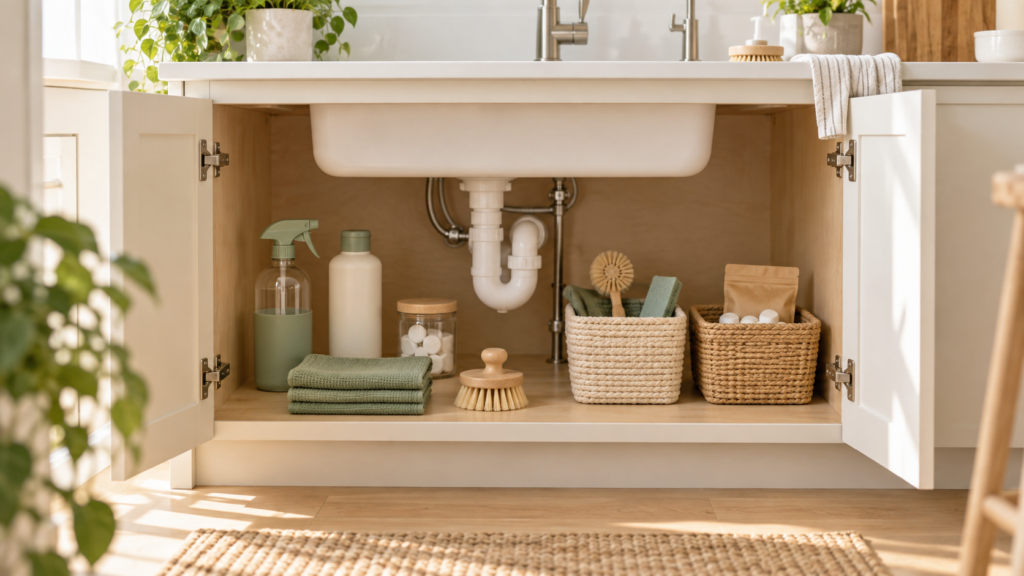
Your cabinet passes the standard if:
- Every product has a clear purpose
- Duplicate cleaners are limited
- Frequently used items are visible
- Specialised cleaners are kept only when needed
- Refills are compact and organised
- Cloths and tools are clean and dry
- Backups are limited
- No unknown products are stored
- Plumbing remains visible
- Nothing is leaking
- Moisture-sensitive refills are kept dry
- The cabinet can be cleaned easily
- You can see what you need at a glance
That is the standard.
Simple.
Functional.
Maintainable.
What This Is Really About
The Minimalist Under-Sink Standard is not really about cupboards.
It is about product habits.
We often solve everyday problems by adding something.
Another cleaner.
Another bottle.
Another organiser.
Another basket.
But sometimes the better solution is subtraction.
Remove overlap.
Reduce packaging.
Use what you already have.
Choose refillable systems.
Keep only what performs a real job.
That makes the entire cleaning routine easier.
Frequently Asked Questions
How many cleaning products should I keep under the sink?
There is no universal number. Keep enough products to handle your actual cleaning needs without unnecessary overlap. Many households can manage routine cleaning with a small core set plus a few specialist products.
What should always be stored under the sink?
Only frequently used cleaning items that are appropriate for that storage environment. Keep the area organised, dry, and clear enough to inspect the plumbing.
Should I keep cleaning tablets under the sink?
Only if the location is dry and consistent with the manufacturer’s storage instructions. Moisture-sensitive tablets may be better stored in a dry drawer or utility cupboard.
Can one multi-surface cleaner replace several products?
Potentially, on compatible surfaces. Always check the manufacturer’s instructions and do not assume one cleaner is suitable for every material.
How do I declutter cleaning products without wasting them?
Use safe, usable products you already own first. Stop repurchasing unnecessary duplicates and simplify gradually.
Should I throw away old cleaning products?
Follow the product label and local disposal guidance. Do not pour unknown chemicals together or dispose of them casually.
Are refill systems better for small kitchens?
They can be useful because concentrated refills often take up less space than multiple full-size bottles.
How many backup cleaning products should I keep?
Keep only a reasonable amount based on how quickly your household uses the product. One backup is often enough for frequently used items.
Is it safe to transfer cleaners into matching bottles?
Only if the product instructions allow it and the new container is suitable and clearly labelled. Never use food or beverage containers for cleaning products.
What is the easiest way to keep the cabinet organised?
Make everything visible, group items by function, limit duplicates, keep daily-use products at the front, and do a quick monthly inventory check.
Final Takeaway
Your under-sink cabinet does not need to hold every cleaning product marketed to you.
It needs to support your actual routine.
That means:
Fewer duplicates.
Clearer functions.
Compact refills.
Better visibility.
Clean tools.
Minimal backups.
No mystery bottles.
And most importantly:
Every product earns its space.
The goal is not an empty cabinet.
The goal is a cabinet that works.
When you open the door, you should immediately know:
What you own.
What each product does.
What is running low.
What needs replacing.
And what definitely does not need to be bought again.
That is the Minimalist Under-Sink Standard.
Not less for the sake of less.
Less clutter. Better function. Smarter cleaning.
Read Our Blog on : How to deal with dust in indian homes?

One Comment