Real Eco vs. Fake Eco: How to Spot Greenwashing in Cleaning Products
A green leaf on the label does not automatically make a cleaning product sustainable.
Neither does a beige bottle.
Neither does the word “natural.”
Neither does calling something “planet-friendly” without explaining what that actually means.
Sustainability claims have become so common in household cleaning that almost every product now seems to have some version of:
Eco-friendly. Green. Conscious. Clean. Natural. Sustainable. Better for the planet.
The problem is that these words can mean very different things.
Some brands genuinely redesign products to use less material, reduce packaging, concentrate formulas, improve refillability, or make environmental claims that can be supported with evidence.
Others simply change the label.
That is where greenwashing becomes a problem.
Greenwashing happens when environmental marketing makes a product, company, or practice appear more sustainable than the underlying evidence really supports.
And cleaning products are especially vulnerable to it because the category combines:
- Plastic packaging
- Chemical formulations
- Water
- Transport
- Fragrance
- Refill claims
- Recycling claims
- “Natural” ingredients
- “Non-toxic” language
- Sustainability imagery
That gives marketers a lot of room to sound green.
But sounding green and being environmentally responsible are not the same thing.
So how do you tell the difference?
The answer is not to distrust every environmental claim.
It is to ask better questions.
What Does Greenwashing Actually Look Like?
Greenwashing is not always an outright lie.
Often, it is more subtle.
A company may highlight one positive attribute while distracting attention from the rest of the product.
For example:
A bottle may be made with some recycled plastic.
Good.
But the product may still be designed as a single-use system with no refill option.
A cleaner may be marketed as “plant-based.”
That sounds environmentally friendly.
But the claim may tell you nothing about:
- Packaging
- Ingredient concentration
- Transport weight
- Product performance
- Biodegradability
- Refillability
- Actual lifecycle impact
A package may feature green leaves, bamboo graphics and earthy colours.
None of those are environmental evidence.
They are design choices.
The core principle is simple:
Environmental claims should be specific enough to verify.
How to Spot Greenwashing in Cleaning Products?
The First Red Flag: Vague Words
Be cautious when a brand relies heavily on words such as:
- Eco-friendly
- Green
- Natural
- Planet-safe
- Earth-friendly
- Sustainable
- Conscious
- Clean
- Non-toxic
without explaining exactly what they mean.
These words can sound powerful while providing very little information.
For example:
“Eco-friendly cleaner”
raises several questions.
Eco-friendly in what way?
Lower packaging?
Lower transport emissions?
Concentrated formula?
Certified ingredients?
Reusable bottle?
Recycled material?
Lower aquatic toxicity?
Biodegradable surfactants?
If the company cannot explain the claim clearly, the claim is not very useful.
A better statement would be something measurable, such as:
“Bottle made with 80% post-consumer recycled plastic.”
or
“One refill produces 500 ml of finished cleaner.”
or
“Designed for reuse with the same bottle.”
Specific claims can be examined.
Vague claims mostly create a feeling.
A Green Leaf Is Not Evidence
Sustainability has developed its own visual language.
You have seen it.
Green labels.
Leaves.
Trees.
Recycled-paper textures.
Water droplets.
Earth icons.
Words printed in handwritten fonts.
Minimal packaging.
Muted colours.
These design choices can make a product feel environmentally responsible before you read a single claim.
But they do not prove anything.
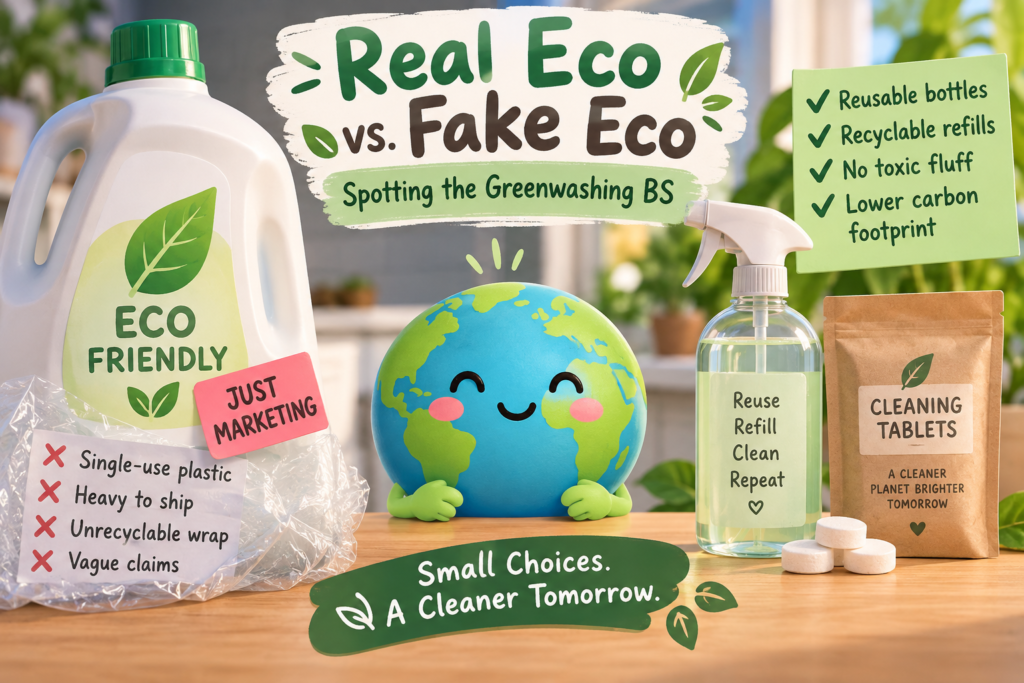
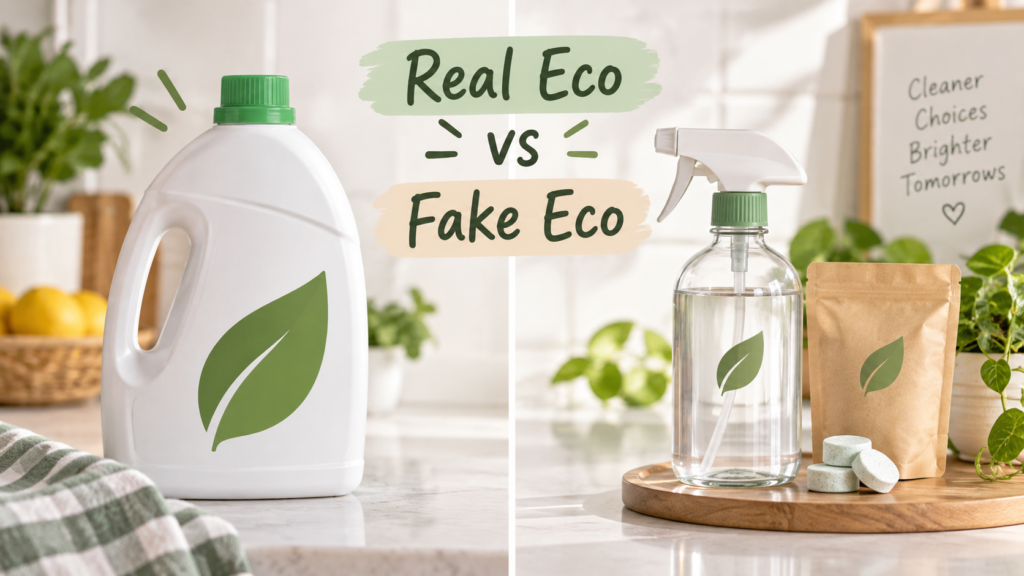
A bright plastic bottle with a leaf printed on it can still be disposable.
A brown paper-looking label can still sit on packaging with complicated end-of-life requirements.
A product called “Nature Clean” could still have environmental trade-offs.
Packaging aesthetics should never substitute for evidence.
Ask:
What has actually changed about the product?
Real Eco Starts With the System, Not the Label
One useful way to evaluate a cleaning product is to stop looking at the front label and look at the entire system.
Ask:
What is being manufactured?
What is being shipped?
What gets used once?
What gets reused?
How concentrated is the formulation?
What packaging is required?
What happens when the product runs out?
What happens to the packaging afterward?
This gives you a much better picture than any green badge.
Sustainability is rarely one feature.
It is a series of trade-offs across a product’s lifecycle.
1. Packaging: Is It Designed for Reuse or Disposal?
This is one of the easiest things to inspect.
Suppose two cleaners perform a similar job.
Product A
Comes in a new full-size spray bottle every time.
Product B
Uses one durable bottle and smaller refill formats.
All else being equal, the second system may reduce the number of full-size bottles entering the household.
That is a meaningful design difference.
But even refill systems need scrutiny.
Ask:
- What is the refill packaging made from?
- Is it actually recyclable where you live?
- Is each refill individually wrapped?
- Does the reusable bottle last?
- How many reuse cycles are realistically expected?
- Is the refill materially smaller than the original package?
A refill system is not automatically sustainable just because the word “refill” appears on the box.
The details matter.
“Zero Plastic” Is a Strong Claim
Claims like:
Zero plastic
or
plastic-free
need to be taken literally.
Does the product contain:
Plastic labels?
Plastic liners?
Plastic coatings?
Plastic seals?
Plastic refill sachets?
Plastic shipping materials?
If any plastic is used, then “zero plastic” needs careful qualification.
A more transparent claim might be:
“No new plastic bottle required for each refill.”
That tells the consumer exactly what benefit the design is trying to provide.
Specific language is more trustworthy than absolute language.
“Recyclable” Does Not Mean “Will Be Recycled”
This is another common source of confusion.
A package can technically be recyclable while still being difficult to recycle in practice.
Recycling depends on:
- Material type
- Local collection
- Sorting infrastructure
- Contamination
- Package size
- Attached materials
- Market demand for recycled material
So when a product says:
100% recyclable packaging
ask:
Where?
Under what local system?
Do consumers need to separate components?
Can the refill itself be recycled?
Does the claim refer only to the bottle body?
A recycling symbol is useful.
But it is not a guarantee that the packaging will actually become another product.
Compostable Needs Context Too
“Compostable” sounds excellent.
But there are important questions.
Can it compost at home?
Or only in an industrial composting facility?
How long does it take?
Does your city actually collect that material?
What conditions are required?
A material that is technically industrially compostable may still end up in landfill if the appropriate infrastructure does not exist.
Again:
The claim may be true.
But the practical benefit depends on the system around it.
2. Concentration: Are You Paying to Transport Water?
This is especially relevant to household cleaning.
Ready-to-use cleaners often contain a large amount of water because the product is already prepared.
That means the manufacturer is shipping:
Cleaning ingredients + water + bottle
Concentrated formats change that.
A tablet or liquid concentrate can allow the consumer to add water later.
That can reduce:
- Product weight
- Storage volume
- Number of bulky bottles
- Transported liquid volume
But concentration alone is not proof of lower total environmental impact.
You still need to consider:
- Manufacturing
- Packaging
- Ingredient sourcing
- Shipping distance
- Bottle reuse
- Refill packaging
- Actual product performance
Still, concentrated formats at least address an obvious inefficiency:
moving large volumes of water that may already be available at the point of use.
Low-Carbon Claims Need Evidence
A brand may say:
Lower carbon footprint
or
low-carbon cleaning
That is a serious claim.
Ask:
Compared with what?
Measured how?
Across which lifecycle stages?
Does it include:
- Raw materials?
- Manufacturing?
- Packaging?
- Transport?
- Consumer use?
- End-of-life?
If no methodology is provided, treat the claim carefully.
A lightweight concentrate may logically require less freight than a heavier ready-to-use bottle in some scenarios.
But a credible brand should avoid pretending that intuitive logic is the same as a full lifecycle carbon calculation.
“We Ship Less Water” Is a Better Claim
This is a good example of transparent language.
If a concentrated product contains much less water than a ready-to-use version, a company can explain that directly.
For example:
“This refill is concentrated. Add 500 ml of water at home.”
That is easy to understand.
It avoids claiming:
“Carbon neutral.”
“Zero emissions.”
“Planet positive.”
unless those claims are properly substantiated.
Good sustainability marketing should explain what the product actually does differently.
Not make the consumer decode a slogan.
3. Ingredients: “Chemical-Free” Is a Red Flag
Everything is made of chemicals.
Water is a chemical.
Citric acid is a chemical.
Sodium bicarbonate is a chemical.
Plant-derived surfactants are chemicals.
So a household cleaner cannot literally be:
chemical-free
That phrase is scientifically meaningless.
A more useful discussion is:
Which ingredients are used?
Why are they used?
At what concentration?
What hazards do they have?
How are they intended to be handled?
Are there ingredient disclosures?
A company using “chemical-free” language may be simplifying chemistry to the point of misinformation.
“Natural” Does Not Automatically Mean Safer
Another common assumption is:
Natural = safe.
Synthetic = dangerous.
Reality is not that simple.
Natural substances can be:
Irritating.
Toxic.
Allergenic.
Corrosive.
Environmentally harmful.
Synthetic ingredients can sometimes be designed for:
Predictability.
Purity.
Stability.
Lower effective doses.
The correct question is not:
Is it natural?
It is:
Is it appropriate for the intended use, and is there evidence supporting its safety and performance?
“Non-Toxic” Is Often Too Vague
Toxicity depends on dose and exposure.
A statement like:
Non-toxic cleaner
can be difficult to interpret without further context.
Non-toxic to whom?
Humans?
Pets?
Aquatic organisms?
At what concentration?
Under what exposure?
Used as directed?
Ingested?
Inhaled?
A more responsible label should communicate specific safety information and instructions rather than relying on broad reassurance.
What About Synthetic Dyes?
A coloured cleaner is not automatically bad.
An uncoloured cleaner is not automatically sustainable.
But unnecessary ingredients are still worth questioning.
If a formulation contains a dye purely for visual appearance, the brand should be able to explain why it is included.
The same applies to fragrance.
The environmental discussion should focus on actual formulation choices rather than assuming:
Clear liquid = eco.
Blue liquid = bad.
Colour is not an environmental metric.
Phthalates, Fragrance and Buzzword Marketing
Ingredient-free lists have become popular.
You may see:
- Phthalate-free
- Paraben-free
- Dye-free
- Chlorine-free
- Ammonia-free
These claims can be useful in context.
But they can also become marketing noise if the excluded ingredient was never relevant to that product category in the first place.
This strategy is sometimes described as “free-from” marketing.
The important question is:
Does removing that ingredient provide a meaningful benefit?
Or is the label simply using a scary-sounding word to create an impression of safety?
Transparency should explain what is inside the product, not only celebrate what is absent.
Ingredient Transparency Is a Better Standard
A more credible cleaning brand should make it reasonably easy to understand the formulation.
That does not necessarily mean revealing proprietary percentages.
But consumers should be able to find information about:
- Major ingredient categories
- Product purpose
- Surface suitability
- Usage instructions
- Safety precautions
- Relevant certifications
- Fragrance information where appropriate
If a brand claims its chemistry is environmentally responsible but refuses to explain anything about it, that creates an obvious credibility gap.
4. Refillability: Is the Bottle Actually Meant to Stay?
A refill system only works if the bottle is genuinely reused.
This sounds obvious.
But sustainability marketing sometimes treats “reusable” as a design feature rather than a behaviour.
Imagine a company gives you a beautiful reusable bottle.
Then:
It breaks quickly.
The trigger fails.
Refills become unavailable.
The design changes every year.
The bottle is difficult to clean.
Consumers end up replacing it frequently anyway.
Calling the bottle reusable did not create the benefit.
Reuse did.
A meaningful refill model should encourage the bottle to remain in service for multiple refill cycles.
The Durable Bottle Test
Ask:
Does the bottle feel designed to last?
Can the trigger survive repeated use?
Can it be cleaned appropriately?
Is the material compatible with the refill?
Are replacement components available if needed?
Does the brand actually sell refills separately?
If the answer to these questions is yes, the reusable claim starts looking more credible.
5. Refill Packaging: Tiny Doesn’t Mean Perfect
Cleaning tablets and concentrates can reduce packaging volume.
But the refill packaging still matters.
A tiny tablet wrapped in multiple layers of difficult-to-recycle material is not packaging-free.
A refill pouch can use less material than a rigid bottle while still being difficult to recycle.
That does not automatically make the refill a bad idea.
It simply means sustainability is about trade-offs.
A transparent company might say:
“This refill uses X% less packaging by weight than our previous bottle.”
That is much stronger than:
“Waste-free cleaning.”
Measured improvement is more believable than perfection.
6. Performance Is Part of Sustainability
This point is often forgotten.
Imagine an “eco” cleaner requires three times as much product to clean the same mess.
Or consumers have to re-clean every surface because performance is poor.
That can increase:
- Product use
- Water use
- Cloth washing
- Packaging consumption
- Replacement frequency
A sustainable cleaning product still needs to clean effectively.
Otherwise, the environmental benefit may be reduced by how people actually use it.
Performance is not separate from sustainability.
It is part of the system.
The Greenest Product Nobody Uses Is Not Very Useful
People are more likely to stick with sustainable products when they are:
Effective.
Easy to use.
Affordable enough.
Convenient.
Available.
Clear about instructions.
If sustainability requires constant compromise, many consumers will simply switch back.
That is why good sustainable design tries to improve the system without making everyday life unnecessarily harder.
7. Certifications: Useful, but Read Them Properly
Third-party certifications can provide useful evidence.
But certifications vary widely.
A logo may relate to:
- Ingredient sourcing
- Manufacturing practices
- Packaging
- Carbon measurement
- Cruelty-free standards
- Biodegradability
- Organic content
- Environmental management
Do not assume a certification covers every environmental aspect of the product.
Check:
Who issued it?
What does it certify?
What criteria were used?
Is the certification current?
A legitimate certification should be traceable.
A homemade green badge designed by the company itself is not the same thing.
Watch Out for Fake-Looking Eco Badges
Some packaging uses official-looking symbols such as:
“Eco Choice.”
“Green Certified.”
“Earth Approved.”
“Planet Safe.”
These may simply be brand graphics.
If the badge implies third-party verification, search for the certifying organisation.
A legitimate certification normally has:
A named standard.
Public criteria.
An issuing body.
A method of verification.
If none of those exist, the badge may be decorative marketing.
8. Carbon Neutral Claims Deserve Extra Scrutiny
“Carbon neutral” sounds extremely powerful.
But it can mean different things.
A company may have reduced emissions.
Or it may have calculated emissions and purchased offsets.
Or the claim may cover only part of the product lifecycle.
Ask:
What emissions are included?
What year does the claim refer to?
Were emissions reduced or offset?
Who verified the calculation?
What standard was used?
A credible company should be able to answer.
9. “Biodegradable” Needs a Time and Place
Almost anything can eventually break down under some conditions.
The important question is:
How quickly?
Under what conditions?
Into what?
A claim such as:
Biodegradable
is more useful when accompanied by details.
For example:
Biodegradable according to a particular test standard.
Under specified conditions.
Within a defined timeframe.
Without that context, the word can be interpreted far more broadly than the evidence supports.
10. Look for Numbers, Not Adjectives
This may be the easiest greenwashing filter of all.
Weak sustainability marketing relies on adjectives:
Eco.
Green.
Clean.
Conscious.
Better.
Planet-friendly.
Strong sustainability communication uses measurable information:
80% less packaging by weight.
500 ml prepared cleaner per tablet.
Bottle contains 70% recycled plastic.
Designed for 20 refill cycles.
Concentrated formula reduces shipped liquid volume.
Specific numbers can still be misleading if poorly calculated.
But at least they can be questioned and verified.
An adjective cannot.
The Greenwashing BS Detector
Before believing an environmental claim, ask these questions:
What exactly is the claim?
Can you explain it in one sentence?
Is it measurable?
Are there numbers?
Compared with what?
The previous product?
A market average?
A conventional bottle?
Who verified it?
The brand itself?
Independent third party?
What part of the lifecycle does it cover?
Packaging only?
Transport?
Ingredients?
Entire product?
Is anything important being ignored?
For example, a recyclable bottle marketed as sustainable while the disposable model remains unchanged.
If the answers are vague, treat the claim with caution.
Real Eco-Friendly Cleaning: A More Honest Framework
Rather than demanding perfection, look for meaningful improvements across several areas.
1. Use Less Material
Avoid unnecessary packaging.
Design durable components for reuse.
Reduce packaging weight where practical.
2. Use Concentration Intelligently
Avoid shipping unnecessary amounts of water where concentrated formats make sense.
3. Make Reuse Easy
Refills should be available, understandable, and convenient.
4. Be Transparent About Ingredients
Explain what the formula contains and what it is designed to do.
5. Design for End of Life
Use materials that fit realistic recycling or disposal systems where possible.
6. Maintain Performance
The product still needs to work effectively.
7. Make Specific Claims
Replace broad slogans with evidence.
That is a much more useful standard than simply looking for the word “eco.”
What Real Eco Does NOT Mean
It does not necessarily mean:
No plastic anywhere.
No synthetic ingredients.
No fragrance.
No colour.
No packaging.
No emissions.
No environmental impact.
Those absolute ideas sound appealing but are often unrealistic.
Every manufactured physical product has some environmental footprint.
The real question is:
Has the system been designed to reduce unnecessary impact compared with reasonable alternatives?
That is much more honest.
The Problem With “Zero Waste”
Zero waste is a useful ambition.
But for individual consumer products, the phrase can become misleading.
Even a refill product may involve:
Manufacturing waste.
Shipping cartons.
Ingredient packaging.
Energy use.
Damaged units.
End-of-life materials.
The better claim is often:
Less waste
with evidence showing where the reduction occurs.
Transparency builds more trust than impossible perfection.
“Eco” Should Not Mean Expensive Guilt
Another problem with green marketing is moral pressure.
Buy this or you do not care.
Choose that or you are harming the planet.
That is not particularly helpful.
People make buying decisions based on:
Budget.
Performance.
Availability.
Convenience.
Safety.
Family needs.
Sustainability.
A good eco-friendly product should make the sustainable choice easier rather than requiring the consumer to perform environmental heroics.
Better design beats guilt.
Why Refill Cleaning Is Interesting
Refill systems address a very specific problem:
Why replace the durable bottle every time the liquid runs out?
A well-designed refill system can:
Keep the bottle in use.
Reduce the number of full-size packages purchased.
Store concentrated formulations more compactly.
Change the recurring purchase from a full bottle to a refill.
This does not automatically make every refill system environmentally superior.
But it solves a real design inefficiency.
That makes it worth evaluating.
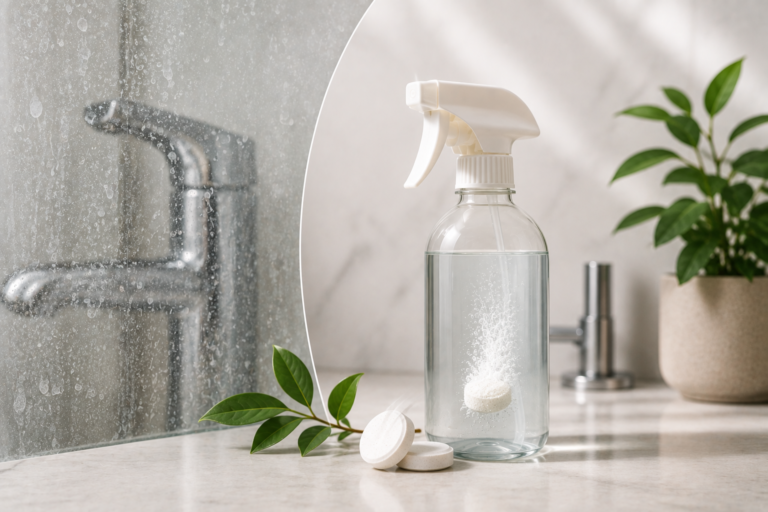
The Cleaning Tablet Example
Consider a cleaning tablet.
The tablet contains a concentrated formulation.
The consumer adds the recommended amount of water at home.
A reusable bottle holds the final solution.
That means the recurring physical product can be much smaller than a full ready-to-use spray bottle.
The potential benefit comes from the system:
Keep bottle + replace concentrate
rather than:
Replace bottle + replace cleaner + replace water
But the environmental claim still needs context.
What is the tablet packaging?
How often is the bottle reused?
Where are the tablets manufactured?
What ingredients are used?
How does performance compare?
Those questions separate real evaluation from marketing hype.
Fake Eco vs Real Eco: A Quick Comparison
| Fake-Eco Signal | More Credible Alternative |
|---|---|
| “Eco-friendly” | Specific environmental claim |
| Green leaf graphic | Verified evidence |
| “Chemical-free” | Ingredient transparency |
| “Zero waste” | Measured waste reduction |
| “100% recyclable” | Clear local recycling instructions |
| “Natural” | Specific ingredient information |
| “Carbon neutral” | Published methodology and scope |
| “Biodegradable” | Test standard and conditions |
| “Reusable” | Refill system designed for repeated use |
| “Sustainable packaging” | Material composition and reduction data |
How to Shop Without Becoming a Sustainability Scientist
Nobody wants to perform a lifecycle assessment in the supermarket aisle.
You do not need to.
Use a simple five-question filter.
1. Is the claim specific?
Good.
2. Can I understand what changed?
Good.
3. Does the system reduce unnecessary material or replacement?
Good sign.
4. Can I verify the claim somewhere?
Better.
5. Does the product still work for the job?
Essential.
If the packaging gives you nothing except green colours and vague environmental language, be skeptical.
Questions Brands Should Be Willing to Answer
A genuinely sustainability-focused cleaning company should be comfortable answering questions like:
What makes this product environmentally preferable?
How much packaging is reduced?
What materials are used?
Can the refill packaging be recycled?
How many times should the bottle be reused?
What ingredients are included?
Are environmental claims independently verified?
How is transport impact being reduced?
What happens at the end of the product’s life?
What are the limitations of your system?
That final question matters.
Credibility increases when companies acknowledge trade-offs.
Transparency Beats Perfection
No cleaning company is environmentally perfect.
Products require:
Raw materials.
Energy.
Packaging.
Factories.
Transportation.
Warehouses.
Delivery.
Eventually, materials reach end of life.
The brands worth trusting are not necessarily the ones claiming:
We have no impact.
They are the ones willing to say:
Here is our impact. Here is what we have reduced. Here is what we are still trying to improve.
That sounds less dramatic.
But it is much more credible.
Frequently Asked Questions
What is greenwashing?
Greenwashing is marketing that makes a product, company, or activity appear more environmentally responsible than the evidence supports.
How can I tell if a cleaning product is really eco-friendly?
Look for specific, measurable claims about packaging, ingredients, concentration, refillability, manufacturing or other environmental factors rather than vague terms such as “green” or “eco-friendly.”
Does recyclable packaging mean a product is sustainable?
Not necessarily. Recycling is only one part of the product lifecycle, and actual recyclability depends on local infrastructure and package design.
Are refill cleaning products always more sustainable?
No. Their impact depends on packaging, product concentration, bottle reuse, manufacturing, transport and actual consumer behaviour.
Are cleaning tablets eco-friendly?
They can reduce packaging volume and the need to transport a complete ready-to-use liquid, particularly when used with a bottle that is reused many times. But the overall impact depends on the complete product system.
Does natural mean environmentally friendly?
No. Natural origin alone does not determine environmental impact, safety or cleaning performance.
Are synthetic ingredients bad for the environment?
Not automatically. Environmental impact depends on the specific substance, dose, production method, use and end-of-life behaviour.
What does biodegradable mean?
It means a substance can be broken down biologically under certain conditions. A useful biodegradability claim should explain the conditions or standard used.
Should I avoid plastic completely?
Not necessarily. Durable plastic can be useful when reused for a long time. The key issue is often unnecessary single-use packaging and poor end-of-life management.
Is “chemical-free cleaning” real?
No. All matter is made of chemicals, including water. A more meaningful discussion focuses on which chemicals are used, in what concentrations and for what purpose.
What is the easiest greenwashing red flag to spot?
A broad environmental claim with no measurable explanation behind it.
What should real environmental transparency look like?
Clear information about what the product changes, what evidence supports the claim, and what limitations or trade-offs remain.
Final Takeaway: Don’t Buy the Green Colour. Buy the Evidence.
Greenwashing works because sustainability is emotional.
People want to make better choices.
Brands know that.
That is why the cleaning aisle is increasingly full of:
Leaves.
Earth tones.
“Natural” labels.
Recycling symbols.
Eco slogans.
But sustainability does not live in the colour of the packaging.
It lives in the system behind the product.
Look for:
Less unnecessary material.
Durable products that are actually reused.
Concentrated formats where they make practical sense.
Transparent ingredients.
Realistic recycling instructions.
Measurable environmental claims.
Products that still perform effectively.
And most importantly:
Evidence.
A green leaf can be printed on anything.
Transparency is harder to fake.
So the next time a cleaning product tells you it is saving the planet, do not immediately believe it.
Ask the only question that really matters:
How, exactly?



One Comment