The Hidden Plastic Problem: What Happens to Single-Use Cleaning Sprays?
Walk into almost any supermarket and head toward the household cleaning aisle.
There are rows of brightly coloured single-use cleaning sprays bottle promising to clean kitchens, bathrooms, glass, tiles, countertops, appliances and almost every other surface in your home.
Pick one up.
Use it for a few weeks or months.
Eventually, the liquid runs out.
And then?
For many households, the entire bottle is treated as finished.
The cleaner is gone, so the packaging goes too.
That seems completely normal because it is how cleaning products have been sold for decades. But when you look closely at what happens to all those bottles after they leave our homes, the system starts to look much less sensible.
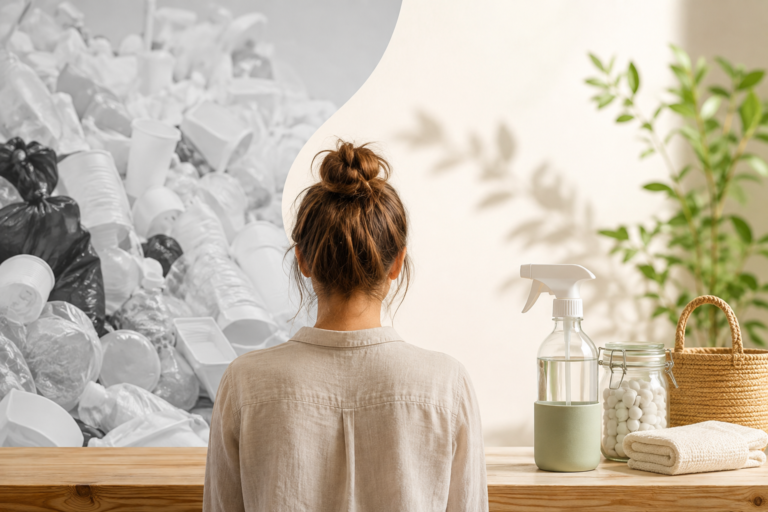
The problem isn’t simply that cleaning sprays come in plastic.
Plastic can actually be extremely useful. It is lightweight, durable, moisture-resistant and capable of protecting liquid products effectively.
The bigger problem is this:
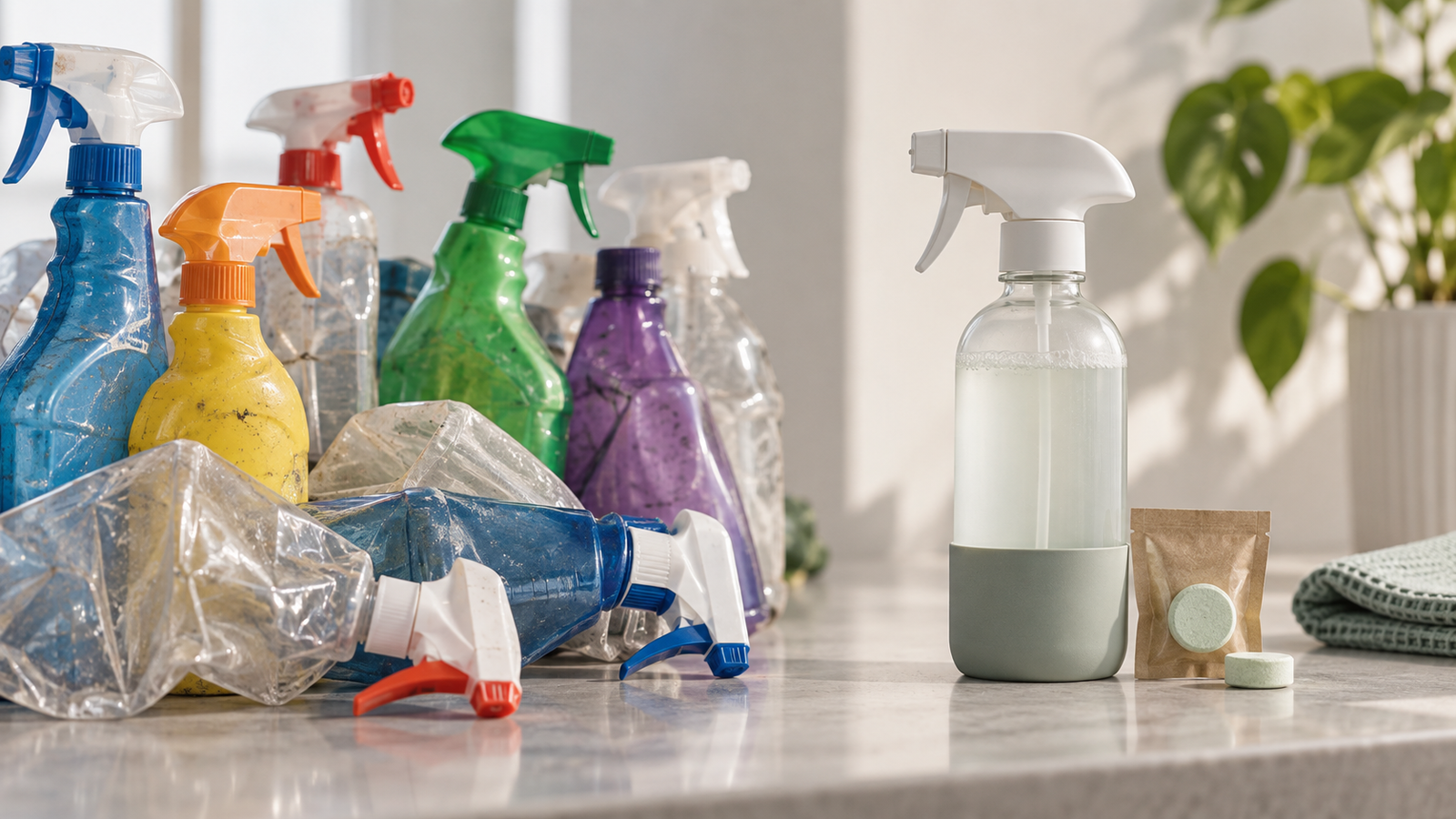
We often use an incredibly durable material to package something designed to disappear in a relatively short period of time.
The cleaning liquid may last a few weeks or months.
The bottle can persist far longer.
And recycling doesn’t automatically make that contradiction disappear.
So what actually happens to a cleaning spray bottle when we throw it away?
Let’s follow the bottle.
The Single-use Cleaning Sprays Bottle Has Two Very Different Lifespans
Think about a typical household surface cleaner.
The liquid inside has a clear job.
Spray.
Wipe.
Clean.
Eventually, the bottle is empty.
From the consumer’s point of view, the product has reached the end of its life.
But materially, something strange has happened.
The cleaner has reached the end of its useful life. The bottle probably hasn’t.
That plastic container may still be structurally functional.
The trigger may still spray.
The bottle may still hold liquid perfectly well.
Yet because the cleaning formulation is finished, the entire package often enters the waste system.
This is the hidden mismatch behind a huge amount of everyday packaging:
short-lived contents inside long-lived materials.
And cleaning products are a particularly interesting example because the bottle doesn’t necessarily need to be disposable in the first place.
Why Plastic Became So Popular for Cleaning Products
Before declaring plastic the enemy, it helps to understand why companies use it.
Plastic packaging has several characteristics that make it practical for household cleaners.
It can be:
- Lightweight
- Durable
- Resistant to moisture
- Relatively inexpensive to manufacture
- Moulded into different shapes
- Designed with ergonomic handles and triggers
- Transported without the weight of glass packaging
Those properties are genuinely useful.
The problem appears when durability and disposability are combined.
A material capable of lasting for years is used within a purchase cycle that may last only weeks.
UNEP has pointed out that the central challenge with many plastic products is not simply the material itself, but the single-use model. In a review of single-use products, UNEP concluded that reuse is generally preferable where systems are appropriately designed for it.
That leads to a useful question:
What if the bottle isn’t the part we should keep replacing?
What Happens When You Throw Away a Cleaning Spray?
There is no single destination for every cleaning bottle.
What happens depends on:
- Where you live
- Your local waste-management system
- The type of plastic
- Whether the bottle has been emptied properly
- Whether it is accepted for recycling
- How the spray trigger is designed
- Whether the waste is collected and sorted correctly
In broad terms, a discarded plastic cleaning bottle can follow several paths.
It may be:
Collected for recycling.
Sent to landfill.
Incinerated.
Rejected during recycling and sent for disposal.
Or, where waste systems are inadequate, it may become mismanaged waste that can leak into the environment.
The global numbers show why simply assuming “plastic gets recycled” is not enough.
The OECD estimated that the world generated 353 million tonnes of plastic waste in 2019. After accounting for losses during recycling, only about 9% was ultimately recycled. Almost half went to sanitary landfill, 19% was incinerated, and the remainder included waste that was inadequately managed.
That doesn’t mean exactly 9% of cleaning spray bottles are recycled.
It does mean that recycling alone has not created a circular plastics system globally.
Stage 1: You Finish the Cleaner
It begins with something completely ordinary.
You spray the final few drops onto the kitchen counter.
The bottle sputters.
You squeeze the trigger again.
Nothing.
The bottle is now “empty.”
At this point, most of us are thinking about the next cleaner.
We aren’t thinking about the bottle.
But that bottle represents materials, manufacturing, transportation and energy that have already been used.
The body had to be produced.
The trigger had to be manufactured.
The bottle and trigger had to be assembled.
The cleaner had to be formulated and filled.
The product had to be labelled.
Then boxed.
Then transported.
Then stocked or delivered.
All of that happened so the packaging could perform a simple job:
Hold and dispense the cleaning solution.
And in many cases, the bottle is still capable of doing exactly that after the first batch is gone.
Stage 2: The Bottle Enters Your Waste Stream
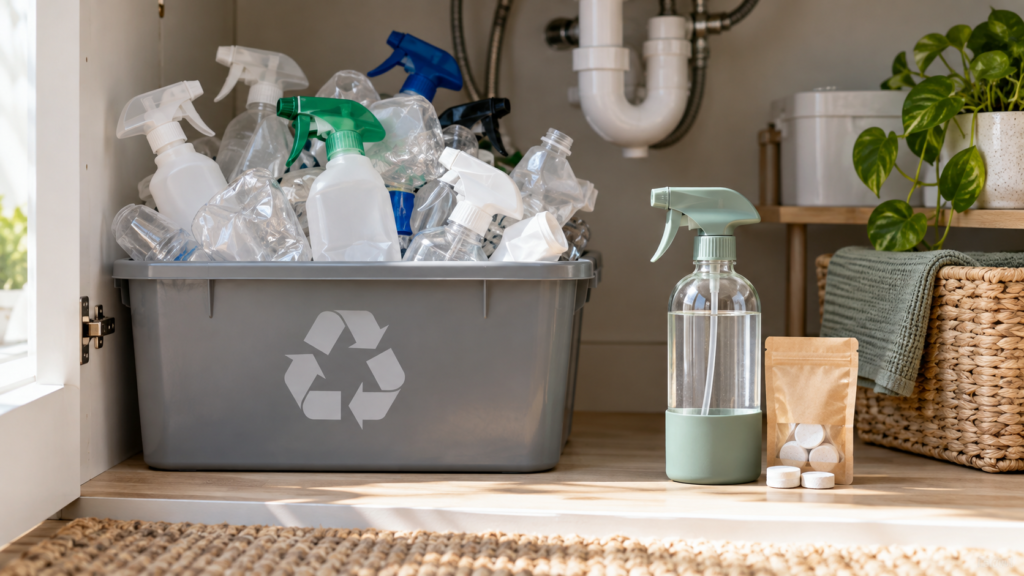
If you place the bottle in general waste, the chances of material recovery are generally much lower.
It may be transported with other household waste and eventually landfilled or processed through another waste-treatment route depending on your local infrastructure.
If you put it into recycling, another process begins.
But recycling is not magic.
The object does not enter the bin and immediately transform into another bottle.
It must first be:
Collected.
Transported.
Sorted.
Separated by material.
Potentially cleaned.
Processed.
Converted into usable recycled material.
Then that material needs a buyer and an application.
And even then, not every piece of plastic entering a recycling stream successfully becomes another product.
The OECD found that in 2019, around 55 million tonnes of plastic waste were collected for recycling, but approximately 22 million tonnes became recycling residues that still required disposal.
So “collected for recycling” and “actually recycled” are not identical things.
Spray Triggers Make Things More Complicated
Take a closer look at the top of your cleaning spray bottle.
It looks simple.
Pull trigger.
Liquid sprays.
But inside, the mechanism may involve several different components.
Depending on the design, there can be:
- Multiple plastic pieces
- Tubing
- Seals
- Internal mechanical parts
- Different polymer types
- Sometimes metal components
That multi-material construction can make recycling more complicated than recycling a simple single-material container.
This doesn’t mean every spray trigger is automatically unrecyclable.
Recyclability varies significantly by design and local recycling infrastructure.
That distinction is important.
If you’re unsure, don’t assume.
Check your local recycling guidance.
A recycling symbol on a plastic component does not necessarily mean the entire item will be accepted by every recycling system.
The Bottle Body May Be Easier Than the Trigger
Many cleaning-product bottles are made from plastics commonly used in packaging.
But the bottle body and the spray mechanism should not automatically be considered one identical material.
Recycling facilities are designed around particular material streams.
The easier a package is to identify, sort and process, the better its chances of fitting into those systems.
Complex packaging can create challenges because attached components can contain different materials.
The OECD notes that recycling potential can be influenced by polymer type, object shape, size, additives and materials attached during assembly.
That explains why packaging design matters.
A product can look like “one plastic bottle” to us while being considerably more complicated from the recycler’s perspective.
What If the Cleaning Bottle Goes to Landfill?
When plastic is landfilled, the bottle does not suddenly disappear.
Plastic’s durability—which was helpful while holding the cleaner—becomes part of the waste problem.
Most conventional plastics do not biodegrade in the same way as food scraps or many natural materials.
Instead, they can persist for long periods and gradually break into smaller fragments.
That is one reason the disposable model is so difficult to reconcile with plastic’s physical characteristics.
We designed a material for durability.
Then built consumption systems around short-term use.
UNEP estimates that packaging accounts for a major share of plastic waste and has repeatedly highlighted the problem created by short-lived plastic applications.
The bottle may have been useful for a few months.
Its material story can continue far beyond that.
And What About Incineration?
Another possible destination is incineration.
Some waste-management systems burn waste, sometimes recovering energy in the process.
This can reduce the physical volume of waste compared with landfilling, but it does not turn the material back into packaging.
Globally, the OECD estimated that around 19% of plastic waste was incinerated in 2019.
This is another reason the phrase “away” deserves scrutiny.
We say:
Throw it away.
But there isn’t really an “away.”
The material moves somewhere else.
Landfill.
Recycling facility.
Incinerator.
Waste dump.
Environment.
Every discarded product continues through a system even after it disappears from our kitchen.
The Worst Case: Mismanaged Plastic Waste
Not every plastic item enters a well-managed waste system.
The OECD estimated that 22 million tonnes of plastic leaked into the environment in 2019, with mismanaged waste being the largest contributor.
Again, that number includes all plastic categories, not specifically household cleaning bottles.
But it shows why packaging decisions matter at scale.
One spray bottle doesn’t look significant.
Millions of households repeatedly replacing bottles creates a very different picture.
The environmental problem is rarely one dramatic bottle.
It is the repetition.
Buy.
Use.
Discard.
Replace.
Buy.
Use.
Discard.
Replace.
Again and again.
The Cleaning Industry Has a Water Problem Too
Now look inside the bottle.
Most ready-to-use household sprays are liquid formulations.
That means the packaged product contains the cleaning formulation plus the water required to prepare it for use.
That water needs a container.
The container has weight.
The finished liquid occupies space.
And the complete product needs to move through manufacturing and distribution.
This doesn’t automatically mean a concentrated product always has a lower total environmental impact; proper lifecycle comparisons depend on formulation, packaging, manufacturing, transportation and actual consumer use.
But concentrated formats introduce an interesting alternative:
What if some of the water is added at home instead of transported inside every replacement bottle?
That is the logic behind products such as cleaning concentrates and cleaning tablets.
The consumer already has access to water.
The refill therefore focuses more heavily on the concentrated formulation.
Cleaning Tablets Change What Gets Replaced
A traditional cleaning spray often works like this:
Bottle + trigger + water + formulation
Use it.
Finish it.
Buy the entire combination again.
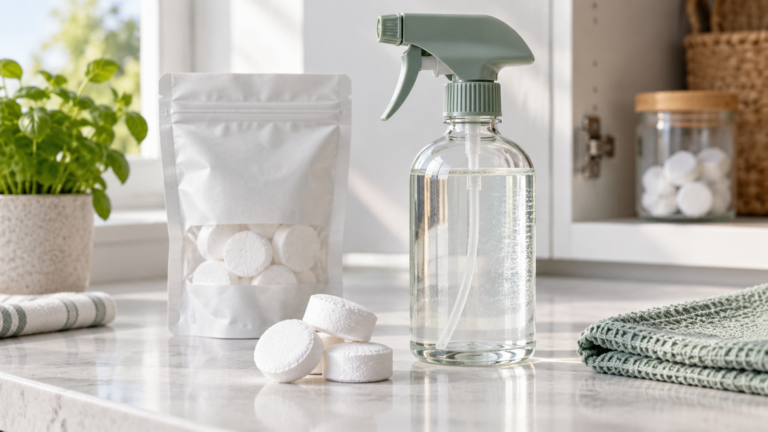
A tablet-based refill system can work differently:
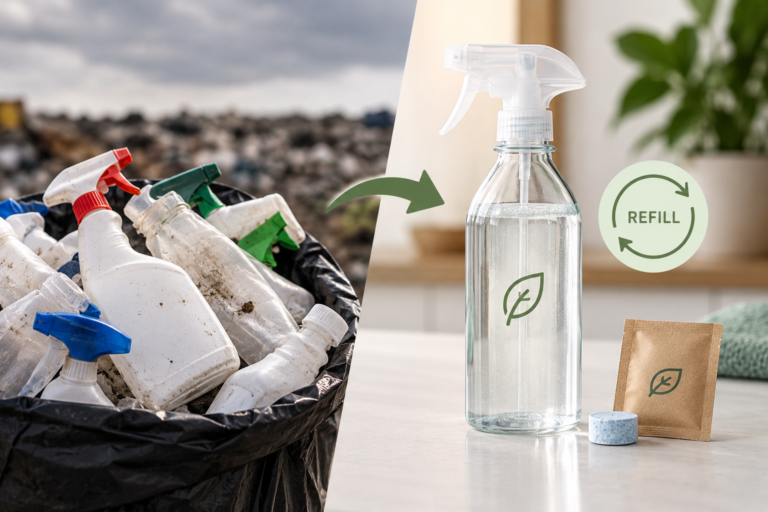
Reusable bottle + local water + concentrated refill
Use it.
Finish the cleaner.
Keep the bottle.
Add water.
Add another refill according to the instructions.
The important part isn’t the tablet itself.
The important part is the system change.
Instead of replacing the entire package every time, the recurring purchase becomes the part you actually consumed.
That idea is remarkably ordinary when you compare it with other things we already refill.
Water bottles.
Soap dispensers.
Coffee containers.
Storage jars.
Printer cartridges.
Pens.
Yet household cleaning has often remained built around complete replacement.
Reuse Changes the Question
Recycling asks:
What should we do with this bottle now that it is waste?
Reuse asks:
Why does this bottle need to become waste yet?
That is a much more interesting question.
If a bottle remains safe, compatible with the product and structurally functional, a well-designed refill system can potentially extend its useful life.
UNEP’s lifecycle work on single-use plastic products emphasizes that reusable options can outperform disposable approaches when reuse systems are appropriately designed and actually reused enough times.
That last point matters.
Simply calling something “reusable” doesn’t create an environmental benefit.
It has to actually be reused.
The Best Bottle May Be the One You Don’t Replace
Packaging innovation usually makes us imagine new materials.
Compostable packaging.
Bioplastics.
Paper bottles.
New recycling technologies.
Lighter containers.
All of those areas can be worth exploring.
But sometimes the simplest innovation is behavioural:
Keep using the existing object.
A cleaning bottle that survives 20 refill cycles has performed a fundamentally different role from a similar bottle discarded after one cycle.
Same basic object.
Very different usage model.
The question shifts from:
“How sustainable is this plastic?”
to:
“How much useful life are we getting from this material before we discard it?”
That is a much more practical way to think about durability.
But Doesn’t a Refillable Bottle Eventually Become Waste Too?
Yes.
Reusable does not mean immortal.
Triggers can fail.
Bottles can crack.
Materials can become damaged.
Products can change.
Eventually, a reusable bottle may need replacement.
The goal isn’t to claim that a refill system produces literally no waste.
The goal is to reduce how often the durable component needs to be replaced.
If one bottle can serve multiple refill cycles, fewer bottle replacements may be needed than under a one-bottle-per-refill model.
That is a more credible sustainability argument than claiming:
Zero waste forever.
Physical products always have material consequences.
The more useful question is whether we can avoid unnecessary ones.
The Packaging Still Matters
Concentrated refills still require packaging.
Cleaning tablets need protection from moisture.
Liquid concentrates need containers.
Products need to remain safe and stable during storage and transportation.
So switching from a spray bottle to a refill does not eliminate packaging altogether.
Instead, it changes the packaging equation.
A full ready-to-use cleaner may require packaging capable of containing the entire finished volume.
A concentrated refill can potentially require much less physical volume.
Exactly how much less depends on the product.
That is why sustainability claims should be based on evidence rather than assumptions.
Smaller does not automatically mean impact-free.
But less material, fewer replacement bottles and repeated reuse can create a fundamentally different packaging system.
Why “Recyclable” Isn’t the Same as “Circular”
These two ideas are often confused.
If something is technically recyclable, we may assume the sustainability problem is solved.
But a truly circular system would require the material to:
be collected,
successfully sorted,
successfully recycled,
converted into useful secondary material,
and used again instead of continually increasing demand for virgin material.
Globally, we are nowhere near that level of circularity.
OECD data shows that only 9% of plastic waste was ultimately recycled in 2019.
This is why product design cannot depend solely on consumers putting everything into a recycling bin.
The system should also ask:
Can we reduce material use?
Can we reuse components?
Can products last longer?
Can packaging be simplified?
Can refilling replace disposal?
Recycling remains important.
But it is one part of a much larger strategy.
One Bottle Doesn’t Look Like a Problem
Imagine one empty cleaning bottle sitting on your counter.
It’s small.
Lightweight.
Maybe 500 ml.
It doesn’t look like an environmental crisis.
Now multiply the behaviour.
One household uses several cleaning categories.
Those bottles are replaced throughout the year.
Multiply that by an apartment building.
Then a neighbourhood.
Then a city.
Then millions of households.
Suddenly the important unit isn’t the bottle.
It’s the system.
This is how packaging waste grows.
Not through one spectacular act of wastefulness.
Through perfectly ordinary products being purchased and discarded repeatedly.
The OECD found that almost two-thirds of global plastic waste in 2019 came from applications with lifespans below five years, with packaging alone accounting for around 40% of plastic waste.
Short-use packaging is therefore not a niche issue.
It is central to the plastics problem.
What Can a Household Actually Do?
Nobody wants cleaning to become an environmental research project.
The practical changes are much simpler.
Finish What You Already Own
Don’t throw away perfectly usable cleaning products simply because you’re switching systems.
Use them responsibly.
Empty them according to their instructions.
Then decide whether you need another complete bottle.
Stop Buying Duplicate Products
Many cleaning cupboards contain several products performing similar jobs.
Simplifying your cleaning routine can reduce both clutter and packaging.
Consider Refillable Formats
Where a safe, effective refillable option exists, compare it with the traditional replacement-bottle model.
Reuse Compatible Bottles Properly
Only reuse containers where the product system permits it.
Don’t mix different cleaners.
Don’t use beverage containers.
Keep cleaning products clearly identifiable.
Check Local Recycling Rules
When a bottle finally reaches the end of its useful life, follow the actual recycling guidance where you live rather than assuming every plastic component belongs in recycling.
Those are small behavioural changes.
But they challenge the disposable model at its source.
Don’t Turn Reuse Into Unsafe DIY Cleaning
There is an important difference between refilling and randomly mixing cleaning chemicals.
A proper refill system provides instructions for:
- Which bottle to use
- How much water to add
- How much concentrate to use
- How long to allow dissolution
- Which surfaces the product is suitable for
Follow those instructions.
Do not mix leftover household cleaners together.
Do not add extra tablets because you assume stronger is better.
Do not transfer household cleaners into bottles that could be mistaken for drinks.
Sustainability only makes sense when the product is also used safely and correctly.
What Should Brands Be Designing For?
Consumers matter.
But packaging systems are also created by companies.
If brands want to reduce unnecessary plastic, some useful questions are:
Can the primary bottle survive repeated use?
Can refill packaging be reduced?
Can components be simplified?
Can replacement triggers be avoided?
Can the bottle be easy to clean?
Can instructions make refilling obvious?
Can the materials eventually fit established recycling streams?
Can the company provide transparent evidence for environmental claims?
Sustainability should be built into the product architecture.
Not added as a green leaf on the label afterward.
Also Read : PLASTIC SPRAY BOTTLE WASTE
From Disposable Packaging to Cleaning Equipment
Perhaps the biggest mindset change is seeing the spray bottle differently.
Traditionally, we think of the bottle as packaging.
Packaging feels disposable.
But what if the bottle becomes equipment?
Your broom isn’t discarded after one clean.
Your bucket isn’t replaced because the water inside was emptied.
Your mop doesn’t become waste every time the floor cleaner runs out.
If a spray bottle is designed for repeated use, perhaps it belongs in the same category.
The bottle stays.
The cleaning formulation gets replenished.
That is a remarkably small conceptual shift.
But it changes the entire product cycle.
The Real Problem Isn’t the Bottle You Can See
Plastic waste is easy to ignore precisely because it disappears from our homes so quickly.
You finish the cleaner.
The bottle goes into the bin.
The bin gets emptied.
Kitchen clean.
Problem gone.
Except the material hasn’t disappeared.
It has simply moved beyond your field of view.
That is the hidden plastic problem.
The bottle’s life continues after its usefulness to you ends.
And when the same short-use cycle repeats across millions of products, enormous waste streams emerge.
UNEP notes that single-use bottles, containers and packaging frequently end up landfilled or mismanaged, highlighting the scale of the challenge posed by disposable packaging.
Out of sight is not the same as gone.
The Sensible Question
At The Sensible, we’re interested in asking simple questions about ordinary cleaning habits.
Not:
How do we make people feel guilty about owning plastic?
But:
Why are we replacing durable objects before they’re worn out?
Not:
Can every household eliminate waste completely?
But:
Can we reduce waste that doesn’t need to exist?
Not:
Is recycling useless?
Absolutely not.
But:
Can reuse happen before recycling?
A good system should use each material for as long as it remains useful, then recover it responsibly when it genuinely reaches the end of its life.
That is a much more sensible relationship with plastic than:
Buy.
Spray.
Finish.
Throw away.
Repeat.
Frequently Asked Questions
What happens to empty plastic cleaning spray bottles?
Their destination depends on local waste infrastructure and packaging design. A bottle may be recycled, landfilled, incinerated or become part of mismanaged waste. Globally, OECD data shows only a relatively small proportion of all plastic waste is ultimately recycled.
Are cleaning spray bottles recyclable?
Some are, but acceptance depends on the material, the bottle design and your local recycling system. Spray mechanisms can contain several components, so check local guidance instead of assuming the entire package is accepted.
Can spray triggers be recycled?
It depends on their construction and your local recycling facility. Triggers can contain several materials or components, which may make processing more complicated than a simple bottle body.
Should I remove the spray trigger before recycling?
Follow the instructions provided by your local recycling authority. Recycling systems vary, so there is no universal rule that applies everywhere.
Is plastic always bad for cleaning products?
No. Plastic has useful properties including durability, low weight and moisture resistance. The sustainability concern is often how quickly durable packaging is discarded rather than simply the existence of plastic itself.
Is reuse better than recycling?
They address different parts of the waste problem. Reuse can extend the useful life of a product before it becomes waste, while recycling attempts to recover material after disposal. UNEP’s lifecycle work has highlighted the advantages reusable systems can offer over single-use approaches when properly implemented.
How can cleaning tablets reduce plastic bottle waste?
A tablet-based refill system can allow a suitable cleaning bottle to remain in use while only the concentrated formulation is replenished. The actual benefit depends on the product, packaging and how many times the bottle is reused.
Are cleaning tablets zero waste?
Not necessarily. Tablets still need ingredients, manufacturing, packaging and transportation. A more accurate benefit is that refill systems can potentially reduce the frequency with which full-sized bottles need to be replaced.
Can I refill any cleaning spray bottle?
No. Use a bottle that is suitable for the specific formulation and follow the manufacturer’s instructions. Never mix different cleaning products or put household cleaners into food or beverage containers.
What’s the simplest way to reduce cleaning-related plastic waste?
Start by using the products you already have, avoiding unnecessary duplicate cleaners, considering refill systems where appropriate, reusing compatible bottles and correctly recycling packaging when it genuinely reaches the end of its useful life.
Final Takeaway: The Bottle Doesn’t Disappear When You Throw It Away
A single-use cleaning spray seems simple.
Buy it.
Use it.
Throw it away.
Buy another.
But behind that routine is a much longer material journey.
The bottle has to be produced.
The trigger has to be manufactured.
The cleaner is filled and transported.
The product is used.
Then a durable package enters a waste system that may recycle it, landfill it, incinerate it or fail to contain it properly.
Globally, plastic waste has grown enormously while actual recycling remains limited.
That doesn’t mean we should stop cleaning our homes.
It means we should rethink which part of the cleaning product actually needs replacing.
Usually, the thing we consumed was the cleaner.
Not the bottle.
So perhaps the future of household cleaning isn’t another smarter disposable bottle.
Perhaps it’s a durable bottle that earns its place in the home by being used again.
And again.
And again.
Keep the bottle. Refill the formula. Make disposal the last step—not the default.