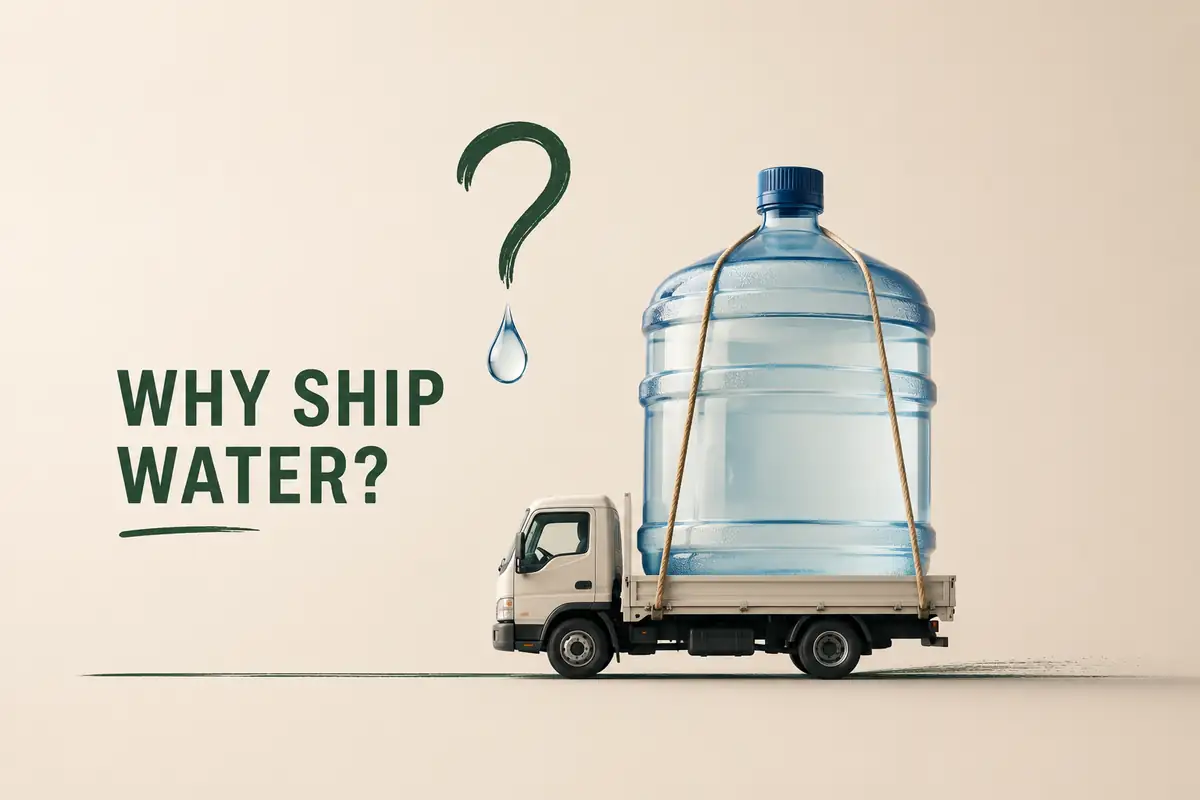
Concentrated Cleaning Products: Why Ship Water?
Stop Paying for Tap Water’s Road Trip: Switch to concentrated cleaning products
Have you ever stopped to think about what you’re actually paying for when you buy a bottle of household cleaner?
You might picture powerful cleaning ingredients, clever chemistry, a convenient spray nozzle, and a bottle designed to make cleaning easier.
But there is another ingredient inside that bottle that often gets overlooked:
Water.
Ready-to-use household cleaning products are, by design, mostly liquid. That makes them convenient—you open the bottle, spray, and start cleaning. But it also creates a surprisingly inefficient system.
Water is heavy.
And when you manufacture, package, warehouse, transport, stock, and eventually replace a bottle of ready-to-use cleaner, you’re moving all of that water through the supply chain along with the ingredients you actually need for cleaning.
Now ask yourself:
Why transport something that already comes out of your tap?
That’s the basic idea behind concentrated cleaning refills.
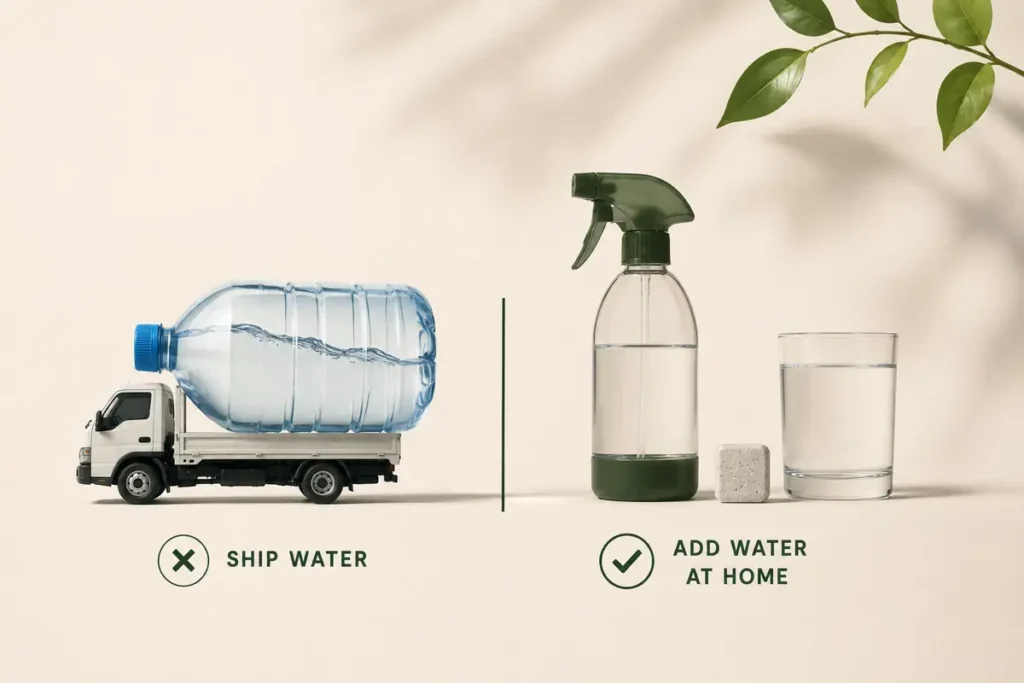
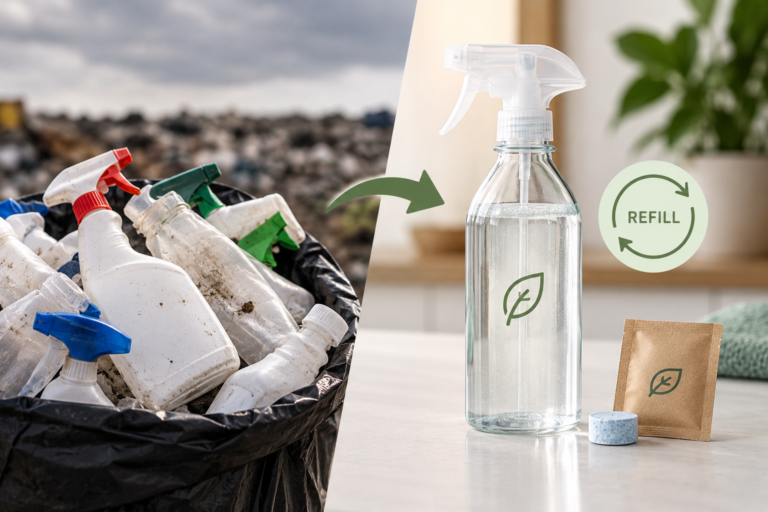
Instead of repeatedly buying a new bottle filled with a finished liquid, you keep your reusable bottle and add the cleaning concentrate at home with water from your faucet.
It’s a small change in your cleaning routine, but it challenges a much bigger assumption:
Do household cleaners really need to be sold as mostly water?
Read : Why use plastic just once ?
The Bottle Under Your Sink Has a Supply Chain
It’s easy to think about a cleaning spray as simply:
Buy → Use → Throw Away → Replace.
But before that bottle reaches your kitchen or bathroom, it has already travelled through a much longer journey.
The product needs to be manufactured.
It needs to be filled.
It needs packaging.
It needs to be packed for distribution.
It needs to move from the manufacturing facility to warehouses and retailers.
And eventually, it needs to make its way into your home.
At every stage, you’re dealing with a physical product that contains liquid.
That matters because water isn’t lightweight.
A concentrated product, on the other hand, separates the part of the product that needs to travel from the water you can add later.
The cleaning ingredients travel.
The water doesn’t have to.
That simple distinction is at the heart of the refill model.
Think About the Journey
Imagine two products that ultimately become the same amount of ready-to-use cleaner.
In the traditional model, the finished liquid is prepared at the manufacturing facility and transported as a liquid.
In a concentrated refill model, the formula is transported in a much smaller format and diluted at home.
The end result can be similar:
Concentrate + water = ready-to-use cleaner.
But the supply chain doesn’t have to look the same.
And that’s where things get interesting.
Follow Us on : Instagram
You’re Not Just Buying Cleaning Ingredients
When you buy any household product, the price isn’t simply the cost of its active ingredients.
The final price reflects everything involved in getting that product into your hands.
That can include:
- Raw materials
- Formulation and manufacturing
- Packaging
- Labour
- Transportation
- Warehousing
- Distribution
- Retail operations
- Marketing
- Business overheads
- Taxes and other costs
So when we talk about the “cost” of a cleaning spray, we shouldn’t assume that most of the price represents the cleaning ingredients themselves.
The bottle is part of the product.
The transportation is part of the supply chain.
The packaging is part of the experience.
And, when the product is sold ready-to-use, the water becomes part of everything that has to be moved and handled.
This doesn’t automatically make traditional cleaning products “bad.”
They are convenient.
They work.
And for many years, ready-to-use liquids have simply been the standard way household cleaning products have been sold.
But standard doesn’t necessarily mean optimal.
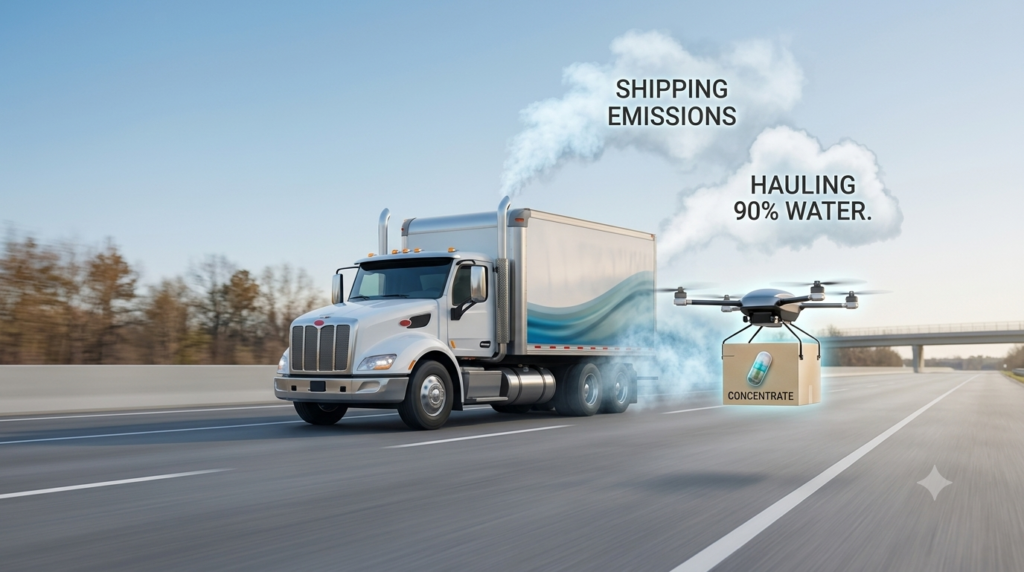
The Hidden Cost of Shipping Water
One of the most overlooked characteristics of water is also one of the most obvious:
It’s heavy.
If you transport a concentrated cleaning formula, you’re primarily transporting the ingredients required to create the final product.
If you transport a ready-to-use cleaner, you’re transporting those ingredients plus the water already added to the formula.
That difference becomes more meaningful when multiplied across thousands or millions of products.
Think about a supermarket shelf filled with household cleaners.
Every bottle arrived there somehow.
It may have travelled from a manufacturing facility to a distribution centre, then to a retailer, and finally home with you.
The exact supply chain varies by company and product, but the fundamental principle remains:
Moving heavier products requires moving more mass.
And transportation has an environmental footprint.
According to the International Energy Agency, road transport is a significant source of global carbon dioxide emissions, which is one reason reducing unnecessary transport weight can be an important part of more efficient supply chains.
This is where concentrated products have an interesting advantage.
They don’t eliminate transportation.
They simply change what is being transported.
What If the Water Came From Your Faucet?
This is the question that makes concentrated cleaning products so interesting.
Your home already has a water supply.
You don’t need a delivery truck to bring you the water required to dilute a cleaning concentrate.
You don’t need a new plastic bottle to hold that water every time you buy another refill.
You simply add the required amount at home.
The process is remarkably straightforward:
1. Keep your reusable bottle.
2. Add the concentrated refill.
3. Add the recommended amount of water.
4. Mix according to the product instructions.
5. Use your cleaner as normal.
Instead of buying the finished liquid over and over again, you buy the concentrated formula and complete the final dilution yourself.
It’s essentially moving one small step of the manufacturing process from the factory to your home.
And that can have implications for packaging, transportation, storage, and convenience.
The Plastic Problem Doesn’t End With the Bottle
Now let’s talk about the other part of the equation:
Packaging.
A ready-to-use cleaning product needs a container capable of holding the finished liquid.
Once that product is used up, the container is left behind.
If you replace the same product several times a year, that means repeatedly purchasing and disposing of additional packaging.
Recycling can help, but recycling isn’t the same thing as eliminating the need for new packaging.
There are collection systems to consider.
There are sorting and processing facilities.
There are transportation requirements.
And not every piece of plastic placed into a recycling bin ultimately becomes a new product.
This is why the concept of reuse can be powerful.
A reusable spray bottle changes the equation.
Instead of:
New cleaner → New bottle → Empty bottle → Repeat
you can move toward:
Reusable bottle → Refill → Refill → Refill
The bottle becomes an asset rather than something you repeatedly replace.
And the refill becomes the part of the product you purchase.
Reuse vs. Single-Use: A Simple Difference
Let’s make this practical.
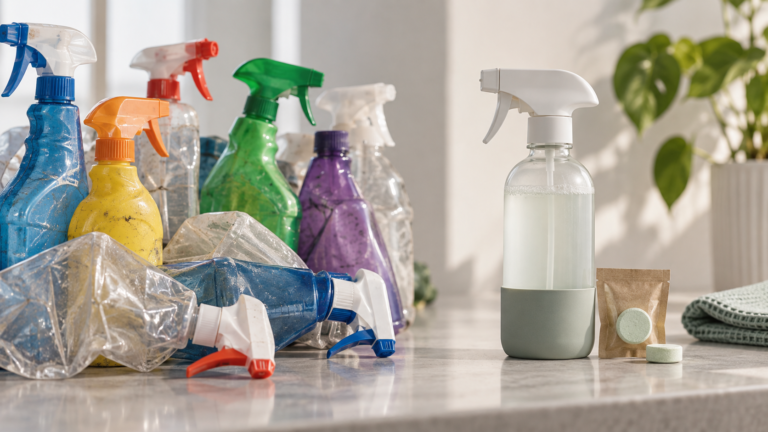
Imagine you buy a new spray bottle every time you run out of cleaner.
Over time, you accumulate bottles.
Some may be recycled.
Some may be discarded.
Some may sit under the sink because you aren’t sure whether they’re recyclable.
Now imagine that your primary spray bottle stays with you.
You don’t throw away the bottle when the cleaner runs out.
You simply refill it.
That doesn’t mean the refill has zero environmental impact.
It still requires ingredients.
It still requires packaging.
It still has to be manufactured and transported.
But it changes the type and amount of material entering your home over time.
That’s an important distinction.
Sustainability isn’t about finding a product with absolutely no impact.
It’s about looking for ways to reduce unnecessary impact.
Why Concentrated Cleaning Products Make Sense
The concept isn’t complicated.
Concentrates have been used in many industries because separating a product from the water used for dilution can make transportation and storage more efficient.
Cleaning products are a natural fit for this approach.
You already have access to water.
The product only needs to provide the ingredients necessary to clean.
So why not separate the two?
That is exactly what refill-based cleaning systems attempt to do.
Instead of purchasing a bottle of diluted product every time, you purchase a compact concentrate and dilute it when you need it.
For consumers, that can mean:
Less packaging
A reusable bottle can remain in your cleaning cupboard while you replace only the refill.
Less liquid to transport
The concentrate is much smaller than the final ready-to-use liquid.
Easier storage
Small refills can take up considerably less space than multiple full-size cleaning bottles.
A different shopping routine
Instead of constantly buying bulky bottles, you can keep a supply of compact refills at home.
Potentially less waste
If the refill system reduces the number of bottles entering your household, it can reduce packaging consumption over time.
But Is Concentrate Actually Better?
This is where we need to be sensible.
A concentrated cleaner isn’t automatically sustainable simply because it’s concentrated.
The entire system matters.
What is the refill made from?
How is it packaged?
How far does it travel?
What is the reusable bottle made from?
How long does the bottle last?
How much packaging does each refill require?
How is the packaging handled at the end of its life?
What ingredients are used in the formula?
These questions matter.
A sustainability claim should never stop at the word “concentrated.”
The goal should be to design a system where the concentrate, packaging, bottle, transportation, and user behaviour work together to reduce unnecessary material and weight.
That’s the bigger opportunity.
The Sensible Approach to Cleaning
This is the thinking behind The Sensible.
We believe cleaning products shouldn’t have to come with unnecessary baggage.
Your home already has water.
Your cleaning routine already has a spray bottle.
So instead of repeatedly shipping a complete bottle of diluted cleaner, why not rethink the system?
With a refill-based approach, your bottle can become the permanent part of the routine.
The concentrate becomes the part you replenish.
And your tap provides the water.
It’s a simple idea, but simple ideas can have meaningful consequences when repeated.
Once.
Twice.
Ten times.
A hundred times.
The impact of a reusable system isn’t about one bottle.
It’s about what happens when the same behaviour is repeated over and over again.
From “Buy and Throw” to “Keep and Refill”
For decades, many household products have followed a familiar model:
Buy → Use → Dispose → Buy Again.
But there is another model:
Buy → Keep → Refill → Repeat.
The second model asks us to think differently about the role of packaging.
Instead of seeing the bottle as disposable packaging, we see it as part of the product itself.
That’s a subtle shift.
And it changes how you think about consumption.
The goal isn’t to make cleaning harder.
Quite the opposite.
The best sustainable alternatives should fit naturally into the routine you already have.
You shouldn’t have to completely change how you clean your kitchen counters, bathroom surfaces, tables, sinks, or other everyday areas.
You simply change what you buy.
Small Changes Can Add Up
It’s easy to dismiss a single cleaning bottle.
After all, it’s only one bottle.
But household consumption doesn’t happen one product at a time.
Millions of households buy cleaning products repeatedly.
One bottle becomes many.
One shopping trip becomes dozens.
One year becomes several years.
That’s why seemingly small changes can be worth considering.
You don’t need to completely redesign your lifestyle to make a more conscious choice.
You can start with something as ordinary as the cleaner sitting beside your sink.
Instead of asking:
“Which bottle should I buy?”
you can ask:
“Do I need to buy another bottle at all?”
That question changes the conversation.
The Economics of Refilling
There’s another reason refill systems are gaining attention:
They can change what you’re paying for.
When you buy a ready-to-use cleaner, you’re purchasing a finished product that includes its packaging, water, transportation, distribution, and retail journey.
With a concentrate, you’re purchasing a smaller product designed to become the finished cleaner after dilution.
That doesn’t guarantee that every refill will be cheaper.
Pricing depends on the formula, brand, packaging, concentration, manufacturing costs, and many other factors.
But the model creates the possibility of getting more usable cleaning solution from a smaller physical product.
And that can make the economics worth examining.
The real comparison isn’t simply:
Bottle price vs. refill price.
It’s:
How much ready-to-use cleaner do I get, how often do I need to replace the bottle, and what am I actually paying for?
That’s a much more useful way to compare cleaning products.
A Better Question to Ask at the Store
Next time you’re standing in the cleaning aisle, don’t just look at the front label.
Turn the bottle around.
Look at the ingredients.
Look at the instructions.
Look at the packaging.
Look at how much product you’re actually getting.
Then ask yourself:
How much of this product needs to be transported as liquid?
And:
Could I add the water myself?
You don’t have to change every cleaning product in your home overnight.
You don’t have to throw away everything you already own.
You can simply start with one product.
Try a refill.
Keep the bottle.
See how it fits into your routine.
That’s how more sensible consumption works—not through perfection, but through better choices repeated consistently.
The Future of Cleaning Might Be Smaller
For years, we have associated a “full-size” cleaning product with a big bottle sitting on a supermarket shelf.
But maybe the future looks different.
Maybe the product you bring home isn’t a large bottle filled with liquid.
Maybe it’s a small refill.
Maybe the bottle stays at home.
Maybe your tap supplies the water.
Maybe the cleaning aisle gradually becomes less about selling more packaging and more about selling better formulas.
That’s the idea behind refill-based cleaning.
The product gets smaller. The bottle lasts longer. And the water comes from where it already was.
It’s not complicated.
It’s just a different way of thinking.
So, Are You Paying for Cleaning—or for Its Journey?
The next time you pick up a traditional cleaning spray, think about everything that had to happen before you could press the trigger.
Ingredients were sourced.
The formula was manufactured.
The product was diluted.
A bottle was produced.
The bottle was filled.
The product was packaged.
It travelled through the supply chain.
It reached a store.
And then you brought it home.
Some of those steps are necessary.
But some of the weight you’re transporting is simply water.
Water that is already available in your home.
That’s the part worth questioning.
Because when a product can be concentrated, packaged more efficiently, and diluted at the point of use, we have an opportunity to rethink the traditional model.
Not because traditional cleaners don’t work.
Not because every plastic bottle is automatically bad.
And not because one refill will solve the world’s waste problem.
But because better systems start by questioning unnecessary steps.
The Sensible Way Forward
At The Sensible, we believe everyday cleaning shouldn’t require unnecessary waste to be convenient.
A cleaning product should do its job.
Your bottle should last.
Your refill should take up less space.
And the water?
That can come from your tap.
It’s a small change to your cleaning cupboard, but it’s part of a bigger idea:
Use what you already have. Reuse what you can. Refill instead of replacing. And don’t transport what doesn’t need to travel.
Because sometimes the most sensible solution isn’t inventing something completely new.
It’s simply asking:
“Why are we shipping this in the first place?”
And when the answer is “because it’s mostly water,” there’s a better question waiting:
“Why not add the water at home?”
That’s the thinking behind The Sensible.
Less unnecessary weight. Less throwaway packaging. A smarter refill routine.
And, perhaps most importantly, a cleaning system designed around what you actually need—not everything you don’t.
Make the Switch to a More Sensible Cleaning Routine
Ready to rethink what’s sitting under your sink?
Explore The Sensible’s refill-based cleaning products and see how concentrated cleaning can fit into your everyday routine.
Keep the bottle. Refill the formula. Add the water at home.
Because you shouldn’t have to pay for tap water’s road trip.
3 Comments