Minimalist Cleaning Cupboard: Evict the Under-Sink Plastic Graveyard
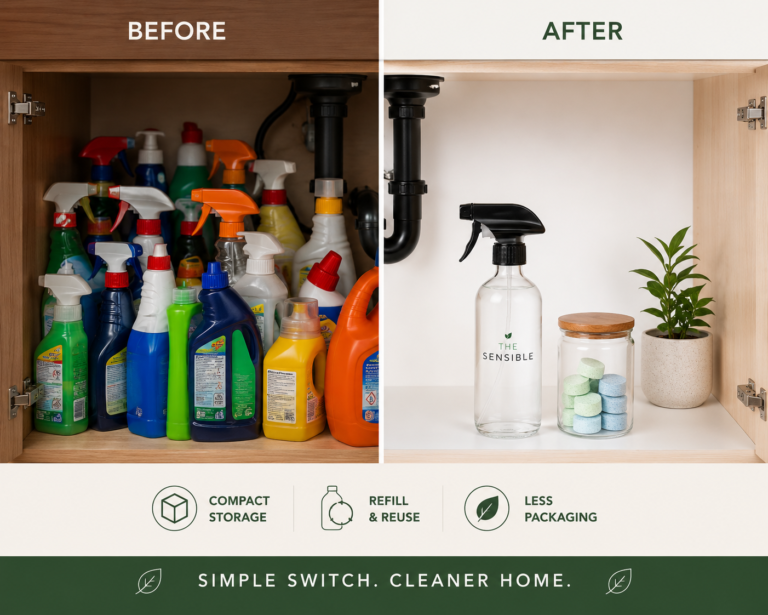
Open the cabinet under your sink.
What do you see?
A glass cleaner. A bathroom cleaner. A kitchen degreaser. A floor cleaner. A stainless-steel spray. Maybe a bottle for tiles, another for granite, another for mirrors, and two or three products you bought once and never used again.
Somewhere at the back, there is probably at least one mystery bottle with a faded label that nobody remembers buying.
For many homes, the under-sink cabinet has quietly turned into a storage zone for half-used cleaning products.
Not because we love clutter.
Because we have been taught to think that every surface needs its own bottle.
Kitchen counter? One product.
Glass? Another.
Bathroom tile? Another.
Sink? Another.
Dining table? Another.
The result is a cabinet full of plastic, overlapping products, duplicate functions, and a cleaning routine that feels more complicated than it needs to be.
But does every everyday surface really need a completely different cleaner?
Usually, the answer is no.
For many routine cleaning tasks, what matters is having a suitable formulation, using it on the right surface, and following the product instructions properly.
That opens the door to a simpler idea:
Fewer bottles. Fewer duplicates. More intentional cleaning.
And that is where the minimalist cleaning cupboard starts to make sense.
What Is a Minimalist Cleaning Cupboard?
A minimalist cleaning cupboard is not about owning the absolute minimum number of cleaning products possible.
It is about removing unnecessary overlap.
The goal is simple:
Keep only the products you actually use.
Choose versatile products where appropriate.
Avoid buying multiple cleaners that perform almost the same job.
Store refills efficiently.
Make it easy to see what you already own.
Instead of a cabinet filled with 12 or 15 bottles, you might have:
- One everyday multi-surface cleaner
- One bathroom-specific product if required
- One glass cleaner if your multi-surface product is not suitable for glass
- One floor-cleaning product where necessary
- A small number of specialised products for genuinely specialised jobs
That is very different from keeping separate bottles for every room, material, and minor variation in cleaning.
Minimalism here is not about aesthetics alone.
It can improve organisation, reduce unnecessary purchases, save space, and make your cleaning routine easier to understand.
Why Do Cleaning Cupboards Become So Cluttered?
Most people do not deliberately decide to build a collection of cleaning bottles.
It happens gradually.
You see an advertisement for a new bathroom spray.
You buy a glass cleaner because the existing product leaves streaks.
Someone recommends a heavy-duty kitchen degreaser.
You pick up a floor cleaner in a different fragrance.
Then you find a product made specifically for stainless steel.
A few months later, your cabinet has doubled in size.
The problem is not that every specialised product is unnecessary.
Some surfaces and cleaning situations genuinely require specific formulations.
The problem is defaulting to specialisation even when it adds little value.
Over time, the cupboard becomes a collection of products that may overlap heavily in function.
Several products may all be designed to remove:
- Dust
- Light grease
- Fingerprints
- Food residue
- Everyday dirt
- Surface grime
Yet each arrives in its own bottle.
That is how clutter builds.
The “One Surface, One Bottle” Habit
The cleaning industry often presents products by location or surface.
Kitchen cleaner.
Bathroom cleaner.
Glass cleaner.
Tile cleaner.
Counter cleaner.
Appliance cleaner.
Multi-surface cleaner.
From a consumer perspective, this can create a simple mental rule:
Different surface = different bottle.
But formulation does not always map that neatly.
Many everyday cleaners rely on combinations of ingredients designed to help loosen soil, reduce surface tension, lift grease, suspend dirt, and help it wipe away.
The suitability of a product still depends on its formulation and the surface it is used on.
But the broader point remains:
You do not necessarily need a completely separate bottle every time the label changes.
The smarter question is:
What cleaning job is this product actually doing?
That is much more useful than asking which room the packaging says it belongs in.
What Do Surfactants Actually Do?
One of the most important ingredient categories in many household cleaners is the surfactant.
Surfactants help water interact more effectively with dirt and oily residues.
Water by itself does not always spread or mix well with grease.
Surfactants help reduce surface tension and can help loosen and lift soils from a surface so they can be wiped or rinsed away.
That is why they are widely used across household cleaning products.
But “contains surfactants” does not automatically mean every cleaner is interchangeable.
Different products may also contain:
- Solvents
- Chelating agents
- Fragrances
- Builders
- Acids
- Alkalis
- Preservatives
- Abrasives
- Other functional ingredients
The concentration and combination of these ingredients affect where the product should be used.
So the minimalist approach is not:
Use one random cleaner on everything.
It is:
Avoid unnecessary duplication while still respecting surface compatibility and product instructions.
That distinction matters.
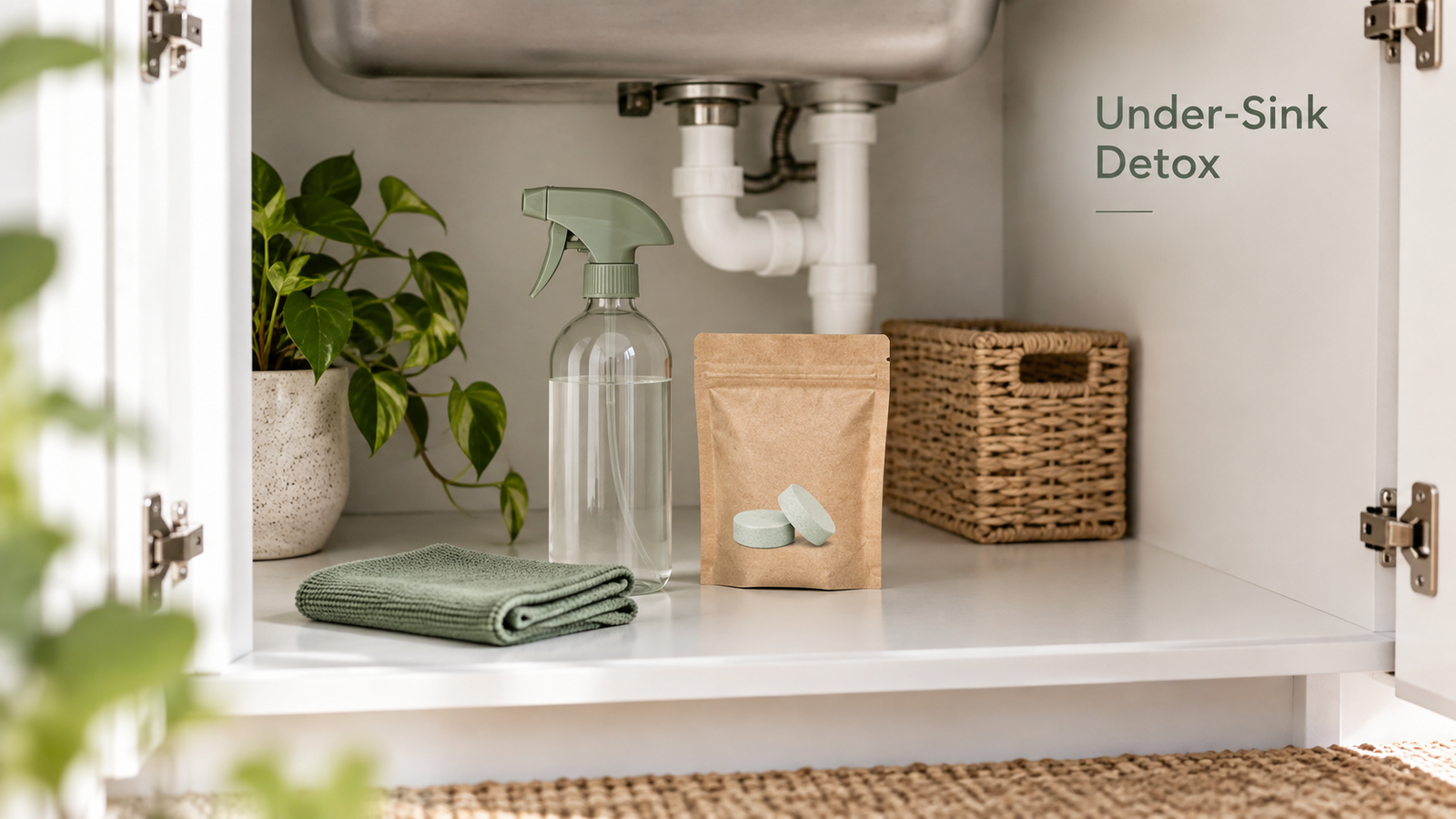
Time for an Under-Sink Detox
If your cleaning cupboard feels chaotic, the easiest way to fix it is to start with everything you already own.
Do not buy new storage boxes yet.
Do not order matching bottles yet.
First, understand what is inside the cabinet.
Take every cleaning product out.
Put them somewhere visible.
Now sort them into groups.
You may be surprised by how much overlap appears once everything is side by side.
You might discover:
Three bathroom cleaners.
Two glass cleaners.
Four half-finished multi-surface sprays.
Several duplicate floor-cleaning liquids.
A specialist cleaner you forgot existed.
And products that expired or have been sitting unused for years.
The point is not to throw everything away immediately.
The point is to see the system clearly.
Step 1: Identify What You Actually Use
Create three simple categories:
Use regularly
These are products you reach for every week or every few weeks.
They clearly have a place in your routine.
Use occasionally
These might be useful for specific materials or deeper cleaning tasks.
You do not need them every day, but they still serve a purpose.
Never use
These are the products creating most of the clutter.
Maybe they did not work well.
Maybe they were bought for one specific problem.
Maybe you replaced them with something better.
Maybe you simply forgot about them.
This category is important because people often continue storing products long after they stopped using them.
Storage space becomes a museum of previous purchasing decisions.
A minimalist cupboard should reflect your current routine.
Not every cleaner you have ever bought.
Step 2: Look for Duplicate Functions
Now compare products by what they actually do.
For example:
A kitchen surface spray and a multi-surface cleaner may both be suitable for many sealed kitchen surfaces.
A separate countertop cleaner may add little if another compatible product already handles the same task.
Two different glass cleaners probably do not need to live under the same sink.
Three bottles of nearly identical bathroom cleaner do not improve your cleaning routine simply because they use different branding.
Ask:
Does this product do something unique?
If the answer is no, the duplication may not be necessary.
This does not mean throwing a usable product away.
You can finish existing products before replacing them.
The goal is to stop repurchasing duplicates once they run out.
Step 3: Keep Specialised Products Only Where They Are Actually Needed
Minimalism becomes unhelpful when it turns into oversimplification.
There are situations where a specialised product makes sense.
For example, delicate natural stone may need different care from a general kitchen counter.
Heavy limescale may require a product designed for mineral deposits.
Certain floor types may require specific cleaning instructions.
Cooktops, ovens, upholstery, and other surfaces can also have special requirements.
So do not force one product onto every material just to reduce the number of bottles.
Instead, think in terms of categories:
Everyday cleaning
Use versatile products where appropriate.
Specialised cleaning
Keep a dedicated product only when there is a genuine reason for it.
This gives you the best of both worlds.
A simple cupboard without careless product use.
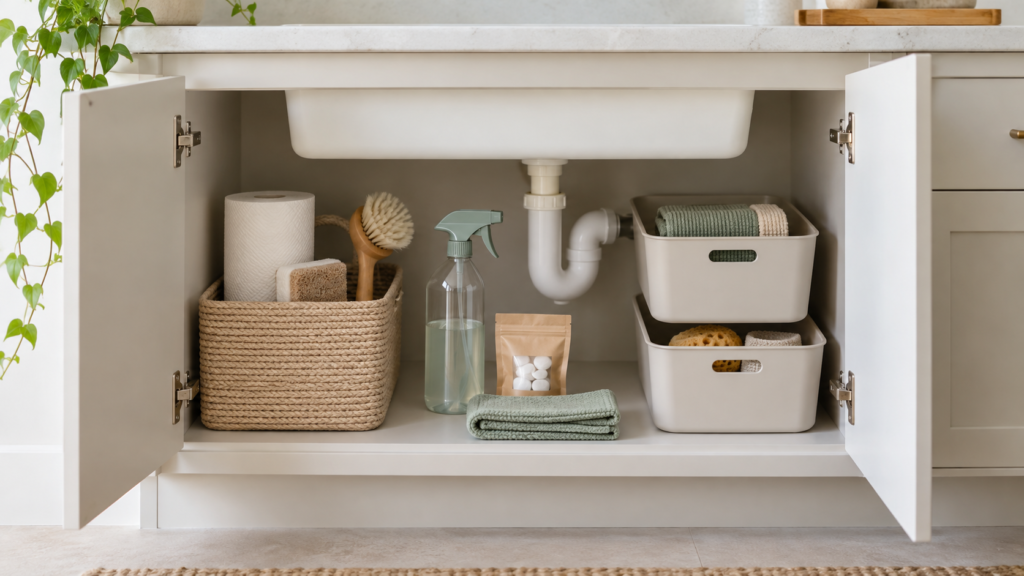
Step 4: Create a Core Cleaning Kit
Most homes can build a small core cleaning system around a few essentials.
For example:
1. An everyday surface cleaner
This handles compatible counters, tables, cabinets, and other everyday surfaces.
2. A bathroom cleaner
Useful if the bathroom requires a formulation designed for soap residue, mineral buildup, or other bathroom-specific soil.
3. A glass cleaner
Keep one only if your general cleaner is unsuitable for glass or does not produce the finish you want.
4. A floor-cleaning product
Choose the correct product for your flooring type.
5. A few physical cleaning tools
Microfiber cloths, sponges, brushes, and a mop often matter just as much as the cleaning liquid itself.
This is already far simpler than a cupboard containing 15 partially overlapping spray bottles.
The Multi-Surface Cleaner: Useful, but Not Magical
Multi-surface cleaners can be an important part of a minimalist cleaning cupboard.
But the phrase “multi-surface” needs to be understood properly.
It does not mean:
Every surface in existence.
It means the formulation has been designed for use across a range of compatible surfaces.
Always check the product instructions.
A multi-surface cleaner may work well on common sealed household surfaces but still be unsuitable for:
- Certain natural stones
- Unsealed wood
- Some specialty coatings
- Screens and electronics
- Delicate fabrics
- Other sensitive materials
A minimalist cupboard works because you understand what each product can safely do.
Not because you assume one bottle is universal.
Why Refill Systems Fit a Minimalist Cleaning Cupboard
Once you reduce unnecessary product overlap, the next source of clutter becomes obvious.
The bottles themselves.
Traditional liquid cleaners often require storing multiple replacement bottles.
You might finish one spray cleaner and buy another complete bottle.
Then another.
Then another.
That means your cabinet repeatedly stores bulky containers filled with liquid.
Concentrated refill formats approach the problem differently.
Instead of replacing the bottle every time, you can potentially reuse a suitable container and replenish the formulation.
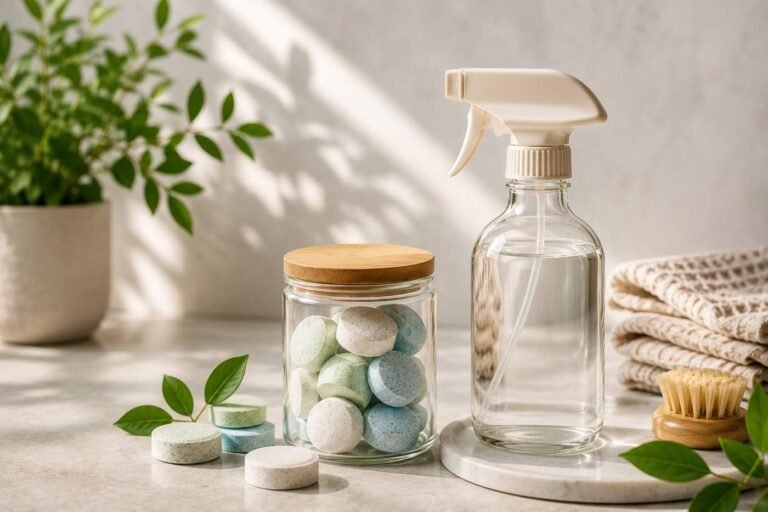
Cleaning tablets are one example.
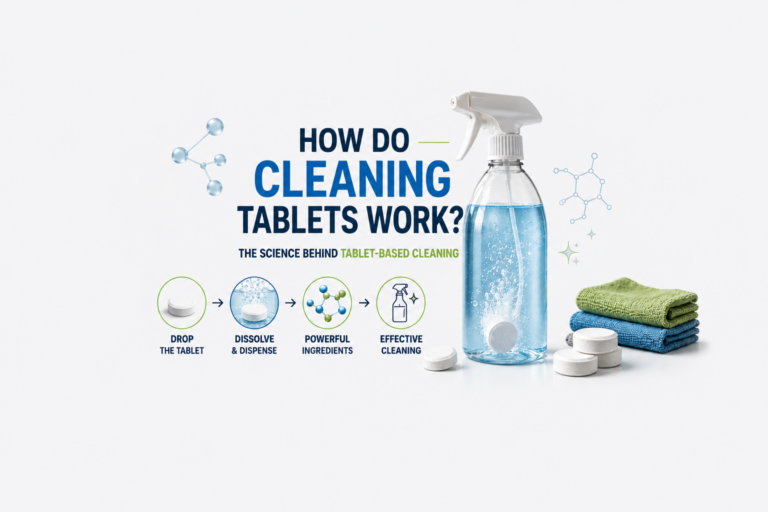
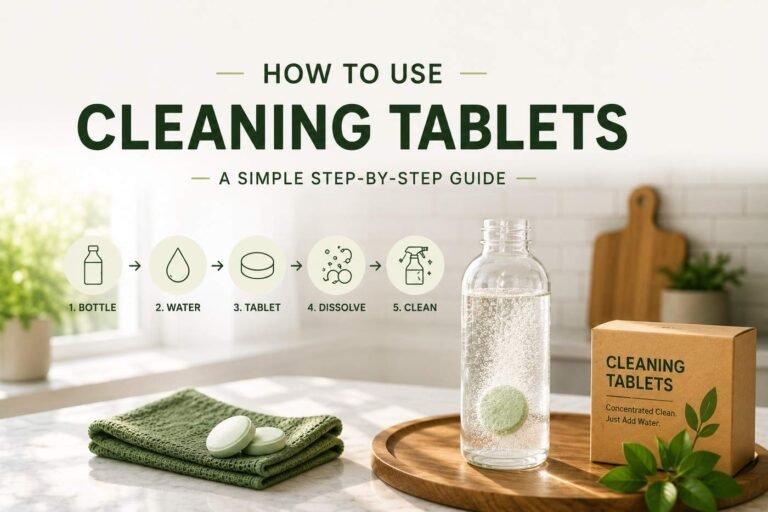
The basic process is simple:
Keep the bottle → add the recommended amount of water → add the tablet → allow it to dissolve → use the cleaner
The bottle stays.
The refill takes up very little space.
That can work particularly well in a minimalist cupboard because you are reducing both:
product duplication
and
packaging volume
The Under-Sink Cabinet Is Prime Real Estate
Kitchen storage is valuable.
Especially in smaller homes and apartments.
The cabinet under the sink is often one of the few convenient places to store:
Cleaning products.
Trash bags.
Sponges.
Brushes.
Dishwashing supplies.
Cloths.
Gloves.
Buckets.
If cleaning bottles consume most of that space, everything else gets pushed into awkward corners.
Large liquid containers are especially inefficient.
They occupy space even when almost empty.
You can have five bottles taking up a large part of the cupboard while each contains only a small amount of product.
Compact refills change that.
A small packet of concentrated tablets can occupy a fraction of the space taken up by multiple full-sized bottles.
That is where the practical benefit becomes obvious.
Minimalism is not simply about making the cabinet look Instagram-ready.
It is about making the storage space function better.
Aesthetic Is a Bonus. Function Comes First.
There is nothing wrong with wanting your home to look organised.
A tidy cleaning cupboard can be satisfying.
Matching containers can look good.
A clean countertop can feel calmer.
But aesthetics should not be the only reason to simplify your cleaning products.
The functional benefits are more important.
A good cleaning cupboard makes it easy to:
Find the product you need.
Know when something is running low.
Avoid accidentally buying duplicates.
Keep incompatible products separate.
Store products safely.
Clean up quickly.
When the cupboard works properly, the aesthetic usually follows naturally.
There is simply less stuff competing for attention.
Why Clutter Encourages More Buying
This sounds counterintuitive.
You might assume that having lots of products prevents you from buying more.
Often, the opposite happens.
When a cupboard becomes cluttered, it becomes harder to see what you already own.
You cannot find the bathroom cleaner, so you buy another.
The glass cleaner is hidden behind a large bottle, so you assume it is finished.
You forget that two refill bottles are already sitting at the back.
The more chaotic the storage becomes, the harder inventory management gets.
Retailers use inventory systems for a reason.
Your house does not need software.
But it does benefit from visibility.
When every product has a clear place, you know what you have.
That helps reduce unnecessary purchases.
The Psychology of “Just in Case”
Another reason cleaning cupboards grow is the “just in case” mindset.
Maybe you will need that specialist cleaner eventually.
Maybe the old bottle still has one use left.
Maybe that half-empty spray could be useful for something.
Maybe you should keep three backup bottles because there was a discount.
Individually, each decision seems harmless.
Collectively, they create clutter.
A useful rule is:
Keep backups only for products you actually use consistently.
A product you have not touched for two years is not an emergency supply.
It is simply taking up space.
Does a Minimalist Cleaning Cupboard Save Money?
Potentially.
But the savings do not come from owning fewer things for the sake of it.
They come from buying more intentionally.
If you stop buying duplicate products, you reduce unnecessary spending.
If you finish products before replacing them, you waste less.
If you use versatile products appropriately, you may need fewer separate cleaners.
If concentrated refill formats cost less per prepared bottle, they may also reduce packaging and storage costs depending on the product.
However, price should always be compared based on the actual finished cleaning solution.
For cleaning tablets, look at:
Cost of refill + amount of finished cleaner produced
rather than simply comparing the price of one tablet with one bottle.
That gives you a much more meaningful comparison.
Cleaning Tablets Can Make Inventory Simpler
Traditional bottles are easy to forget.
One might be nearly empty.
Another might be hidden.
Another might have leaked.
Refill tablets are easier to count.
You can look at a small box and know:
Five refills left.
Three refills left.
One refill left.
That makes replenishment easier.
Instead of opening the cupboard and trying to judge how much liquid remains across several bulky containers, you can see your supply more clearly.
For a minimalist system, that simplicity matters.
Fewer Bottles Can Also Mean Fewer Visual Decisions
Clutter creates small mental interruptions.
Which cleaner should I use?
Is this one for the kitchen?
Is that one safe for the table?
Which bottle is almost empty?
Where did I put the glass spray?
None of these decisions is particularly difficult.
But repeated friction adds up.
A simpler cleaning kit makes the routine more predictable.
For example:
Everyday mess → everyday surface cleaner
Bathroom buildup → bathroom cleaner
Glass → glass-compatible product
Floor → correct floor cleaner
That is enough structure for most everyday situations.
Also Read : Why Reuse Beats Throwing Away?
Do You Really Need a Different Cleaner for Every Room?
Probably not.
A room is not a material.
Your kitchen contains:
Glass.
Metal.
Stone or laminate.
Plastic.
Wood.
Ceramic.
Painted surfaces.
Your bathroom also contains several different materials.
So dividing cleaning products strictly by room can sometimes be less useful than dividing them by function and surface compatibility.
Instead of thinking:
Kitchen bottle.
Bathroom bottle.
Bedroom bottle.
Think:
Everyday compatible surfaces.
Glass.
Flooring.
Specialised buildup.
That usually produces a simpler, more logical system.
What About Disinfectants?
Cleaning and disinfecting are related but different tasks.
Cleaning primarily removes dirt, grease, debris, and other material from surfaces.
Disinfection is intended to reduce or inactivate microorganisms according to the product’s directions.
You should not assume that every general cleaner is a disinfectant.
And you should not assume every surface needs routine disinfection all the time.
If you need a disinfecting product, use one that is specifically designed and labelled for that purpose and follow its contact-time instructions carefully.
A minimalist cupboard can still include a disinfectant.
The point is simply that it should have a clear function.
Why More Products Don’t Automatically Mean a Cleaner Home
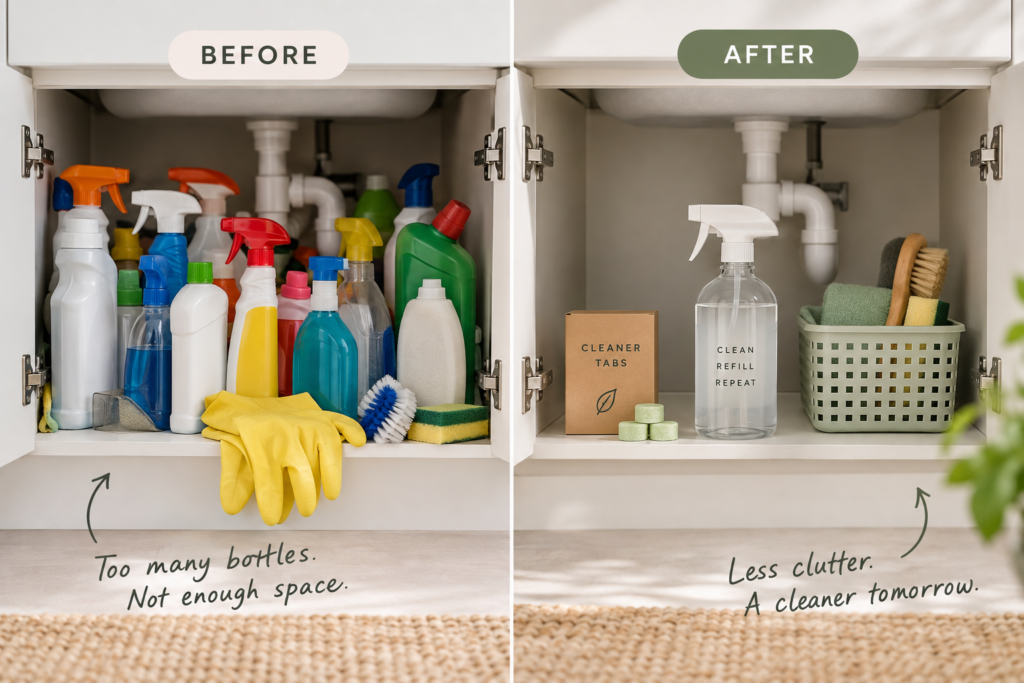
Having 15 cleaning bottles does not guarantee better cleaning.
Cleaning effectiveness depends on factors such as:
The right formulation.
Correct dilution.
Appropriate contact time.
Proper wiping or scrubbing.
Surface compatibility.
Consistent cleaning habits.
A cupboard filled with products does not compensate for using them incorrectly.
In fact, a smaller number of well-understood products may be easier to use properly because you actually know what each one is designed to do.
The “Use What You Have” Rule
If you’re starting your minimalist cleaning cupboard today, do not throw away 12 perfectly usable products simply because you want a cleaner-looking cabinet.
That defeats the purpose.
Use what you already own.
Finish compatible products.
Avoid purchasing replacements for unnecessary duplicates.
Over time, the cupboard naturally becomes simpler.
This is much more sensible than replacing every existing bottle with a brand-new minimalist version in one weekend.
Sustainability does not require an immediate aesthetic reset.
Often, the most responsible thing is simply:
Use the product you already bought.
How to Organise the Cupboard Once You’ve Decluttered
Once the unnecessary duplicates are gone, organisation becomes much easier.
You do not need an elaborate storage system.
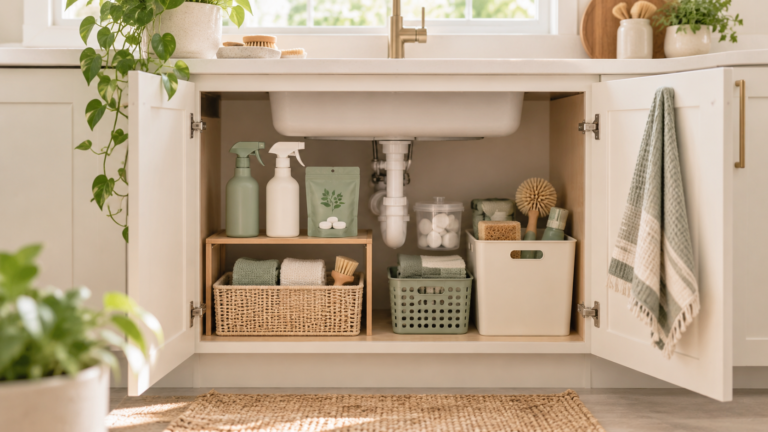
A few simple zones are enough.
Daily-use products
Keep frequently used cleaners near the front.
Specialised products
Store occasional-use products together.
Refills
Keep concentrated tablets or other refills in a dry, clearly labelled area.
Cleaning tools
Use a basket or container for cloths, sponges, brushes, and gloves.
Backups
Keep only a reasonable quantity.
The main rule:
Everything should be visible and easy to access.
If you have to remove six bottles to reach another bottle, the system is too crowded.
Safety Still Comes Before Minimalism
Cleaning cupboards contain chemical products.
Organisation should never compromise safety.
Always:
Keep products in clearly identified containers.
Follow manufacturer storage instructions.
Keep cleaning products away from children and pets.
Avoid mixing different products.
Never transfer cleaners into beverage bottles or food containers.
Keep incompatible products separated where required.
Make sure lids and spray triggers are closed properly.
A beautiful cupboard that creates confusion is not an improvement.
Clear labelling matters more than aesthetics.
Reusable Bottles Need Maintenance Too
A refill system does not mean using the same bottle forever without cleaning it.
Reusable bottles need care.
When preparing a new batch, follow the product instructions regarding rinsing and cleaning.
Do not continuously top up old solution indefinitely.
If you switch between different formulations, clean the bottle appropriately before reuse.
Never mix leftover cleaning chemicals simply to avoid wasting a small amount.
A minimalist system works best when the bottle has one clearly defined purpose.
The Countertop Version of Minimalism
The same principle applies outside the cupboard.
Many homes keep several cleaning products visible on kitchen or bathroom counters.
A multi-surface spray.
Handwash.
Glass cleaner.
Disinfectant.
Bathroom spray.
Then another bottle appears.
And another.
Visual clutter grows quickly.
If one reusable bottle handles most everyday compatible surfaces, the counter becomes simpler too.
One attractive bottle can stay within easy reach.
The remaining specialised products can stay stored until needed.
That is where aesthetics and function align naturally.
A Simple Minimalist Cleaning Setup
A practical setup could look something like this:
On the counter
One reusable everyday cleaning bottle.
A clean microfiber cloth.
Under the sink
One bathroom-specific cleaner.
One floor product.
One glass cleaner if required.
One specialist product for occasional difficult jobs.
A small box of cleaning tablet refills.
A few cleaning tools.
That’s it.
Not because minimalism demands a specific number.
But because every item has a reason to be there.
The Refill Drawer Idea
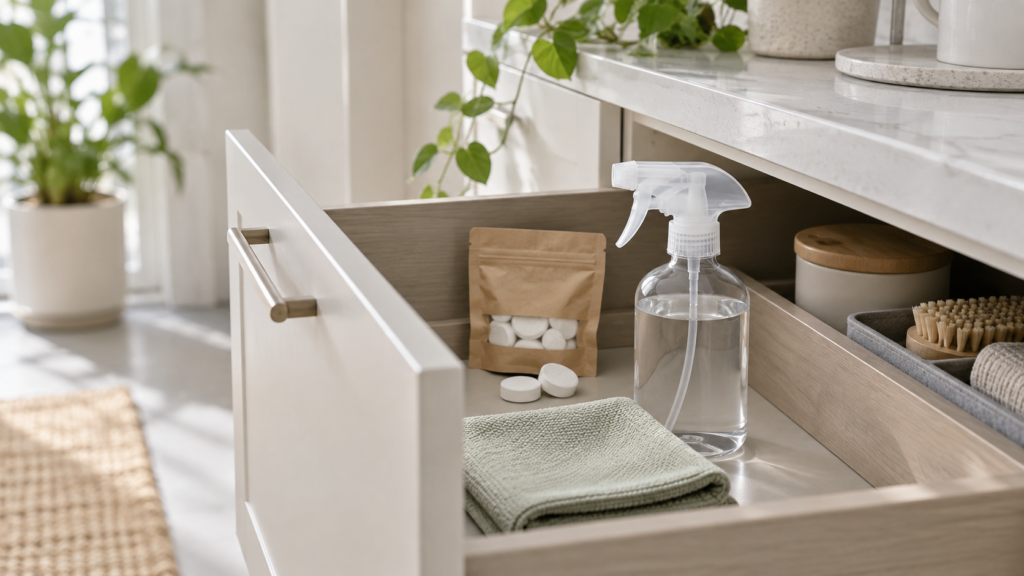
One of the nicest things about concentrated cleaning formats is that refills do not necessarily need to live under the sink.
If the packaging instructions allow it, they can be stored somewhere cool and dry.
A small drawer.
A utility cupboard.
A dedicated refill container.
This frees the under-sink cabinet for larger tools and products.
It also protects moisture-sensitive cleaning tablets from damp environments.
That matters because many dissolvable tablets need to remain dry before use.
Compact storage is one of the less glamorous but genuinely useful advantages of refill formats.
Minimalism Is Really About Better Systems
Minimalism often gets presented as:
Own less.
Throw things away.
Buy beige containers.
That is a very shallow version of the idea.
Functional minimalism is about designing systems with less unnecessary friction.
A minimalist cleaning cupboard works when:
You know what every product does.
You can find everything quickly.
You are not buying duplicates.
The products are stored safely.
Your routine is simple.
Refills are easy to manage.
There is enough space for the tools you actually need.
That is much more valuable than simply making the cabinet photograph well.
The Sustainable Angle
Reducing clutter can also reduce packaging turnover.
If you use fewer overlapping products, fewer containers need to enter your household.
If a compatible bottle can be reused across multiple refills, the durable component remains in service longer.
If concentrated formats reduce the amount of prepared liquid that needs to be stored and transported, the system can also become more space-efficient.
None of this makes any product impact-free.
But it does challenge an unnecessary pattern:
Buy bottle → use cleaner → discard bottle → repeat
A refill model asks a different question:
Why replace the bottle if the bottle still works?
That is the same thinking behind the “forever bottle” approach.
A Cleaner Cupboard Can Change How You Shop
Once you simplify the cupboard, shopping becomes easier too.
Instead of wandering through the cleaning aisle and buying whatever looks useful, you have a clear system.
You know:
What you use.
What needs replacing.
What you already have.
Which surfaces need specialist care.
How many refills remain.
That reduces impulse purchases.
It also makes comparison easier.
You can evaluate products based on function rather than marketing categories.
Does it replace something you already use?
Does it perform a genuinely different job?
Is it compatible with your surfaces?
Is the refill system practical?
If the answer is no, it probably does not need space in your cupboard.
The 10-Minute Under-Sink Reset
You do not need an entire weekend.
Try this:
Take everything out.
Wipe the cabinet.
Group similar products.
Move duplicates together.
Put unused or questionable products aside for proper disposal according to local guidance.
Return regularly used products first.
Return specialised products second.
Put backups at the back.
Store refills together.
Keep cleaning tools in one small basket.
Stop.
Your cabinet should already feel dramatically different.
The important part happens afterward:
Do not refill the clutter.
When a product runs out, ask whether it actually needs replacing.
Questions to Ask Before Buying Another Cleaner
Before the next bottle goes into your basket, ask:
Do I already own something that does this job?
Is this product genuinely suitable for a different surface or cleaning need?
Will I actually use it regularly?
Is there a concentrated refill option?
Can I reuse an existing suitable bottle?
Am I buying this because I need it or because the packaging promises a very specific cleaning problem?
Those five seconds of thought can prevent another bottle from disappearing into the back of the cupboard for three years.
Why This Fits The Sensible
At The Sensible, the idea is not to turn household cleaning into another complicated sustainability project.
It should become simpler.
A crowded cabinet full of partially used plastic bottles is not particularly efficient.
Neither is transporting and storing a full new bottle every time the cleaner runs out when a refill system can work instead.
The alternative is straightforward:
Use fewer products where appropriate.
Keep the bottles that still work.
Refill what you actually need.
Store the concentrate, not endless bulky liquids.
It is less about being perfect.
More about removing the parts of the routine that never made much sense.
Frequently Asked Questions
How many cleaning products do I actually need?
There is no universal number. It depends on your home’s surfaces and cleaning needs. The goal is to avoid unnecessary duplication while keeping specialised products where they are genuinely required.
Can one multi-surface cleaner replace every cleaning product?
No. Multi-surface cleaners are suitable for a range of compatible surfaces, but they are not automatically safe or effective for every material. Always follow the manufacturer’s instructions.
Are cleaning tablets good for small homes?
Compact refill formats can be particularly convenient where storage space is limited because the refills generally take up much less room than multiple bottles of prepared liquid.
Can cleaning tablets replace all my cleaning bottles?
That depends on the specific products available and the surfaces in your home. Tablet formats may work well for several everyday cleaning categories, but you may still need specialised products for certain jobs.
Is it safe to reuse cleaning spray bottles?
Reuse only suitable bottles and follow the product manufacturer’s instructions. Keep bottles clearly identified and avoid mixing different cleaning formulations.
Should I throw away old cleaning products when decluttering?
Do not dispose of chemical cleaning products casually. Follow the disposal instructions on the label and any applicable local waste guidance. If the product is still usable and appropriate, finishing it before switching systems can reduce waste.
Where should I store cleaning tablet refills?
Follow the manufacturer’s instructions. Many tablet formulations should be kept dry and protected from moisture until use.
Why is my under-sink cupboard always cluttered?
Duplicate cleaners, oversized bottles, rarely used specialist products, and excessive backups are common causes. Grouping products by function can make unnecessary overlap much easier to identify.
Is minimalist cleaning actually cheaper?
It can be if it helps you avoid duplicate purchases and unnecessary specialty products. However, always compare products based on how much usable cleaning solution they provide rather than package size alone.
What is the easiest way to start?
Do not buy anything.
Take everything out of the cupboard.
Identify duplicates.
Finish what you already have.
Then replace only the products that have a clear role in your routine.
Final Takeaway
Your under-sink cabinet does not need to look like the cleaning aisle of a supermarket.
More bottles do not automatically mean better cleaning.
Often, they mean more clutter, more duplicate products, more storage problems, and more packaging moving through the household.
A better system can be surprisingly simple.
Keep the products that have a clear purpose.
Use versatile cleaners where appropriate.
Keep specialised products for genuinely specialised jobs.
Reuse suitable bottles instead of automatically replacing them.
Store concentrated refills in a small, organised space.
The result is not just a prettier cupboard.
It is a cleaning routine that is easier to understand, easier to maintain, and harder to overbuy.
So the next time you open the cabinet under the sink and a tower of spray bottles starts falling toward you, remember:
You probably do not need a bigger cabinet.
You need a better system.
Follow The Sensible On: