
How to Deal With Dust in Indian Homes: A Practical Guide That Actually Works
Dust in indian homes?
You clean the table in the morning.
By evening, there is already a thin layer of dust sitting on it again.
You wipe the TV unit.
Two days later, fingerprints and grey dust are back.
You clean the windowsill.
The next morning?
Same story.
If you live in India, dust can feel less like a cleaning problem and more like a permanent roommate.
And depending on where you live, it can get worse because of:
- Road traffic
- Construction
- Dry weather
- Open windows
- Ceiling fans
- Soil and outdoor dust
- Pollution
- Nearby vacant plots
- Pets
- Fabric-heavy interiors
- Frequent movement in and out of the house
The frustrating part is that many people try to solve dust by simply cleaning more often.
That helps temporarily.
But if you want to actually manage dust better, the smarter approach is to understand:
Where is the dust coming from?
Why does it settle so quickly?
Which cleaning method removes it instead of spreading it around?
And how do you reduce the amount entering your home in the first place?
That is what this guide is about.
Not making your home permanently dust-free.
That is unrealistic.
The goal is simpler:
Less dust entering. Less dust floating. Less dust settling. Easier cleaning.
Why Do Indian Homes Get So Dusty?
Dust is a mixture of tiny particles.
It can include:
- Soil
- Sand
- Textile fibres
- Hair
- Skin flakes
- Pollen
- Soot
- Outdoor pollution particles
- Construction debris
- Tiny fragments from household materials
The exact mix changes depending on where you live.
A flat beside a busy road may deal with different dust from a house near an open field.
A home near construction may experience heavier visible dust.
A home with carpets, curtains and pets may accumulate more indoor fibres.
This is why there is no single solution for every house.
But there is one useful principle:
Dust management works best when you control both the source and the cleaning method.
If you only wipe surfaces, the dust keeps returning.
If you only shut the windows, indoor dust still builds up.
You need both.
Step 1: Understand Where the Dust Is Entering
Before buying another cleaning product, observe your home.
Look at the places where dust builds up fastest.
Usually, you will notice patterns.
Near windows
If your windows face a road, construction site or dusty outdoor area, they can become a major entry point.
Near balconies
Balcony doors are frequently opened, especially in Indian homes where balconies are used for drying clothes, plants or ventilation.
Near the main entrance
Shoes, footsteps and airflow can bring in outdoor dust.
On ceiling fans
Fans collect dust because air constantly passes across the blades.
Once heavily coated, they can also redistribute some dust into the room.
On curtains and soft furnishings
Fabric can trap dust and release particles when disturbed.
Under beds and furniture
Low-airflow areas become dust storage zones.
Around electronics
TV units, routers, speakers and other electronics often attract visible dust quickly.
Once you identify the worst zones, your cleaning becomes much more targeted.
Dust Control Starts Before Cleaning
Most people think dust control means wiping furniture.
That is only the second half of the problem.
The first half is reducing how much dust gets inside.
If your home receives a constant supply of outdoor dust, cleaning every surface daily becomes exhausting.
So start at the entry points.
Keep Windows Open Strategically
In Indian homes, keeping windows permanently closed is often impractical.
You need ventilation.
Fresh air matters.
But keeping every window fully open during the dustiest parts of the day can also invite more outdoor particles indoors.
Instead of treating windows as either:
open all day
or
closed all day
use them strategically.
For example:
If your home faces a busy road, avoid keeping roadside windows fully open during periods of heavy traffic.
If construction is happening nearby, close those windows while active construction is creating visible dust.
Open windows when outdoor conditions are calmer.
Cross-ventilate for a period rather than leaving everything open continuously.
The goal is not to eliminate airflow.
It is to reduce unnecessary dust entry.
Window Screens Help, but They Are Not Dust Filters
Mosquito mesh is useful.
But it is important to understand what it does.
Standard mesh is designed primarily to stop insects.
It can block larger particles, but fine dust can still pass through.
So if you have mesh screens and still find dust inside, that does not mean they are failing.
They are simply not designed as high-efficiency particle filters.
The mesh itself also needs cleaning.
A dirty mesh can hold a surprising amount of dust.
When air passes through, some of that buildup may shift around.
Clean window screens periodically using an appropriate method for the material.
Your Balcony May Be a Dust Highway
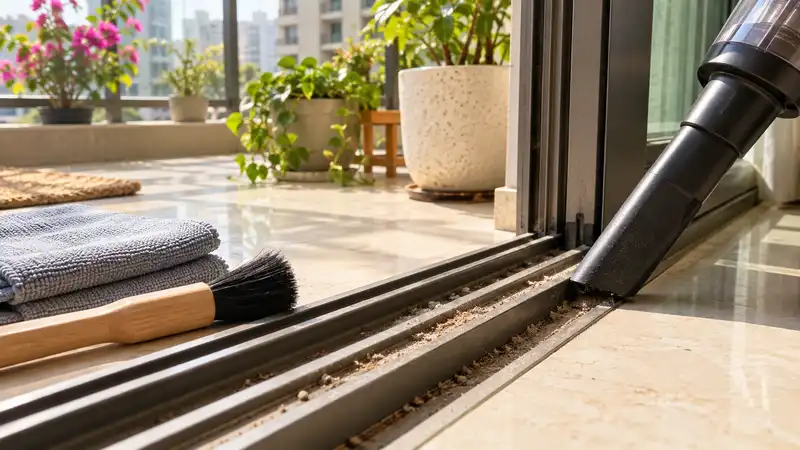
Balconies can collect enormous amounts of dust.
Then every time the balcony door opens, some of it can move indoors.
A useful routine is:
Clean the balcony floor regularly.
Wipe railings.
Avoid allowing thick layers of dust to build up.
Keep the area immediately outside the door relatively clean.
If you wait until the balcony is visibly filthy, every gust of wind has more material available to move.
A clean balcony does not guarantee a dust-free home.
But it can reduce one obvious source.
Shoes Bring More Than You Think
Look at the bottom of a shoe after walking outside.
Dust.
Soil.
Tiny particles.
Road residue.
Then imagine that travelling across the living room.
A simple entrance routine can help considerably.
Use:
- An outdoor doormat
- An indoor mat where practical
- A designated shoe area
- Indoor slippers if your household prefers them
You do not need an elaborate system.
The basic idea is just:
Leave as much outdoor dust near the entrance as possible.
And do not forget the mats themselves.
A mat full of dust becomes another dust source.
Clean or wash it regularly.
The Biggest Dust-Cleaning Mistake for dust in Indian homes
This is where many homes accidentally make the problem worse.
You pick up a completely dry cloth.
Wipe the table.
The surface looks clean.
But a visible cloud of dust goes into the air.
Much of it eventually settles somewhere else.
You have not necessarily removed all the dust.
You have relocated part of it.
This is why a slightly damp microfiber cloth can often work better for routine surface dusting.
The fibres physically capture particles, while slight moisture helps prevent loose dust from becoming airborne.
The cloth should not be dripping wet.
Just damp enough to capture dust effectively.
Why Microfiber Cloths Work Well for Dust
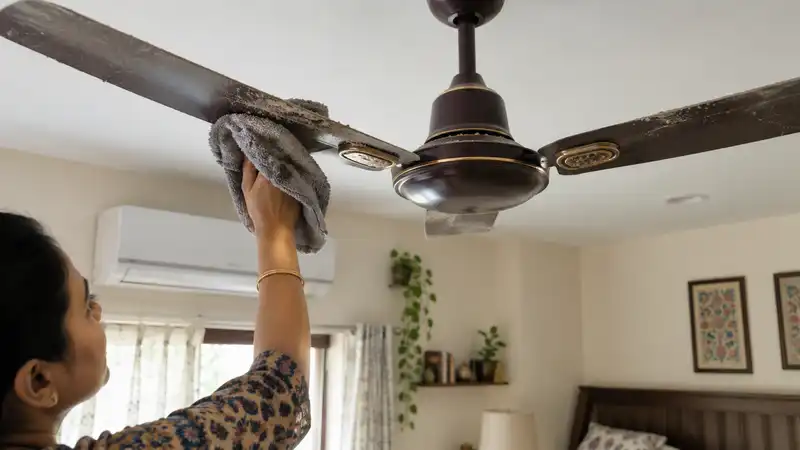
Microfiber cloths are useful because their very fine fibres can collect dust and particles efficiently.
They can be used on many household surfaces, depending on the surface requirements.
For everyday dust:
Fold the cloth into sections.
Wipe one area.
Turn to a clean section.
Continue.
Once the cloth becomes dirty, rinse or wash it.
Using one filthy cloth across the whole house simply moves residue from one surface to another.
For certain surfaces, you may use a compatible cleaning solution.
For others, a damp cloth may be enough.
Always follow the surface-care instructions.
Clean From Top to Bottom
This sounds obvious.
But it makes a huge difference.
Imagine cleaning your floor first.
Then you wipe:
The ceiling fan.
A shelf.
A picture frame.
The top of a wardrobe.
Where does the dust go?
Down.
Onto your freshly cleaned floor.
So use gravity instead of fighting it.
A sensible sequence is:
Ceiling fan
↓
High shelves
↓
Furniture
↓
Tables and counters
↓
Low surfaces
↓
Floor
This way, anything disturbed during cleaning is removed at the end.
Ceiling Fans Are Dust Magnets
In Indian homes, ceiling fans are often used extensively.
And fan blades can collect thick layers of dust surprisingly quickly.
The problem is easy to ignore because you do not see the top of the blade from below.
Then one day you look closely.
It is not pretty.
Clean ceiling fans periodically before the buildup becomes heavy.
Switch the fan off completely.
Use a stable, safe way to reach it.
A slightly damp microfiber cloth can help capture dust rather than allowing it to fall everywhere.
Some people use a pillowcase-style method to contain loose dust around the blade.
Whatever method you use, focus on capturing the dust, not knocking it around the room.
Don’t Forget the Top of Doors and Wardrobes
Dust loves surfaces you rarely look at.
The top of:
- Wardrobes
- Doors
- Cabinets
- Refrigerators
- Bookshelves
- Air-conditioner units
- Picture frames
- Curtain rods
These areas can hold a large amount of dust without looking dirty from normal eye level.
Then airflow disturbs that buildup.
Add these surfaces to a less-frequent deep-cleaning routine.
You do not need to clean them every day.
But ignoring them for months allows dust reservoirs to develop.
Also Read : Powerful Sustainable habits without the pressure
Curtains Are Giant Dust Collectors
Curtains may look clean while holding a considerable amount of dust.
Every time you:
Open them.
Close them.
Shake them.
Move past them.
some particles can move back into the room.
Follow the manufacturer’s washing or cleaning instructions for your curtains.
Heavy curtains may need different care from washable lightweight fabrics.
If dust is a major problem in your home, consider whether your curtains are unnecessarily heavy or difficult to maintain.
A beautiful curtain that never gets cleaned becomes part of the dust problem.
What About Sofas, Cushions and Mattresses?
Fabric furniture can also collect dust, fibres and other particles.
Vacuuming upholstery can help, especially in homes where visible dust accumulates quickly.
Cushions should also be cleaned according to their care instructions.
Mattresses can benefit from periodic vacuuming where appropriate.
Bed linen should be washed regularly.
Again, you do not need to obsessively deep-clean everything every day.
The goal is to stop fabric surfaces from becoming long-term dust storage zones.
Visit Us On : INSTAGRAMhttps://www.instagram.com/thesensibleliving/
Carpets and Rugs Need More Attention
Rugs can make a room look warm and comfortable.
But they also collect:
- Dust
- Hair
- Fibres
- Crumbs
- Outdoor soil
If your home has severe dust issues and multiple large carpets, those surfaces may require frequent vacuuming.
Small rugs can sometimes be easier to clean and maintain.
If you have pets, the cleaning requirement increases further.
This does not mean carpets are “bad.”
It simply means:
More textile surface usually means more maintenance.
That is a trade-off worth understanding.
Vacuum First or Mop First?
Vacuum or sweep first.
Mop afterward.
Wet mopping a dusty floor immediately can turn loose dust into muddy streaks.
Instead:
Remove loose particles.
Then mop to remove finer residue.
If you use a broom, choose one that does not throw excessive dust into the air.
Vacuuming can be especially useful because the machine is designed to pull loose debris away rather than push it around.
The quality of the filtration system also matters.
Does a Vacuum Cleaner Help With Indian Dust?
Yes, especially for:
- Floors
- Rugs
- Sofas
- Corners
- Under beds
- Mattress surfaces
- Upholstery
- Hard-to-reach gaps
A vacuum can remove particles that are difficult to collect effectively with a broom.
But there is one important point:
Maintain the vacuum.
A full dust container.
Blocked filter.
Dirty brush.
Poorly maintained machine.
All of these can reduce performance.
Follow the manufacturer’s instructions for filter cleaning and replacement.
A vacuum is only useful if it can actually retain the particles it collects.
What About HEPA Filters?
HEPA filtration is commonly used in vacuum cleaners and air purifiers designed to capture very small airborne particles.
If fine dust is a major concern, filtration quality matters.
But do not assume any product labelled “HEPA-like” or “HEPA-style” performs identically to a properly specified HEPA system.
Look at the manufacturer’s actual filtration information.
And remember:
An air purifier does not replace surface cleaning.
It addresses airborne particles.
Dust already sitting on your table still needs to be removed.
Can an Air Purifier Reduce Dust?
An air purifier can reduce some airborne particles, especially when equipped with an appropriate particle filter.
This may be useful in homes dealing with:
- Outdoor pollution
- Fine airborne dust
- Pollen
- Pet particles
- Heavy urban exposure
But expectations should be realistic.
An air purifier will not:
Stop dust entering through an open balcony.
Clean your furniture.
Vacuum your carpet.
Remove dust from fan blades.
Replace mopping.
Think of it as one part of a broader dust-management system.
Not a magic dust eraser.
The AC Filter Is Easy to Forget
Air conditioners move large amounts of air.
Their filters collect dust.
If the filter becomes heavily loaded, airflow and performance can suffer.
Check and clean your AC filters according to the manufacturer’s instructions.
This is especially important during periods of frequent use.
A visibly dirty filter is telling you something:
That material was floating around somewhere before the filter captured it.
Clean Your Exhaust Fans Too
Kitchen and bathroom exhaust fans are another overlooked area.
Grease plus dust can create sticky buildup around kitchen exhaust systems.
Bathroom exhaust fans can accumulate lint and dust.
Clean accessible parts safely according to the manufacturer’s instructions.
If the unit requires disassembly, professional servicing may be safer than improvising.
Why Kitchen Dust Is Different
Kitchen dust can become especially stubborn.
Why?
Because it mixes with airborne oil and grease.
Plain dry dust is relatively easy to wipe away.
Dust mixed with cooking residue can become sticky.
That is why kitchen cabinet tops, exhaust areas and surfaces near the stove often develop a greasy film.
Regular cleaning is much easier than allowing months of buildup.
A suitable kitchen or multi-surface cleaner can help loosen this residue on compatible surfaces.
But check surface instructions.
Natural stone, wood, laminates and metals can require different care.
Why Bedrooms Get Dusty So Fast
Bedrooms contain a lot of fabric.
Bedsheets.
Blankets.
Clothes.
Curtains.
Pillows.
Mattresses.
Upholstery.
Every movement releases tiny fibres.
Add outdoor dust from windows and the room can accumulate visible particles quickly.
A useful bedroom routine includes:
Regular bed-linen washing.
Vacuuming or cleaning under the bed.
Dusting fan blades.
Cleaning window tracks.
Managing curtains.
Avoiding piles of unused clothing collecting dust.
Keeping wardrobes reasonably closed.
Again, the answer is not more cleaning products.
It is better maintenance.
Window Tracks Deserve Their Own Cleaning Routine
Look inside the sliding track of a window.
It can hold an impressive combination of:
Dust.
Sand.
Dead insects.
Hair.
Small debris.
Because the track is narrow, regular wiping often misses it.
Use a suitable vacuum attachment or brush to loosen debris.
Then wipe according to the window material.
If you clean the glass but ignore the track, a major dust collection area remains untouched.
The Same Goes for Door Tracks
Sliding balcony doors are similar.
Dust sits in the channels.
Shoes and airflow introduce more.
Then every time the door moves, debris shifts around.
Cleaning tracks periodically is a small task with a surprisingly satisfying result.
It also helps the entire doorway look cleaner.
Avoid Overusing Cleaning Spray
One common misconception is:
More cleaning spray = cleaner surface.
Not necessarily.
Too much product can leave residue.
That residue may make some surfaces feel sticky.
And sticky surfaces can attract dust faster.
Follow the recommended quantity.
For routine dusting, you may not even need a cleaning chemical every time.
Sometimes a clean, slightly damp microfiber cloth is enough.
Use cleaning formulations where they add value.
Do not soak every surface unnecessarily.
Does a Multi-Surface Cleaner Help With Dust?
It can help with everyday dust and light grime on compatible surfaces.
The benefit of a multi-surface cleaner is simplicity.
Instead of keeping a separate bottle for:
Table.
Shelf.
Cabinet.
Counter.
Desk.
you may be able to use one suitable formulation across several surfaces.
But “multi-surface” does not mean “every surface.”
Always check whether the product is appropriate for:
- Natural stone
- Wood
- Glass
- Metal
- Painted finishes
- Electronics
- Other delicate materials
A good dust routine is more about method than the number of bottles in your cupboard.
Dusting Electronics Needs Extra Care
TV screens, laptops, monitors and other electronics attract visible dust.
But do not treat them like kitchen counters.
Avoid spraying general cleaning product directly onto electronics.
Follow the manufacturer’s cleaning instructions.
Usually, this means using an appropriate dry or slightly damp soft cloth depending on the device.
For vents, use suitable methods that do not push liquid inside the equipment.
The surface may look similar to furniture.
The cleaning requirements are not.
Plants Can Collect Dust Too
Indoor plants are beautiful.
But broad leaves collect visible dust surprisingly quickly.
A thick dust layer can make plants look dull.
Depending on the plant, leaves may be gently wiped or cleaned using an appropriate method.
Avoid using household cleaning chemicals on plant leaves.
Plants are living things.
Treat them accordingly.
Pets Change the Dust Equation
If you have pets, what looks like “dust” may also contain:
Hair.
Dander.
Fine fur.
Outdoor dirt carried on paws.
More vacuuming may be necessary.
Washable pet bedding is helpful.
Regular grooming can also reduce loose hair depending on the animal.
A home with pets does not need to be spotless.
It simply requires a slightly different maintenance rhythm.
The Monsoon Dust Problem
Monsoon season changes the nature of household dust.
Outdoor dust may sometimes decrease because rain settles particles.
But indoor dirt can become stickier due to moisture and humidity.
Wet footwear can bring in mud.
Dust in corners can combine with humidity.
Bathrooms stay damp longer.
This is why cleaning routines should adapt with the season.
During humid weather, focus on:
Drying wet floors.
Improving ventilation where practical.
Cleaning muddy entry areas quickly.
Avoiding damp cloths being left around.
Keeping cleaning tablets and moisture-sensitive products stored in dry conditions.
Indian homes do not experience the same cleaning conditions all year.
Summer Creates Its Own Challenges
Hot, dry months can increase visible outdoor dust, especially in areas with:
- Dry soil
- Construction
- Unpaved roads
- High traffic
- Strong winds
Open windows can bring in more particles.
Ceiling fans may run continuously.
Balconies become dusty quickly.
During these periods, shorter but more frequent dust removal can be easier than allowing heavy buildup.
A five-minute wipe every couple of days can be less work than a huge weekly cleaning session.
Construction Dust Is a Different Level
If construction is happening next door, normal dust routines may struggle.
Fine construction dust can enter through surprisingly small gaps.
During active work:
Keep nearby windows closed where practical.
Use door and window sealing where appropriate.
Clean entrance areas frequently.
Cover sensitive furniture if necessary.
Vacuum rather than aggressively dry-sweeping fine dust.
Consider an appropriate air purifier if indoor airborne dust becomes a persistent problem.
And if the dust is unusually heavy or irritating, treat it as more than an aesthetic issue.
Construction dust can contain very fine particles, so reducing exposure is sensible.
A Simple Daily Dust Routine
You do not need to clean the entire house every day.
Try focusing on the highest-traffic areas.
Daily or as needed
Wipe dining table.
Wipe kitchen counter.
Clean visibly dusty furniture.
Clean entry area.
Remove visible floor debris.
Every few days
Dust high-use surfaces.
Vacuum or sweep main rooms.
Clean TV unit.
Clean balcony near the door.
Weekly
Vacuum deeper areas.
Mop floors thoroughly.
Clean fans if needed.
Clean window sills.
Vacuum sofa.
Wash frequently used mats.
Periodically
Curtains.
Wardrobe tops.
AC filters.
Window tracks.
Behind furniture.
Under beds.
Exhaust fans.
The exact frequency depends entirely on your home.
A house near a highway may need more frequent cleaning than a high-rise flat with sealed windows.
The 15-Minute Anti-Dust Reset
When the whole house feels dusty, do this:
Minute 1–3
Open or close windows strategically depending on outdoor conditions.
Collect loose items from surfaces.
Minute 4–7
Use a damp microfiber cloth on the most visible surfaces.
Start high.
Work down.
Minute 8–11
Vacuum or sweep the highest-traffic floor areas.
Minute 12–15
Quick mop where necessary.
Clean the entrance mat area.
Done.
Not perfect.
But noticeably better.
Cleaning routines become sustainable when they are easy enough to repeat.
The Real Secret: Don’t Let Dust Build Up
This sounds obvious, but it is the biggest difference between easy cleaning and exhausting cleaning.
A thin layer of dust:
Wipes away quickly.
A month’s worth of dust mixed with grease, humidity and grime:
Requires scrubbing.
The easiest homes to maintain are not necessarily cleaned more aggressively.
They are cleaned before dirt becomes difficult.
That is why regular light maintenance usually beats occasional cleaning marathons.
A Minimalist Dust-Cleaning Kit
You probably do not need ten products.
A practical setup might include:
- 3–5 microfiber cloths
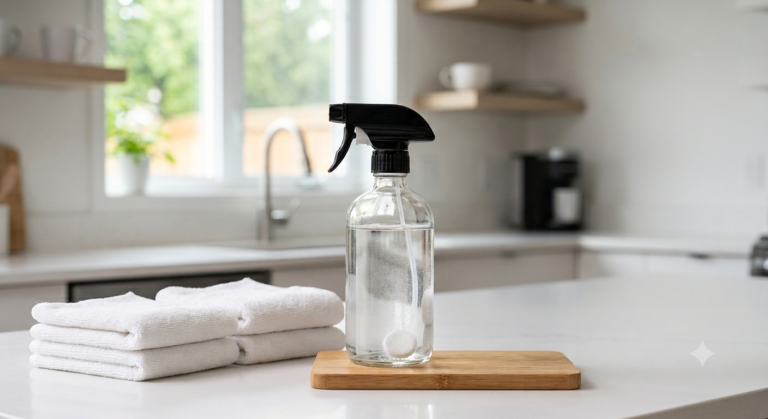
- A suitable multi-surface cleaner
- A vacuum cleaner or effective floor-cleaning tool
- A mop
- A soft brush for tracks and corners
- One bathroom-specific cleaner where required
- One kitchen degreasing option where required
- Appropriate specialist products for delicate surfaces
That is enough for most everyday dust management.
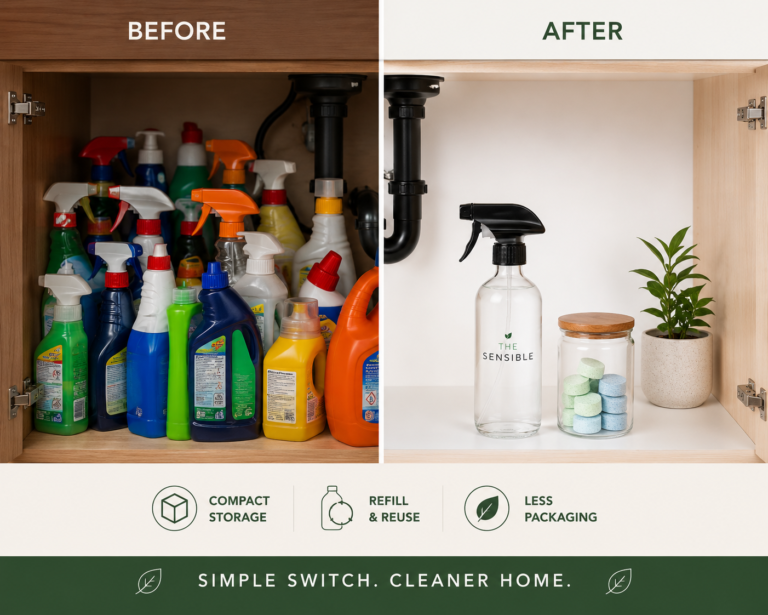
Cleaning should not require a cupboard full of bottles.
It requires the right tools used consistently.
The Sensible Approach to Dust
At The Sensible, we prefer systems that make everyday cleaning easier rather than more complicated.
Dust is unavoidable.
You live in a home.
You open doors.
You use fans.
You cook.
You wear clothes.
You walk inside.
Particles will exist.
The goal is not to create a laboratory.
The goal is to manage dust intelligently.
That means:
Stop as much as possible at the entrance.
Capture dust instead of throwing it into the air.
Clean from top to bottom.
Use fabric and filtration maintenance to reduce hidden buildup.
Keep floors and high-contact surfaces on a simple routine.
Use cleaning products only where they are actually needed.
And above all:
Make the routine easy enough that you will actually keep doing it.
Frequently Asked Questions
Why does my house get dusty so quickly in India?
Outdoor traffic, construction, dry soil, open windows, balconies, footwear, fabrics, pets and indoor airflow can all contribute. The exact cause depends on the home’s location and layout.
Is it better to dust with a wet or dry cloth?
For many household surfaces, a slightly damp microfiber cloth can capture loose dust more effectively than aggressive dry dusting, which can send particles back into the air. Always check the care requirements of the surface.
How often should I dust my house?
There is no universal schedule. High-dust homes may need light cleaning every few days, while lower-dust homes may need less frequent maintenance. Focus on visible buildup and high-use areas.
Should I keep my windows closed to reduce dust?
Closing windows during heavy traffic, strong winds or nearby construction can reduce outdoor dust entry. However, ventilation is also important, so use windows strategically rather than keeping the home sealed all the time.
Does an air purifier remove household dust?
An air purifier can help capture airborne particles if it has an appropriate filter, but it will not remove dust already settled on furniture or floors.
Does a vacuum cleaner work better than a broom for dust?
A vacuum can be useful because it pulls loose particles into the machine instead of pushing them around. Performance depends on the machine, attachments, filtration and maintenance.
Why does dust collect so quickly on ceiling fans?
Fan blades constantly move through air, allowing particles to settle on their surfaces. Because the top of the blade is difficult to see, buildup can become significant before you notice it.
Can I use one cleaner for all dusty surfaces?
Not necessarily. A multi-surface cleaner may work across several compatible materials, but delicate surfaces, electronics, wood, natural stone and speciality finishes can require different care.
How can I reduce dust near my main door?
Use mats, keep shoes near the entrance, clean the entrance regularly and avoid allowing outdoor dust to build up around the doorway.
What is the easiest way to keep dust under control?
Use a repeatable routine: reduce dust entry, wipe surfaces with a suitable cloth, vacuum or sweep regularly, mop when needed and clean hidden dust reservoirs such as fans, curtains and window tracks.
Final Takeaway
Dust in Indian homes is not going away completely.
And that is fine.
The answer is not to spend your entire life cleaning.
It is to build a better system.
Reduce the amount entering the house.
Do not allow balconies, mats and window tracks to become dust reservoirs.
Capture dust instead of spreading it around.
Clean from top to bottom.
Maintain fans, curtains, filters and fabrics.
Vacuum or sweep before mopping.
Use the right cleaner only when the surface actually needs it.
And clean lightly and regularly instead of waiting until the entire home feels dusty.
Because when it comes to dust, the smartest cleaning routine is not:
Clean harder.
It is:
Let less dust in, remove it properly, and make the routine simple enough to repeat.




One Comment