The Science of Mineral Dissolution: The Powerful Chemistry Behind Cleaning Tablets
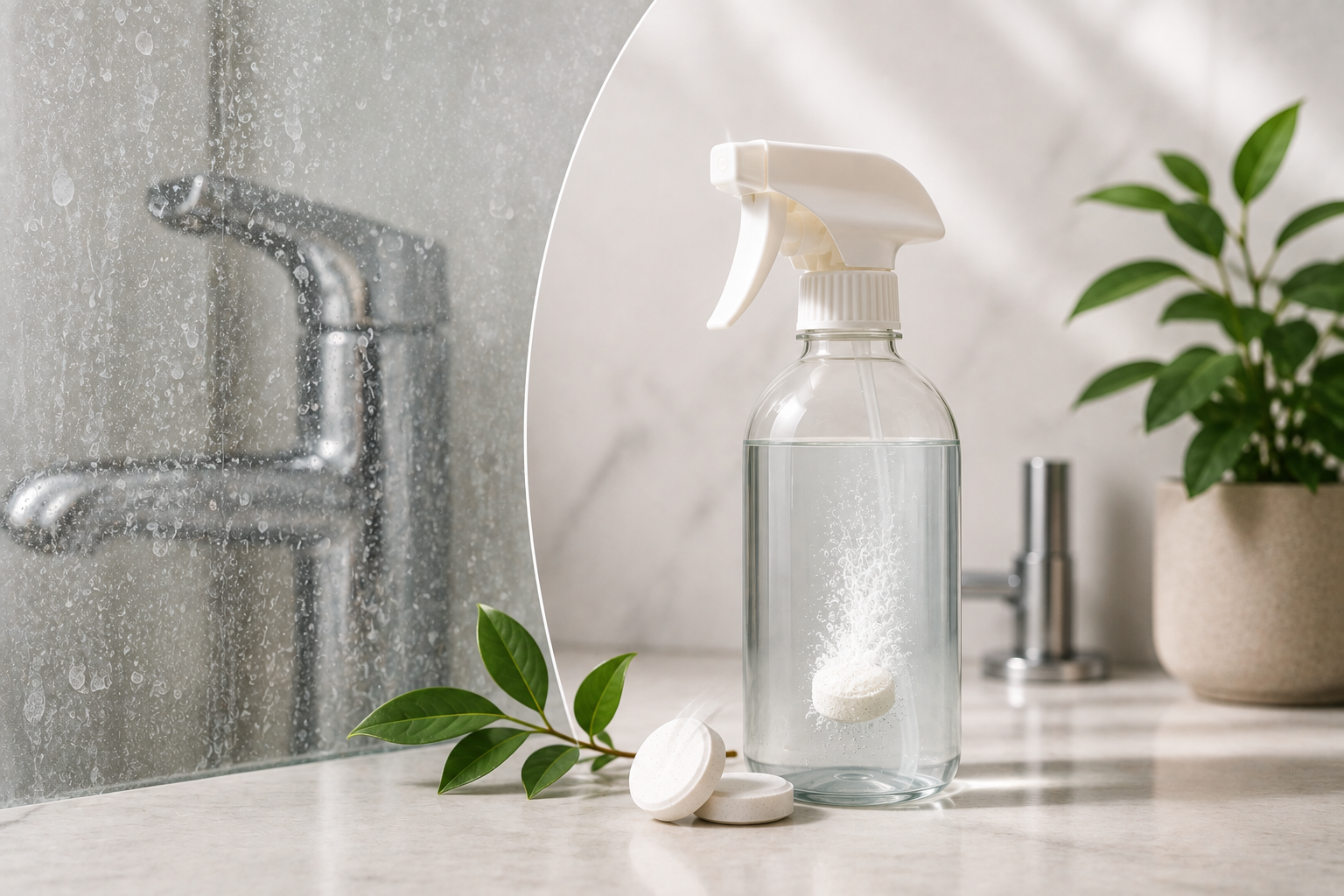
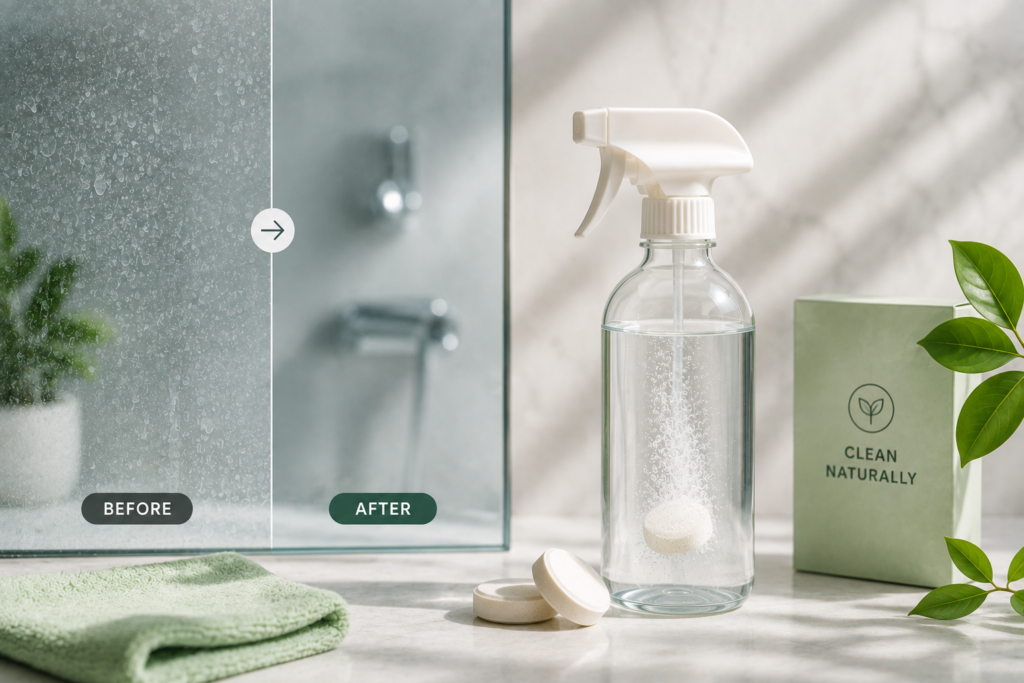
If you have ever cleaned a glass shower door, polished a chrome faucet, or wiped down a kitchen surface only to find cloudy white marks appearing again once everything dries, you have probably encountered hard water stains.
It can be frustrating.
You clean the surface. It looks perfect. Then the next time water evaporates, the white film returns.
The reason is simple: the water is leaving something behind.
Hard water contains dissolved minerals, primarily calcium and magnesium. When water evaporates, those dissolved substances do not disappear with it. Under the right conditions, they can contribute to mineral deposits and scale on glass, metal, fixtures, appliances, and other household surfaces. The U.S. Geological Survey identifies calcium and magnesium as the principal contributors to water hardness and notes that hard water can contribute to scale formation and cloudy deposits on household surfaces.
So how do you remove those deposits without relying on aggressive cleaning chemistry?
The answer begins with understanding mineral dissolution.
Modern cleaning formulations can use a combination of acids, chelating agents, surfactants, builders, and other ingredients to interact with mineral residues and help lift them from a surface. The exact chemistry depends on the product.
And that is why the idea that an effective cleaner has to be extremely harsh is misleading.
A well-designed cleaning formula doesn’t need to rely on brute force.
It needs the right chemistry for the problem.
What Is Hard Water?
Hard water is water containing relatively high concentrations of dissolved calcium and magnesium ions.
These minerals are naturally present in many water sources. As groundwater moves through soil and rock, it can dissolve minerals along the way and carry dissolved calcium and magnesium into water supplies.
Water hardness is commonly expressed as an equivalent concentration of calcium carbonate, or CaCO₃.
The USGS generally classifies water with:
- 0–60 mg/L as calcium carbonate as soft
- 61–120 mg/L as moderately hard
- 121–180 mg/L as hard
- More than 180 mg/L as very hard
You don’t need to measure your water hardness to notice its effects.
You may see:
- White spots on shower glass
- Cloudy marks on faucets
- Mineral deposits around taps
- Scale inside kettles or water heaters
- Film on dishes and glassware
- Reduced soap performance
- Chalky deposits around sinks and fixtures
Hard water itself isn’t necessarily a health problem. In the home, it is more commonly a maintenance and cleaning problem. The minerals can create visible deposits and make some cleaning tasks more difficult.
But what actually happens when one of those water droplets dries?
Why Hard Water Leaves White Spots
Imagine spraying water onto a glass shower door.
At first, the water looks completely clear.
As it sits on the glass, evaporation begins.
The water molecules gradually leave the surface and enter the air. The dissolved minerals, however, remain behind.
With repeated cycles of wetting and drying, those residues can accumulate.
Under suitable conditions, calcium and carbonate chemistry can result in calcium carbonate scale. Heating water can make this process especially noticeable; the USGS notes that calcium carbonate scale can form when hard water is heated.
This is why the marks often become more noticeable around:
- Shower doors
- Faucets
- Sink edges
- Water heaters
- Kettles
- Dishwasher components
- Other surfaces repeatedly exposed to water
The problem isn’t simply that the surface is dirty.
You’re dealing with a mineral residue.
And mineral residue requires a different cleaning strategy from grease, fingerprints, or ordinary dust.
Why Mineral Deposits Can Be Difficult to Remove
Different types of household dirt behave differently.
Grease is largely an organic, oily substance.
Dust can often be physically lifted.
Food residue may respond to surfactants and water.
Mineral scale is different.
It is an inorganic deposit.
That means simply adding more soap or scrubbing harder isn’t necessarily the best solution.
In fact, aggressive scrubbing can create another problem: scratching or dulling the surface.
The better approach is to encourage the mineral deposit to become chemically easier to remove.
That process is broadly known as mineral dissolution.
What Does Mineral Dissolution Mean?
Mineral dissolution is the process in which a solid mineral breaks down and enters a surrounding liquid as dissolved species.
You can think of it as the opposite of a mineral deposit forming.
When minerals precipitate, dissolved components come together and form a solid.
When a mineral dissolves, components of that solid move back into solution.
Cleaning chemistry can take advantage of this principle.
For example, acidic conditions can help dissolve carbonate-based deposits. This is why acidic substances such as vinegar can help with certain types of mineral buildup; the USGS specifically notes that vinegar’s acidity can help dissolve mineral particles.
But acids are not the only chemistry involved in mineral removal.
Another important tool is chelation.
The Role of Chelating Agents
The word chelation comes from the Greek word chele, meaning claw.
The name reflects the basic idea: a chelating molecule can bind a metal ion at multiple points, creating a more stable complex.
In cleaning chemistry, chelating agents can interact with metal ions such as calcium and magnesium.
Instead of allowing those ions to remain available to participate in mineral deposits, a suitable chelating agent can bind them into a soluble complex.
This can help keep minerals in solution and support their removal during wiping or rinsing.
That doesn’t mean chelation is a magical “claw” that physically grabs an entire piece of scale and pulls it away.
The chemistry is more nuanced.
The effectiveness of a chelating system depends on factors such as:
- The specific chelating agent
- Its concentration
- The pH of the formula
- The type of mineral deposit
- Contact time
- Water chemistry
- Surface conditions
- The rest of the cleaning formulation
Certain chelating systems have specifically been investigated for calcium and magnesium scale removal, demonstrating why metal-ion binding can play an important role in mineral-deposit chemistry.
So when you see the term chelating agent on a cleaning formulation, think of it as part of a chemical system designed to manage metal ions—not as a universal replacement for every other type of cleaning chemistry.
Acid vs. Chelation: What’s the Difference?
This is where cleaning chemistry becomes particularly interesting.
Acids and chelating agents can both play roles in mineral removal, but they do so through different chemical mechanisms.
Acids
Acids can react with certain mineral deposits, particularly carbonate-based scale.
In simple terms, the acid helps convert relatively insoluble mineral material into forms that can enter solution more readily.
This is why acidic cleaners can be highly effective against limescale.
However, stronger is not automatically better.
A highly acidic formulation may be unsuitable for certain surfaces, finishes, natural stones, metals, or sealants.
The correct chemistry depends on the surface and the type of deposit.
Chelating agents
Chelating agents work primarily by binding metal ions.
Rather than relying only on acidity, they can help control calcium and other metal ions in solution.
This can be particularly useful as part of a broader formulation designed to loosen and remove mineral residues.
The key idea
Effective mineral cleaning isn’t necessarily about choosing the harshest chemical available.
It’s about choosing chemistry that is appropriate for:
the deposit + the surface + the intended use.
That is a much more useful way to think about cleaning.
Why pH Matters in Mineral Cleaning
One of the most important factors in cleaning chemistry is pH.
The pH of a formulation affects how different ingredients behave and how certain materials interact with the cleaning solution.
For mineral deposits, pH can influence dissolution chemistry, especially when carbonate-based scale is involved.
This creates an important balancing act.
A formulation needs enough chemical activity to address the target residue, while also being appropriate for the surfaces it is intended to clean.
That is why you should never assume that a cleaner with a lower pH is automatically better.
Likewise, you shouldn’t assume that a neutral cleaner can remove every type of mineral buildup.
The formulation needs to be designed around the cleaning task.
And the manufacturer’s surface-compatibility instructions always matter.
Why Cleaning Tablets Are an Interesting Format
Cleaning tablets change something that is easy to overlook:
when the cleaning solution is prepared.
A conventional ready-to-use cleaner is manufactured as a finished liquid.
You purchase the bottle.
You open it.
You spray.
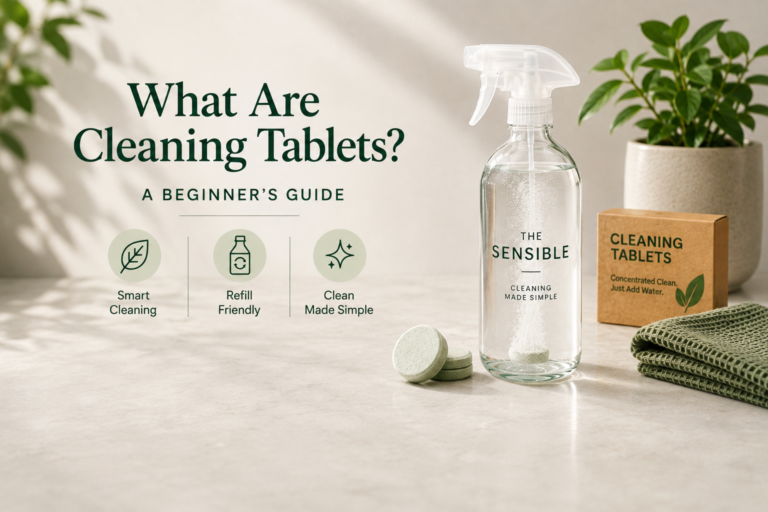
A cleaning tablet takes a different route.
You purchase a concentrated formulation.
You add the recommended amount of water.
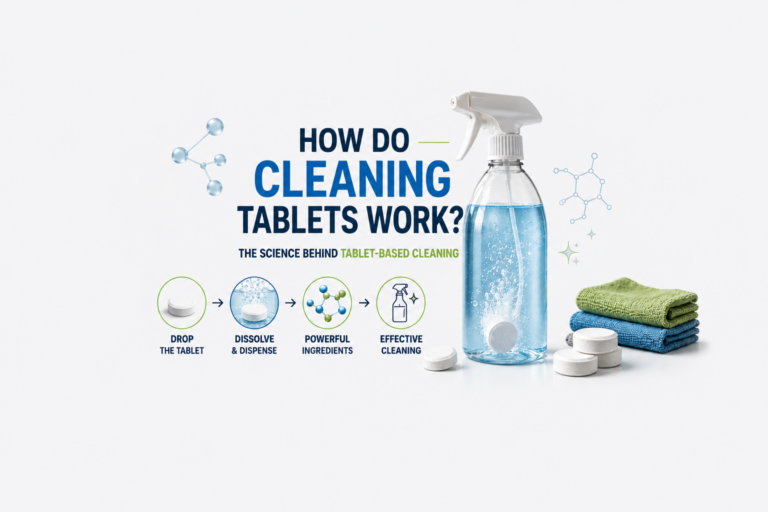
The tablet dissolves or disperses.
The resulting solution becomes your ready-to-use cleaner.
In simple terms:
Tablet + water → cleaning solution
This format can have practical advantages.
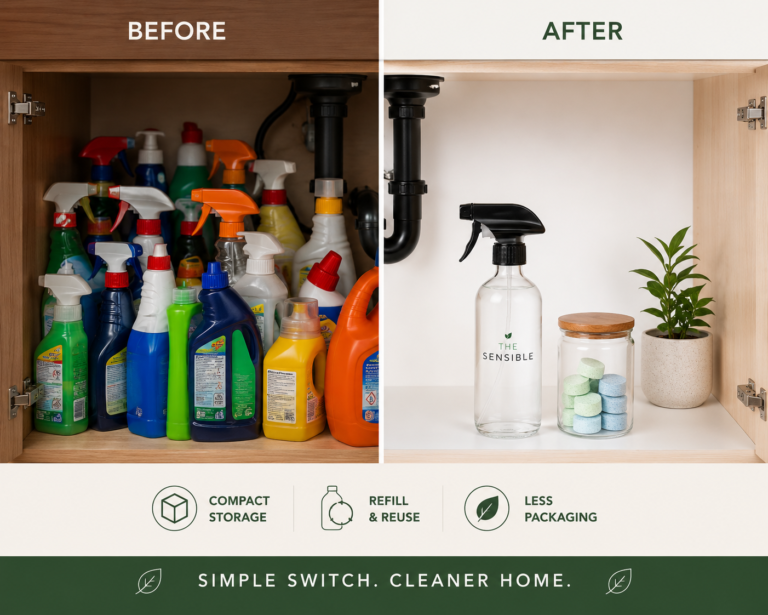
The concentrated product can be stored in a smaller form, while the reusable bottle stays in your home.
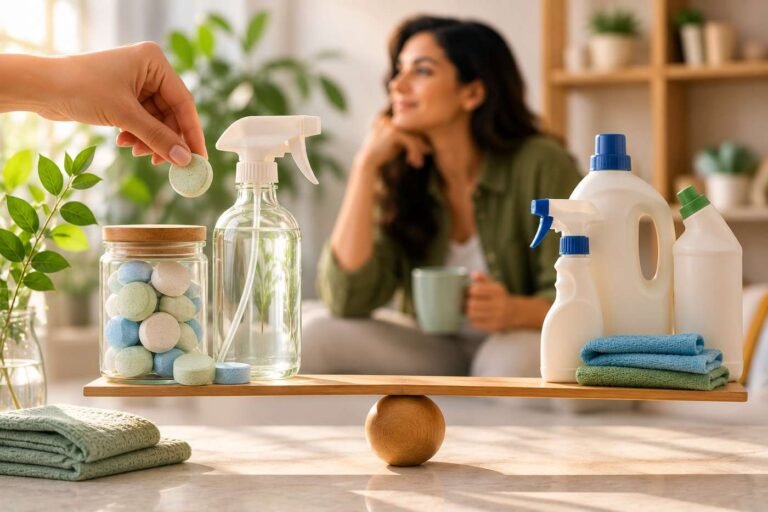
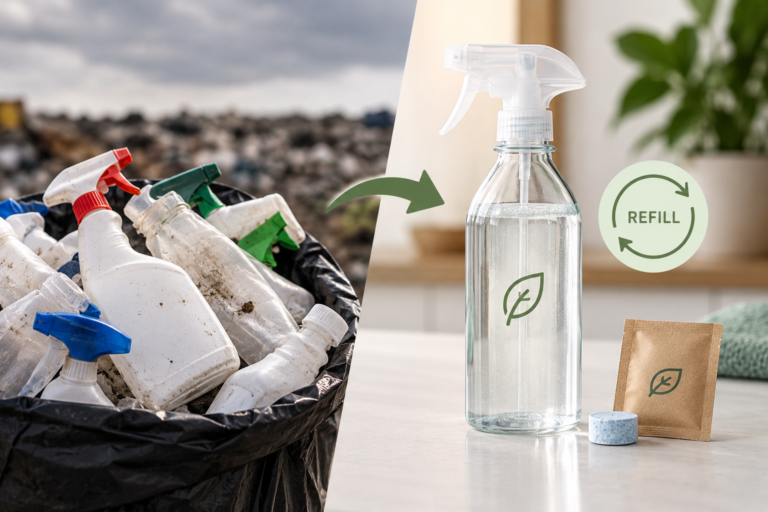
Instead of repeatedly purchasing a complete bottle of finished liquid, a refill-based system can separate the reusable container from the cleaning formulation.
That changes the routine from:
Buy → Use → Empty → Replace
to:
Keep → Refill → Prepare → Use
The exact environmental and performance benefits depend on the specific formulation, packaging, transport system, and how often the bottle is reused. The tablet format itself should not automatically be treated as proof that a product has a lower environmental impact.
The whole system matters.
Fresh Water and At-Home Preparation
One of the interesting aspects of tablet-based cleaning is that the final solution is prepared at home.
The tablet and the water are stored separately until you are ready to make the cleaner.
That means the product doesn’t need to be shipped and stored as the finished diluted solution.
From a user perspective, this can also make the cleaning system more flexible.
You can keep a supply of compact refills and prepare a new bottle when required.
But there is an important detail:
Follow the manufacturer’s dilution instructions.
Adding too little water doesn’t automatically create a “stronger” or better cleaner.
Likewise, adding more tablets doesn’t necessarily improve cleaning performance.
A formulation is designed around a specific concentration and intended use.
The goal is consistency.
Can Cleaning Tablets Handle Hard Water?
This is where formulation matters more than marketing.
A cleaning tablet can be designed to address mineral residues, but whether it performs well against hard-water buildup depends on its actual ingredients and formulation.
A product intended primarily for everyday surface cleaning may not be designed to remove heavy limescale.
Another formulation may specifically incorporate chemistry intended to help with mineral deposits.
So don’t ask only:
“Is it a tablet?”
Ask:
“What is the formulation designed to do?”
This is an important distinction.
The shape of a cleaning product doesn’t determine its cleaning chemistry.
A tablet is a delivery format.
The ingredients and formulation determine what happens when that tablet meets water and a dirty surface.
Read : how do cleaning tablets work ?
Why Surfactants Still Matter
Mineral removal isn’t the only job happening during cleaning.
A good household cleaner may contain surfactants, which help water spread across surfaces and interact with soils.
Surfactants can help loosen and lift residues so that they can be wiped away.
When dealing with hard-water deposits, the overall formulation may therefore involve several complementary mechanisms:
Water + active cleaning ingredients + surfactants + mineral-binding chemistry + mechanical wiping
Each component can contribute something different.
This is why modern cleaning formulations are better understood as systems rather than single-ingredient solutions.
The goal isn’t simply to find the “strongest” ingredient.
It’s to create a formula in which the ingredients work together.
3 Simple Tips for Tackling Hard-Water Buildup
Chemistry is important, but your cleaning technique matters too.
1. Give the Cleaner Time to Work
One of the most common cleaning mistakes is spraying and immediately wiping.
Cleaning chemistry needs contact time.
If the product instructions allow it, give the solution enough time to interact with the residue before wiping.
This can be particularly useful when you’re dealing with mineral buildup that has accumulated over multiple wet-dry cycles.
However, never allow a product to remain on a surface longer than its instructions recommend.
2. Use a Quality Microfiber Cloth
Once the mineral residue has been loosened, you need to remove it.
A clean microfiber cloth can help lift and capture the loosened solution and residue rather than simply spreading it around.
Use a suitable cloth for the surface and keep it clean.
A dirty cloth can simply redistribute residue.
3. Dry High-Shine Surfaces
This is especially useful for glass and polished fixtures.
After cleaning, remove excess water rather than allowing droplets to sit and evaporate naturally.
Remember the original problem:
Water evaporates. Minerals remain.
If hard water is repeatedly allowed to dry on a surface, new mineral spots can form.
Drying the surface helps interrupt that cycle.
Prevention Is Easier Than Repeated Removal
There is another important lesson in hard-water cleaning:
The easiest mineral deposit to remove is often the one you don’t allow to build up.
If you live in an area with hard water, regular light cleaning can be easier than waiting until a thick layer of scale develops.
For example, wiping down shower glass after use can reduce the amount of water left behind.
Drying faucets can reduce repeated mineral deposition.
Regular cleaning can prevent small residues from becoming stubborn buildup.
This doesn’t eliminate hard water.
It simply changes how much buildup you have to deal with later.
What About Glass, Chrome, Quartz and Stone?
Different surfaces have different chemical tolerances.
Glass is generally resistant to many common cleaning formulations, but finishes, coatings, and treated surfaces can change that.
Chrome fixtures can be affected by unsuitable chemicals or prolonged exposure.
Quartz surfaces may contain resin and should be cleaned according to the manufacturer’s care recommendations.
Natural stone requires particular caution because some stones can react with acidic cleaners.
This is why one of the most important rules of cleaning chemistry is:
Never choose a cleaner based only on the stain. Choose it based on the stain and the surface.
A product that is excellent for removing limescale from one surface may be inappropriate for another.
Always read the product label and follow the manufacturer’s instructions.
Follow us on : INSTAGRAM
The Myth That “Green” Means Weak
There is a persistent idea that an eco-friendly cleaner must be gentle to the point of being ineffective.
But environmental positioning and cleaning performance are not opposites.
A cleaning product can be designed around concentrated ingredients, appropriate surfactants, mineral-binding chemistry, controlled pH, and other formulation choices while still being designed with packaging and refill considerations in mind.
The important question isn’t whether a product sounds “green.”
The important question is:
Does the formulation work for the cleaning job it claims to perform?
That is the standard every cleaner should be judged by.
At The Sensible, this is particularly important.
The goal isn’t to make cleaning sound complicated.
It’s to make the chemistry work in a format that fits naturally into everyday routines.
The Sensible Approach to Mineral Cleaning
A good cleaning experience shouldn’t require you to understand every chemical reaction happening inside the bottle.
But understanding the basic science can help you make better choices.
Hard water contains dissolved minerals, primarily calcium and magnesium.
As water evaporates, mineral residues can remain behind.
Repeated exposure can contribute to visible deposits and scale.
Removing those deposits requires more than simply wiping with water.
The right formulation can use different chemical mechanisms—including acidity, chelation, surfactants, and other ingredients—to help loosen, dissolve, bind, and remove mineral residues.
And the best formula isn’t necessarily the harshest one.
It’s the one designed for the job.
That is the principle behind sensible cleaning.
Final Takeaway: The Science Behind a Cleaner Surface
Hard-water buildup may look like a simple white stain, but there is real chemistry behind it.
The water itself isn’t necessarily leaving a “dirty” surface.
It is leaving behind minerals.
Calcium and magnesium are the primary contributors to water hardness, and under suitable conditions, mineral deposits can form as water evaporates or is heated.
Once you understand that, the cleaning strategy becomes clearer.
You don’t necessarily need to scrub harder.
You need to use the right chemistry.
Mineral dissolution, acid-base chemistry, chelation, surfactant action, contact time, and mechanical wiping can all play roles in the cleaning process.
And cleaning tablets offer an interesting way to deliver a concentrated formulation that is prepared with water when you need it.
But the tablet itself isn’t the magic.
The formulation is.
The right ingredients, in the right concentrations, at the right pH, used on the right surface, can make everyday mineral buildup much easier to manage.
That’s the real science behind effective cleaning.
And perhaps the most sensible way to approach hard water isn’t to fight it with increasingly aggressive chemistry.
It’s to understand what you’re actually trying to remove—and choose a cleaning system designed to work with the chemistry of the problem.