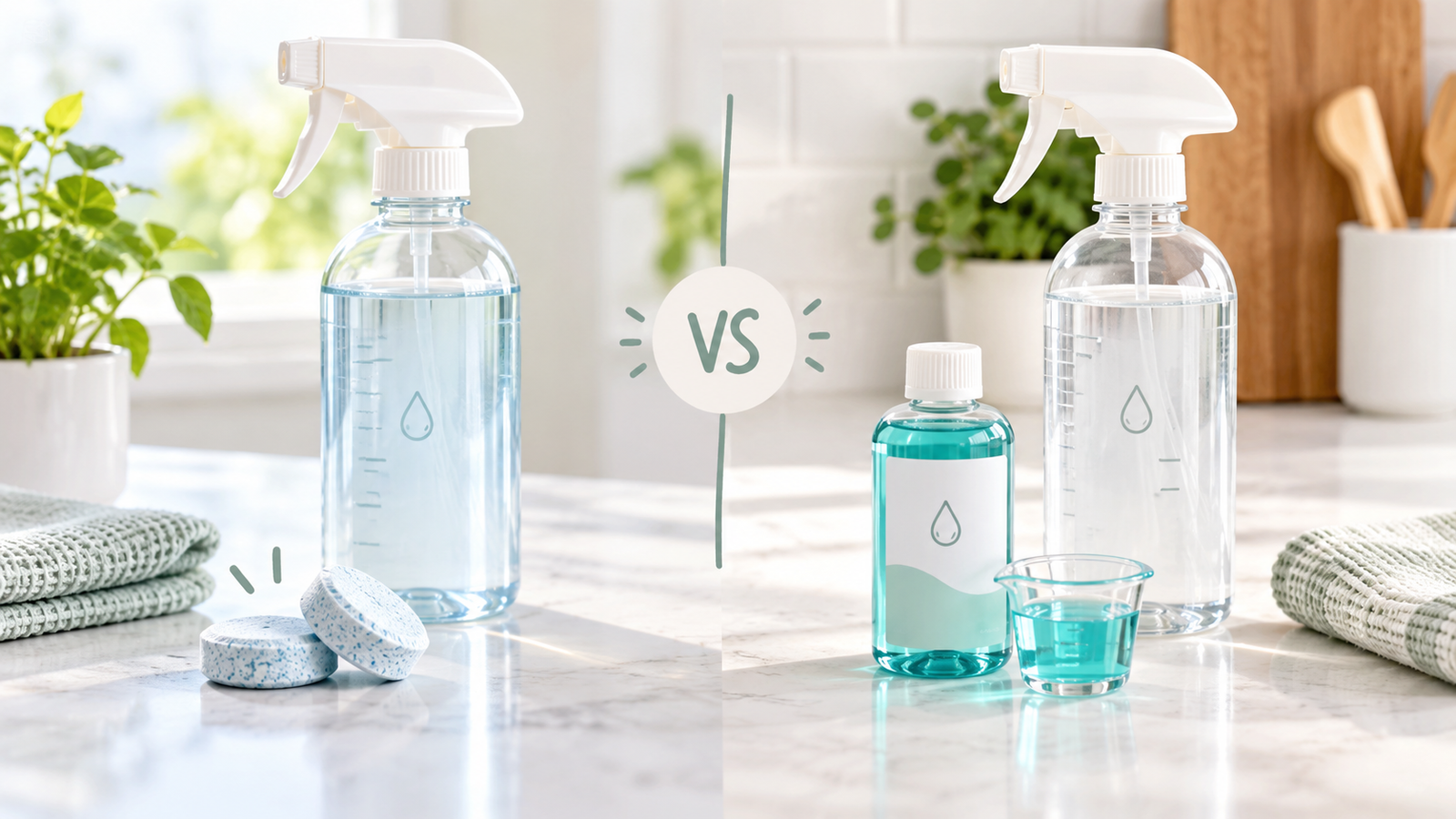
Cleaning Tablets vs Cleaning Concentrates: What’s the Difference?
If you are trying to reduce bulky cleaning bottles at home, you will probably come across two popular refill formats:
Cleaning tablets vs Cleaning concentrates
At first, they can sound almost identical.
Both are more concentrated than a typical ready-to-use cleaner.
Both usually require water before use.
Both can be designed for reusable bottles.
And both can reduce the need to keep buying a completely new spray bottle every time the cleaner runs out.
So what is actually different?
The simplest answer is:
Cleaning tablets are solid concentrates. Cleaning concentrates are usually liquid concentrates.
That difference in format changes how they are stored, measured, prepared, transported, and used.
Neither format is automatically better for everyone.
The better choice depends on what matters more to you:
Convenience.
Storage space.
Ease of dosing.
Preparation.
Packaging.
Flexibility.
Or simply what fits your cleaning routine best.
Let’s break it down properly.
What Are Cleaning Tablets?
Cleaning tablets are concentrated cleaning formulations made in a solid form.
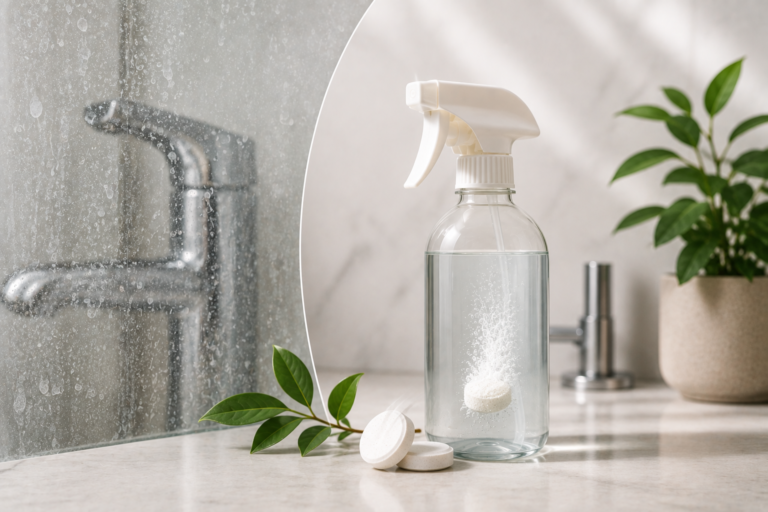
Instead of buying a bottle that already contains the finished cleaning solution, you start with a small tablet.
The usual process looks something like this:
Bottle → Water → Tablet → Dissolve → Use
The tablet contains the cleaning ingredients in a compact format.
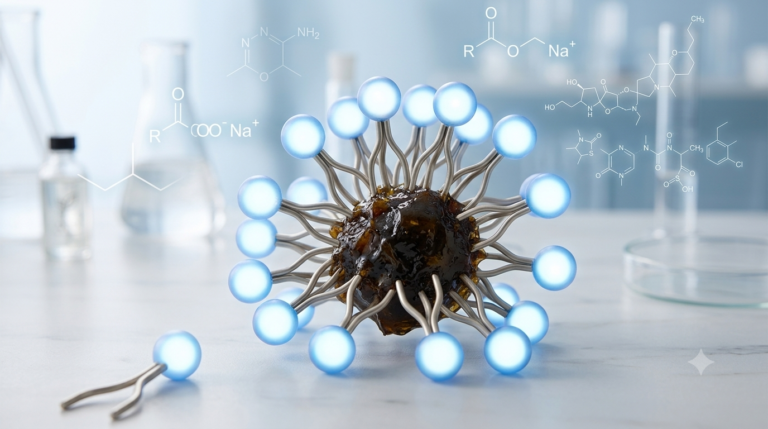
Once added to the recommended amount of water, it breaks down and disperses its ingredients through the solution.
The final liquid is then used for its intended cleaning task.
Depending on the product, tablets may be designed for:
- Multi-surface cleaning
- Bathroom cleaning
- Glass cleaning
- Floor cleaning
- Kitchen cleaning
- Other household applications
The important thing to understand is that the tablet is not the cleaner in its final usable form.
It is the concentrated format used to prepare the cleaner.
What Are Cleaning Concentrates?
Cleaning concentrates are also designed to be diluted before use.
The main difference is that they are usually supplied as a concentrated liquid rather than a solid tablet.
The process may look like:
Bottle → Water → Measured concentrate → Mix → Use
A manufacturer might instruct you to add a certain amount of concentrate to a specific volume of water.
Depending on the product, the concentrate may come in:
- Small bottles
- Sachets
- Pods
- Refill pouches
- Measuring containers
- Dosing systems
Once diluted correctly, the result is a ready-to-use cleaning solution.
So both formats solve a similar problem:
Why transport and store a full bottle of diluted cleaner when water can be added later?
But they solve it in different ways.
Cleaning Tablets vs Cleaning Concentrates: The Core Difference
The biggest difference is physical form.
Cleaning tablets
Solid.
Pre-portioned.
Require dissolution.
Usually very compact.
Cleaning concentrates
Liquid.
May require measuring.
Usually mix into water more quickly.
Can offer more dilution flexibility depending on the product.
That one difference affects almost everything else.
1. Solid vs Liquid Format
This is the most obvious distinction.
A cleaning tablet is a compressed solid formulation.
A cleaning concentrate is usually a concentrated liquid formulation.
That matters because solid and liquid products behave differently in storage and preparation.
A liquid concentrate can usually be poured into water and mixed quickly.
A tablet needs time to dissolve.
A tablet may also be more sensitive to moisture before use because unwanted water exposure can begin affecting the product.
A liquid concentrate, on the other hand, is already in a liquid state and needs secure packaging to prevent leaking.
So the storage challenges are different.
2. Measuring and Dosing
This is one of the biggest practical differences.
Cleaning tablets are often pre-measured
One tablet may be designed for one specific bottle volume.
That means the dosing process can be very simple.
For example:
One tablet + specified amount of water
No pouring.
No measuring cap.
No guessing.
That can reduce one common user error:
Using too much concentrate.
Liquid concentrates may require measuring
A concentrate might need:
10 ml.
20 ml.
One capful.
Half a cap.
A sachet.
A pump.
A specific ratio.
This can provide more flexibility, but it also adds a measuring step.
If the user adds too much, the solution becomes more concentrated.
If too little is added, it becomes more diluted.
So the instructions matter.
Neither system is difficult.
But tablets can offer a more standardized dose.
3. Ease of Preparation
When it comes to speed, liquid concentrates may have an advantage.
A liquid concentrate can often be added to water and mixed almost immediately.
Tablets usually need time to dissolve.
Depending on the formulation, that might take:
A few minutes.
Several minutes.
Or longer.
Some tablets fizz visibly.
Others dissolve quietly.
So if you need a cleaner immediately, a liquid concentrate may feel faster.
But if you do not mind waiting a few minutes, tablets can still be very straightforward.
The process is simply different.
4. Storage Space
This is where tablets can become very attractive.
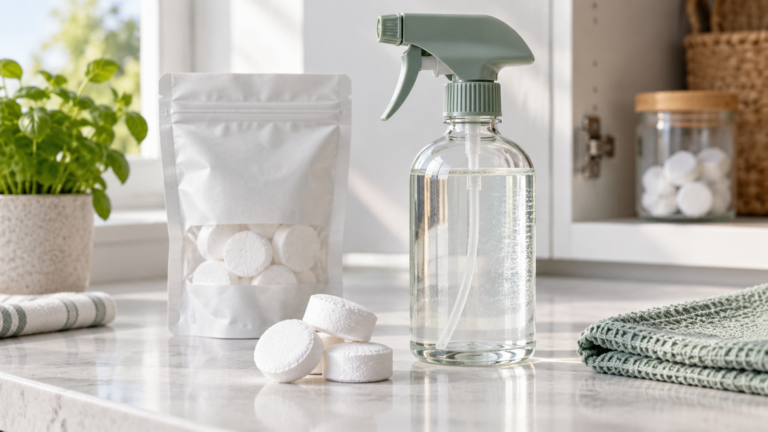
A small pack of tablets can hold multiple refills in very little space.
Compare that with storing several bottles of liquid concentrate.
Even concentrated liquids still need containers.
Tablets can often be stored in:
- Small pouches
- Compact cartons
- Individual wrappers
- Small refill boxes
That makes them useful for:
- Small apartments
- Minimalist cleaning cupboards
- Travel
- Utility drawers
- Limited under-sink storage
Liquid concentrates are still far more compact than full ready-to-use bottles.
But tablets can push compactness even further.
5. Packaging
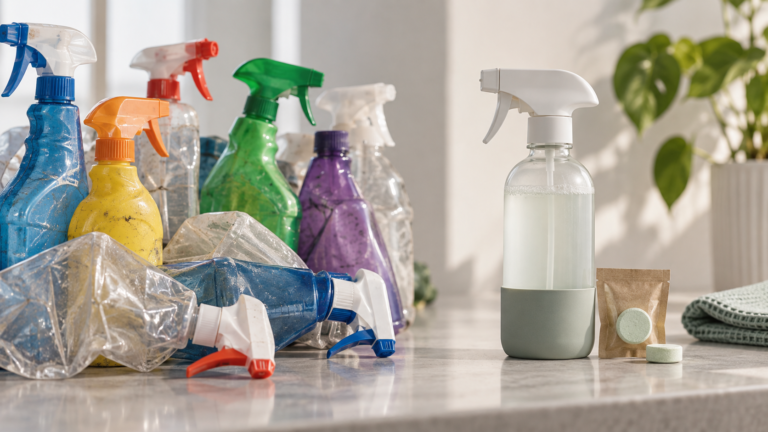
Both formats can reduce the need for repeated full-size spray bottles.
But the packaging itself differs.
Cleaning tablets may need moisture protection
Because tablets are designed to react or dissolve in water, humidity can affect some formulations.
That means packaging needs to protect the tablet from moisture before use.
Depending on the product, this could involve:
- Individual wrappers
- Moisture-resistant pouches
- Airtight containers
- Protective sachets
Liquid concentrates need leak-resistant packaging
Liquid products require packaging that safely contains fluid.
That usually means:
- Small bottles
- Sachets
- Pods
- Pouches
The environmental impact of either system depends on the actual packaging materials, product design, transportation, and how often the reusable bottle is actually reused.
So it is better to compare real products than assume one format is automatically waste-free.
6. Transportation
Both tablets and concentrates have one obvious advantage over conventional ready-to-use liquid sprays:
They can reduce the amount of water transported with the product.
A conventional spray cleaner arrives already diluted.
That means much of the bottle’s weight may be water.
With a concentrated format, water can be added closer to the point of use.
This changes what needs to travel through the supply chain.
Cleaning tablets can be especially lightweight because they are solid and compact.
Liquid concentrates still contain some liquid, but usually far less than a fully diluted spray.
The actual transport benefit depends on:
- Product concentration
- Packaging weight
- Shipping distance
- Refill size
- Distribution system
But in general, concentrated formats reduce the need to ship full volumes of ready-to-use liquid.
7. Flexibility
Liquid concentrates may offer more flexibility in some cases.
For example, one concentrate might allow different dilution ratios depending on the cleaning task.
A stronger dilution may be used for one purpose.
A weaker dilution may be recommended for another.
This only applies where the manufacturer explicitly provides those instructions.
Tablets are usually more fixed.
One tablet is often designed for one specific amount of water.
That makes tablets simpler, but less adjustable.
So:
Tablets prioritize consistency.
Liquid concentrates may offer more flexibility.
Neither is inherently better.
It depends on how much control you want.
8. Risk of Overuse
Because tablets are often pre-portioned, it may be harder to accidentally overuse the cleaning formulation.
One tablet means one refill.
Liquid concentrates can be easier to over-pour.
Someone may think:
“More product means better cleaning.”
But that is not always true.
Over-concentrating a cleaner can:
Waste product.
Leave residue.
Change surface performance.
Move the solution outside its intended formulation range.
So with liquid concentrate, accurate measuring matters.
With tablets, the pre-measured format can simplify that process.
9. Spill Risk
Liquid concentrates can spill.
That sounds obvious, but it matters.
A small leak in a concentrated liquid product can create:
Mess.
Product loss.
Sticky residue.
Possible contact with nearby materials.
Tablets do not spill like liquids.
But they have their own weakness:
Moisture.
A tablet stored incorrectly may soften, crumble, or begin reacting before use.
So the risk changes from:
Leakage
to
moisture sensitivity
Different format.
Different storage discipline.
10. Shelf Stability
Both formats can be stable when properly formulated and stored.
But their storage requirements are different.
Cleaning tablets often need:
- Dry conditions
- Original packaging
- Protection from humidity
- Proper sealing
Liquid concentrates often need:
- Secure caps
- Temperature control
- Protection from leakage
- Correct storage position
Always follow the manufacturer’s instructions.
Do not assume a product remains stable indefinitely simply because it looks fine.
11. User Experience
This is where preference becomes important.
Some people like the ritual of a tablet.
Fill the bottle.
Drop it in.
Watch it dissolve.
Wait.
Use.
It feels clean, simple, and controlled.
Others prefer speed.
Pour concentrate.
Add water.
Shake or mix if instructed.
Done.
Neither experience is difficult.
But they feel different.
The best format is often the one you are actually willing to use consistently.
12. Cleaning Performance
A very important point:
Format does not determine cleaning performance by itself.
A tablet is not automatically weaker.
A liquid concentrate is not automatically stronger.
Cleaning performance depends on:
- Formulation
- Surfactants
- Solvents where applicable
- Acids or alkaline ingredients
- Builders
- Concentration
- Surface compatibility
- Contact time
- Mechanical action
- Correct dilution
The format is simply how the cleaning ingredients are delivered.
A poorly formulated tablet can perform badly.
A poorly formulated concentrate can perform badly.
A well-formulated version of either can work effectively for its intended task.
So never judge cleaning power by format alone.
Cleaning Tablets vs Cleaning Concentrates: Quick Comparison
| Factor | Cleaning Tablets | Cleaning Concentrates |
|---|---|---|
| Format | Solid | Usually liquid |
| Measuring | Often pre-measured | May require measuring |
| Preparation | Needs dissolution | Usually faster to mix |
| Storage | Very compact | Compact, but still liquid |
| Spill risk | Low | Higher |
| Moisture sensitivity | Higher | Lower |
| Flexibility | Usually fixed dose | May allow multiple dilutions |
| Ease of dosing | Very simple | Depends on measuring system |
| Packaging | Moisture-protective | Leak-resistant |
| Transport weight | Very low | Low compared with ready-to-use sprays |
| Best for | Simplicity and compact storage | Flexibility and fast preparation |
Which Is Better for Small Homes?
Cleaning tablets may have an advantage.
Why?
Because storage space matters.
A small apartment does not need several large cleaning bottles.
A single reusable spray bottle plus a small box of tablets can be extremely compact.
Liquid concentrates are still space-efficient.
But they need small bottles or sachets.
If the goal is maximum storage efficiency, tablets can be hard to beat.
Which Is Better for Families?
This depends on usage.
A large household may use cleaning products more frequently.
Liquid concentrates can be useful where:
More volume is required.
Multiple dilution ratios are needed.
Large batches are prepared regularly.
Tablets can still work well, especially if the dosing is standardized.
The better choice depends on:
How often you clean.
How much solution you use.
Whether you want fixed or flexible dosing.
Which Is Easier for Beginners?
Tablets can be very beginner-friendly.
Why?
Because the process is usually simple:
Fill to line → add tablet → wait → use
There is less measuring.
Liquid concentrates are also easy, but the user may need to understand:
Ratios.
Caps.
Millilitres.
Fill lines.
The difference is small.
But tablets can reduce decision-making.
Which Is Better for Travel?
Tablets can be particularly convenient.
A solid refill:
Takes little space.
Does not leak like a liquid.
Can be lightweight.
Can be carried in small quantities.
However, travel rules and packaging requirements still matter.
And the tablet needs suitable dry storage.
A liquid concentrate can also work, but leakage becomes a bigger concern.
For portability, tablets often have a practical advantage.
Which Produces Less Packaging?
There is no universal answer.
It depends on the specific product.
A tablet individually wrapped in multiple layers may use more packaging than expected.
A liquid concentrate sold in a lightweight refill pouch may perform very well from a packaging perspective.
So avoid oversimplified claims like:
Tablet = zero waste
or
Concentrate = more waste
The correct comparison requires looking at:
- Packaging material
- Packaging weight
- Number of refills
- Reuse cycles
- Transport
- End-of-life handling
The format alone does not tell the whole story.
The Sensible is on INSTAGRAM.
Which Is More Sustainable?
Again, this depends on the whole system.
A concentrated format can reduce transport weight and packaging turnover compared with repeatedly purchasing ready-to-use bottles.
But sustainability depends on:
How the product is made.
How concentrated it is.
How much packaging is used.
How many times the bottle is reused.
How far the refill is transported.
What happens to the packaging afterward.
So instead of asking:
Which format is more sustainable?
A better question is:
Which system uses fewer resources while still delivering the cleaning performance you need?
That is more practical.
Why the Reusable Bottle Matters More Than the Format
This is the bigger point.
A tablet or concentrate only reduces bottle turnover if the bottle is actually reused.
If you buy a new bottle for every tablet refill, you lose much of the advantage.
If you buy a new spray bottle every time you purchase liquid concentrate, the same issue remains.
The real system is:
Durable bottle + concentrated refill
The bottle should stay in service as long as it remains suitable and functional.
That is where the model becomes meaningfully different from ready-to-use cleaning sprays.
Cleaning Tablets vs Ready-to-Use Sprays
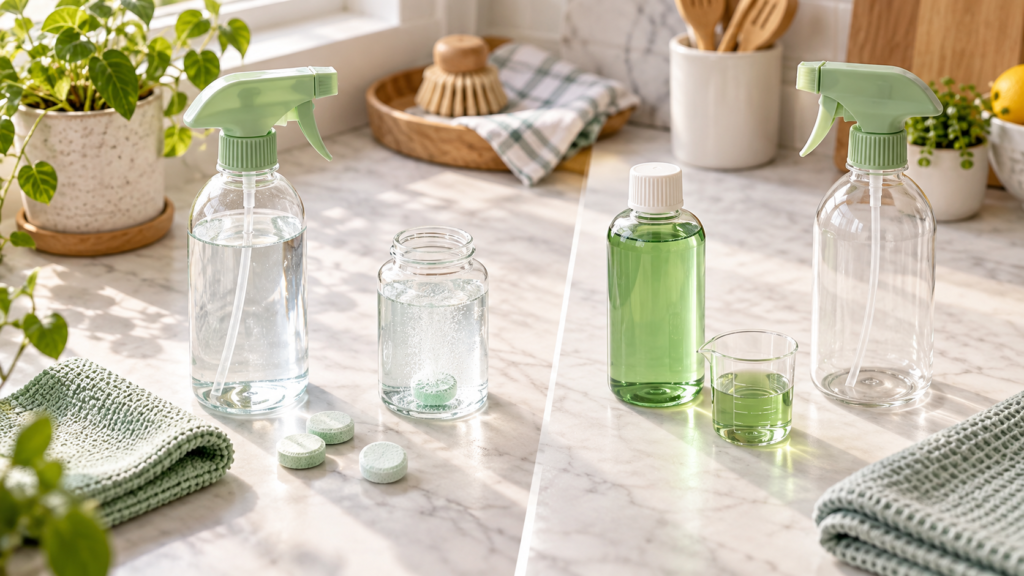
Both tablets and concentrates belong to the same broader family:
Refill-based cleaning systems.
Their biggest competitor is not each other.
It is the traditional model:
Buy another full bottle every time the cleaner runs out.
Ready-to-use sprays offer maximum convenience.
Open.
Spray.
Clean.
No mixing.
No waiting.
But they also require the manufacturer to package and transport the full diluted solution.
Concentrated formats shift part of that preparation to the home.
That is the trade-off.
Convenience versus concentration.
When Cleaning Tablets Make More Sense
Cleaning tablets may suit you if you want:
- Very compact storage
- Simple pre-measured dosing
- Minimal mess
- No liquid concentrate spills
- Easy refill counting
- A fixed routine
- Lightweight refills
They can work especially well in:
Small apartments.
Minimalist cleaning cupboards.
Homes with limited storage.
Households that want simple refill instructions.
When Cleaning Concentrates Make More Sense
Liquid concentrates may suit you if you want:
- Faster preparation
- More dilution flexibility
- Larger refill volumes
- Familiar pouring or measuring
- Easy batch preparation
- No waiting for dissolution
They may work well for:
Large households.
Frequent cleaning.
Commercial or semi-commercial use.
Users who prefer liquid formats.
What About Cost?
Cost should not be compared based only on the refill price.
A tablet pack may look expensive.
A concentrate bottle may look cheap.
But you need to calculate:
Cost per prepared litre
or
Cost per prepared bottle
For example:
If one pack produces ten 500 ml bottles, compare its total cost with the same amount of usable cleaner produced by the concentrate.
That gives a much more meaningful comparison.
Also include:
Reusable bottle cost.
Shipping.
Refill frequency.
Waste.
Do not judge by package price alone.
Common Mistakes With Cleaning Tablets
Using too much or too little water
Follow the recommended amount.
Adding more tablets for stronger cleaning
Do not assume stronger means better.
Crushing tablets unnecessarily
Let them dissolve according to instructions.
Storing them in humid areas
Keep them dry.
Using the wrong tablet on the wrong surface
Check compatibility.
Common Mistakes With Cleaning Concentrates
Guessing the amount
Measure accurately.
Over-pouring
More concentrate is not automatically better.
Using the wrong dilution
Follow the manufacturer’s ratio.
Mixing products
Never combine cleaning products unless explicitly instructed.
Using unlabelled bottles
Always keep the final solution clearly identified.
Can You Use the Same Reusable Bottle for Both?
Possibly, but do not assume it.
Different cleaners can contain different ingredients.
Bottle compatibility matters.
If switching formulations:
Empty the bottle.
Rinse or clean it according to instructions.
Make sure there is no residue from the previous cleaner.
Never mix different cleaning products.
A reusable bottle is helpful.
But it still needs proper care.
What About Water Quality?
Water can affect both tablets and liquid concentrates.
Hard water contains higher levels of minerals such as calcium and magnesium.
Depending on the formulation, this may affect:
Dissolution.
Residue.
Cleaning performance.
Appearance.
Manufacturers may provide specific guidance.
If they do, follow it.
Do not change dilution ratios simply because your water is hard.
The Minimalist Cleaning Perspective
From a minimalist point of view, both formats are attractive.
They reduce the need to store multiple full replacement bottles.
The difference is:
Tablets maximize compactness.
Liquid concentrates maximize flexibility.
If you are trying to create a simple under-sink cleaning system, either can work.
The best system is the one where:
You know what each product does.
You can see your refills.
You do not overbuy.
You reuse the bottle.
You follow the instructions.
That is more important than the physical format itself.
The Sustainability Perspective
Both formats challenge the same old habit:
Cleaner finished = bottle finished
That assumption does not have to be true.
If the bottle remains safe and functional, refill systems allow the packaging to stay in use longer.
The actual cleaning formulation becomes the consumable.
That is a more logical division:
Durable object → reuse
Consumable formula → replace
Whether the refill arrives as a tablet or liquid concentrate is secondary.
The bigger change is the refill model.
Which One Should You Choose?
Ask yourself five questions.
1. Do you want fixed dosing?
Choose tablets.
2. Do you want flexible dilution?
Concentrate may be better.
3. Do you have limited storage?
Tablets may have the advantage.
4. Do you want instant preparation?
Liquid concentrate may feel easier.
5. Do you dislike measuring?
Tablets may suit you better.
Simple.
A Practical Example
Imagine you need a new 500 ml multi-surface cleaner.
Option A: Tablet
Fill bottle with 500 ml water.
Add one tablet.
Wait for it to dissolve.
Use.
Option B: Concentrate
Fill bottle with the recommended amount of water.
Measure concentrate.
Add it.
Mix according to instructions.
Use.
The final result may serve the same purpose.
But the preparation experience is different.
That is the heart of the comparison.
The Sensible Take
There is no need to turn this into:
Tablet good.
Concentrate bad.
Or:
Concentrate good.
Tablet bad.
Both are simply different ways of delivering concentrated cleaning chemistry.
The real question is:
Which format makes your cleaning routine easier while reducing unnecessary packaging and storage?
If you want:
Pre-measured simplicity and compact storage, tablets make a lot of sense.
If you want:
Fast preparation and flexible dilution, liquid concentrates can be excellent.
Both can support reusable-bottle systems.
Both can reduce reliance on repeated ready-to-use packaging.
And both can be a more thoughtful alternative to automatically purchasing another complete bottle every time the cleaner runs out.
Frequently Asked Questions
Are cleaning tablets the same as cleaning concentrates?
Not exactly. Cleaning tablets are concentrated cleaning formulations in solid form, while cleaning concentrates are usually liquid formulations designed to be diluted before use.
Which is easier to use?
Cleaning tablets can be easier because they are often pre-measured. Liquid concentrates can be faster because they do not need to dissolve.
Which takes up less space?
Cleaning tablets are generally extremely compact. Liquid concentrates also take up less space than ready-to-use cleaners, but usually require larger packaging than tablets.
Do cleaning tablets clean better than concentrates?
Not necessarily. Cleaning performance depends on the formulation, concentration, surface compatibility, and how the product is used.
Are cleaning tablets more sustainable?
Not automatically. The overall impact depends on packaging, transport, ingredients, bottle reuse, and how the product is manufactured and disposed of.
Do liquid concentrates require measuring?
Many do. Some use caps, pumps, sachets, or other dosing systems. Always follow the manufacturer’s instructions.
Can I use extra concentrate for better cleaning?
Do not assume more product improves performance. Use the recommended dilution.
Can I use two cleaning tablets instead of one?
Only if the manufacturer specifically instructs you to do so. Otherwise, stick to the recommended ratio.
Which is better for small apartments?
Cleaning tablets may have an advantage because they are extremely compact and easy to store.
Which is better for large households?
Liquid concentrates may be useful for larger volumes, but tablets can also work well if the refill system is designed for frequent use.
Do both formats need reusable bottles?
Not always, but reusable bottles are where much of the packaging benefit can come from.
Can I switch from one format to the other?
Yes, but make sure the bottle is compatible and properly cleaned before switching formulations.
Final Takeaway
Cleaning tablets and cleaning concentrates are not competing ideas as much as they are two versions of the same bigger shift.
Both challenge the traditional model of:
Buy full bottle → use → throw away → buy another
Instead, they focus on:
Keep bottle → add concentrate → prepare cleaner → reuse
The difference is mainly in the format.
Cleaning tablets are solid, compact, and usually pre-measured.
Cleaning concentrates are liquid, fast to prepare, and often more flexible.
Choose based on how you actually clean.
If you value simplicity:
Go tablet.
If you value flexibility:
Go concentrate.
If you value reducing unnecessary bottle turnover:
Either can make sense.
The smartest system is not the one with the trendiest format.
It is the one you will actually use properly, consistently, and repeatedly.
Also Read : The Minimalist:Under sink organization